






 Portuguese
  Spanish


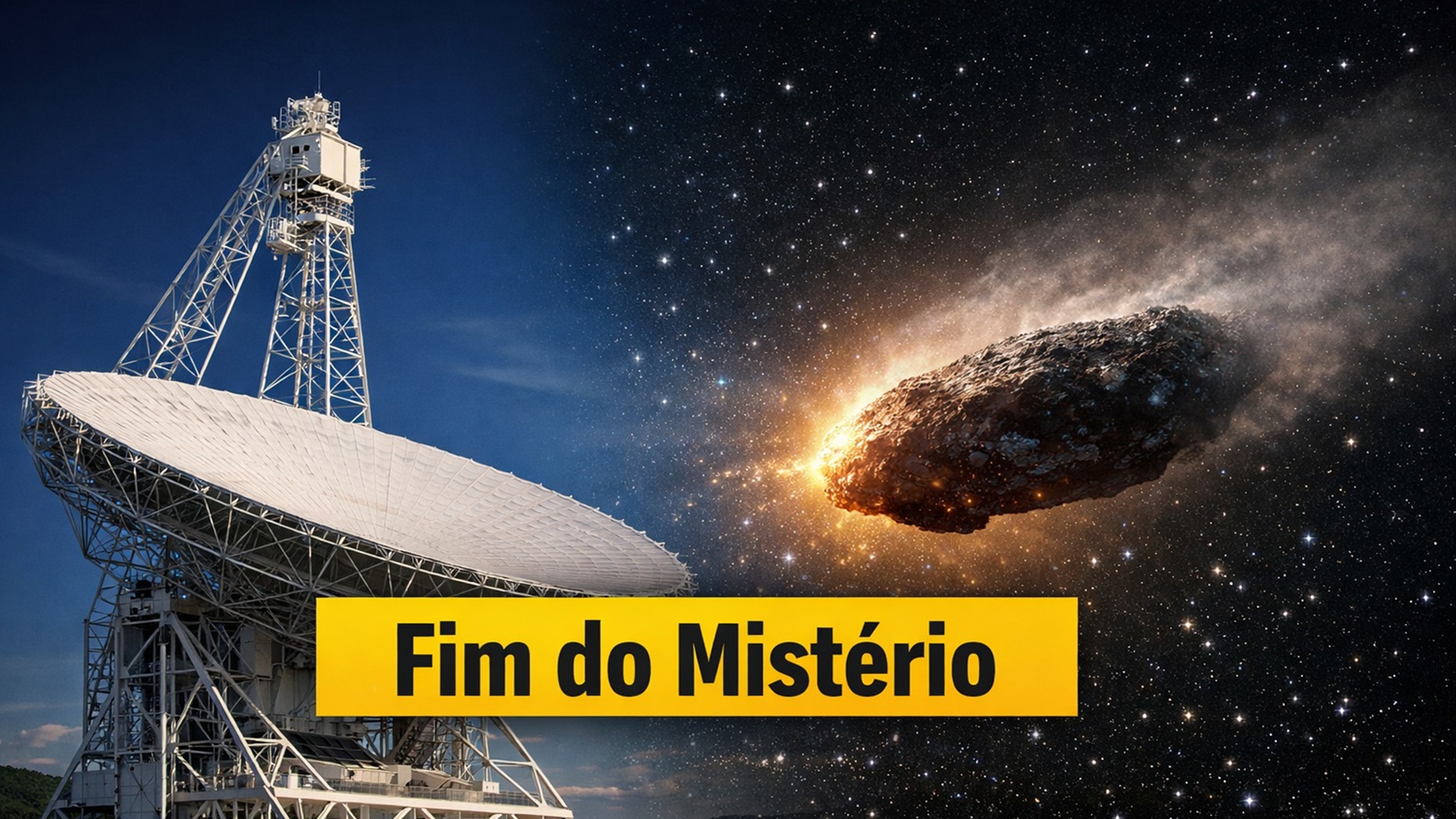


Radio Observations Conducted in Four Bands Between 1 and 12 GHz, With Data Collected on December 18, 2025 by the 100-Meter Green Bank Telescope, Analyzed Over 471,000 Candidate Signals and Found No Evidence of Technosignatures Associated with the Interstellar Object 3I/ATLAS During Its Close Passage to Earth
The interstellar object 3I/ATLAS, discovered on July 1, 2025, was the subject of high-sensitivity radio observations conducted on December 18, 2025 by the Green Bank Telescope, as part of the Breakthrough Listen program, with no evidence of technosignatures or artificial signals associated with the body being found.
Since its identification, 3I/ATLAS has attracted significant attention from researchers and the public, fueling speculation, expectations, and fears about the possibility that the object may contain signs of technologically advanced civilizations beyond the solar system.
A new scientific paper, published on the preprint server arXiv, details the results of the radio observations conducted one day before the object’s closest approach to Earth.
-
China Develops Custom 140-Ton Electric Mining Truck with 770 kWh Swappable Battery, Deploys 290 Units in Xinjiang’s Largest Zinc Mine

-
Meta to Launch Arena, a New Prediction App Targeting 3.56 Billion Users, Competing with Polymarket and Kalshi

-
Scientist Challenges Famous Human Evolution Theory, Argues Homo Sapiens Evolved Gradually Over Thousands of Years
-
15-Year-Old American Builds Ocean Generator with PVC Pipe and 3D-Printed Propeller for $12, Wins National Prize, Presents at White House, and Makes Forbes 30 Under 30 List




The analyzed data is part of the systematic effort of the Breakthrough Listen program aimed at searching for technological signals coming from outside Earth.
Despite the high sensitivity achieved in the measurements, the results presented do not indicate the presence of artificial transmissions associated with 3I/ATLAS, contrary to the expectations of some in the community interested in evidence of extraterrestrial intelligent life.
Interstellar Object and Context of Initial Speculations
So far, only three interstellar objects have been observed passing through the solar system. The first, 1I/”Oumuamua, was initially classified as an asteroid and later as a comet. The second, 2I/Borisov, was directly identified as a comet.
3I/ATLAS, in turn, presents typical characteristics of this type of body, including the presence of a coma and a nucleus that is not elongated.
Even so, as with other objects of this kind, its discovery was followed by a wave of speculation. After the official announcement, rumors spread on social media about supposed anomalous characteristics of 3I/ATLAS, suggesting a possible artificial origin.
In parallel, scientific teams began detailed studies of the object, adopting a more cautious approach based on observational evidence.
The authors of the study themselves emphasize that, to date, there is no evidence indicating that interstellar objects are anything beyond natural astrophysical bodies. Nevertheless, they point out that the extremely limited number of known ISOs justifies further investigations, as interstellar probes are considered a plausible form of technosignature.

Methodology of Radio Observations at Green Bank
The observations described in the new paper were conducted with the 100-meter Green Bank Telescope, one of the most sensitive instruments in the world for this type of study.
The researchers focused their search on narrowband radio signals, which are considered more efficient for interstellar communication and less susceptible to attenuation in space.
The team conducted the analysis in four different radio bands, covering frequencies between 1 and 12 GHz, approximately during the time of closest approach of 3I/ATLAS to Earth. This range was chosen to maximize the possibility of detecting any artificial transmissions associated with the object.
Initially, the search identified over 471,000 candidate signals. After applying filters that take into account the location in the sky, this number was reduced to just nine events.
Additional analyses demonstrated that all of these signals were consistent with radiofrequency interference, as they also appeared in observations outside the target or corresponded to known contaminants.
Results and Limits of Achieved Sensitivity
Even operating at its highest sensitivity levels, the study found no candidate signal that could be attributed to a technosignature from 3I/ATLAS.
This result aligns with analyses conducted by other research groups that also observed the object across different ranges of the electromagnetic spectrum.
The authors state that the research allows for the conclusion that there are no isotropic continuous-wave transmitters above 0.1 W at the location of 3I/ATLAS.
For comparison purposes, the study notes that a typical cell phone operates as an approximately isotropic continuous-wave transmitter at a level close to 1 W.
The distribution of analyzed signals, including the relationship between frequency, drift rate, and signal-to-noise ratio, was detailed in the paper. None of the detected events coincided with the drift rate regions expected from the Earth’s orbital and rotational movement or from the rotation of 3I/ATLAS itself, reinforcing the negative conclusion regarding the presence of artificial signals.
Continuity of Analyses and Future Monitoring
Six months after the object’s discovery, data from 3I/ATLAS has already been collected in various wavelength bands, including radio, infrared, X-rays, and optical.
These observations have been analyzed by multiple research groups, with no evidence of technosignatures identified so far, according to information from SETI.
The data used in the study, as well as in other research from the Breakthrough Listen program, is publicly available. The collection of new observations will continue at some telescopes, including Hubble, allowing for additional analyses as the object moves away.
Although it is considered unlikely, according to the authors themselves, that future observations will reveal technological signals associated with 3I/ATLAS, the researchers emphasize that surveillance will continue.
Numerous ground-based telescopes will remain alert for the entry of new interstellar objects into the solar system and the eventual detection of technological signatures, maintaining active monitoring in light of each new ISO that is identified, even if current results reinforce the natural nature of these bodies.
This article was produced based on data and analyses published on arXiv, the Breakthrough Listen program, and information released by SETI.







E quem disse q uma suposta sonda alienígena deve emitir sinais de rádio? O problema é que nós seres humanos, achamos que uma civilização avançada teria q se comunicar através de rádio e falar o inglês