Portuguese
  Spanish


Case in Santos shows how an attempt to control rats with cats in the beach gardens gained national repercussion and came to involve abandonment of animals, public health, and urban management.
The City Hall of Santos, on the coast of São Paulo, adopted cats as part of a strategy to reduce the presence of rats in the beach gardens at the end of the 1980s.
The measure, known as Operation Tom & Jerry, was associated with the administration of then-mayor Oswaldo Justo and gained repercussion in 1988, but began to require sanitary control actions after the feline population increased along the shore.
The episode is remembered in records about the urban history of Santos for bringing together pest control, animal management, and public health in an area of high circulation.
-
Tourist Discovers Forgotten Joaquín Sorolla Painting Worth Up to 60,000 Euros While Strolling in Seville

-
Brazil’s Fernando de Noronha Boasts World’s Most Beautiful Beach, Accessible Only by Descending 208 Cliffside Steps and With No Food Vendors Allowed

-
Wave Rock: Australia’s Giant Granite Wave Stands 15 Meters Tall, Spans 110 Meters, and Showcases 2.7 Billion Years of Erosion in the Australian Desert
-
How to Unclog Showerhead Holes Blocked by Limescale and Hard Water Without Replacing or Hiring a Technician




The initiative was based on the natural relationship between predator and prey, but the urban environment brought factors that hindered the execution of the plan, such as animal abandonment, uncontrolled reproduction, and the risk of soil contamination.
Rat infestation on the Santos shore
Operation Tom & Jerry emerged during a period of administrative reorganization in Santos.
Oswaldo Justo was elected mayor in 1984, after the resumption of municipal autonomy, and governed the city until 1989, according to the City Hall of Santos.
In that context, the shore gardens already played an important role in the urban and tourist landscape of the municipality.
Currently, the area is described by the City Hall of Santos as the largest beachfront garden in the world, with 5,335 meters in length and 50 meters in width, recognition attributed to the Guinness World Records.
The presence of rodents in sections of the beach bothered residents, merchants, and visitors.
Reports published about the period indicate that the debate gained momentum in 1986, when complaints pointed out that dead rats were being buried in the sand by employees linked to the municipal urban cleaning service.
The pressure for a solution increased because traditional rat extermination actions were not seen as sufficient to eliminate the problem.
The use of rodenticides also faced resistance within the administration itself, due to the risk of affecting other animals that roamed the gardens, such as birds, dogs, and cats.
How the idea of using cats against rats came about
The proposal advocated by Justo relied on a known biological principle: the relationship between predators and prey.
Instead of basing rodent control solely on poisons or traps, the municipal administration decided to test the presence of cats in the beach gardens.
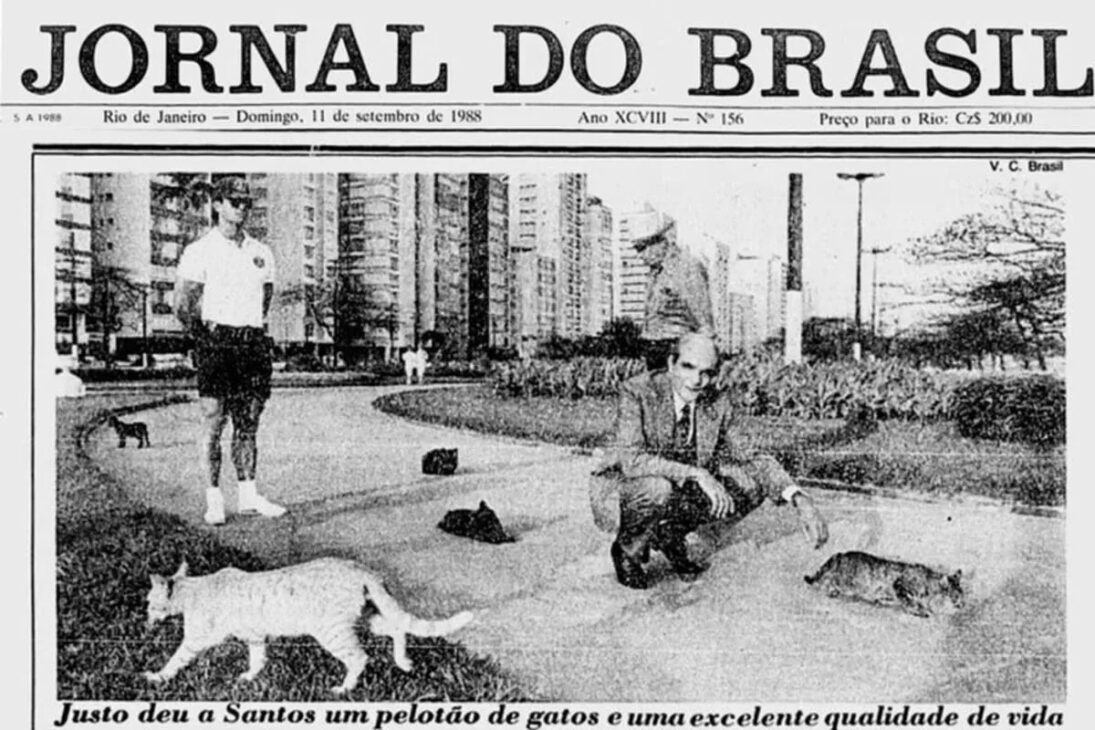
According to records from Memória Santista, the inspiration came from a 76-year-old resident who walked along the shore accompanied by her six cats.
During these walks, the animals were seen hunting rats in the flowerbeds, which caught the attention of the municipal administration.
The justification presented by Oswaldo Justo was recorded in a statement from that time.
“As an ecology advocate, I do not accept this practice, especially because the poison, besides killing the rodents, ends up affecting birds. I am in favor of ecological balance and, therefore, the use of cats to kill the rats,” stated the then-mayor, according to Memória Santista.
Before expanding the measure, the city hall conducted tests in areas considered critical, especially between channels 1 and 2.
With the perception of a reduction in the presence of rodents, the administration decided to extend the action to other parts of the beach in May 1988, according to the same historical record.
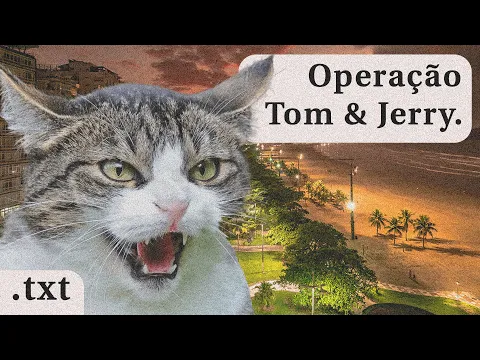
The press began to call the initiative Operation Tom & Jerry, in reference to the animated cartoon of the cat and the mouse.
The nickname helped turn a local pest control policy into a topic of discussion beyond the Baixada Santista.
Cats in the beach gardens
In the first months, the operation received support from some residents.
The reduction of rats in some parts of the shore was reported at the time, while the cats began to roam the gardens and receive food from beachgoers.
As the action progressed, some animals were informally adopted by residents, especially the elderly who already frequented the area.
The coexistence between cats, residents, and tourists also sparked discussions about public responsibility, veterinary care, and protection against mistreatment.
The repercussion reached the City Council.
In June 1988, councilman Reynaldo Cammarosano proposed that the cats used in the fight against rats should receive identification collars.
The proposal stated that the animals were “at the service of the City Hall” and aimed to differentiate them from abandoned cats or those not involved in the operation.
The city hall also adopted measures to shelter the felines.
In October 1988, following a resident’s suggestion, small wooden structures were installed in the gardens along the shore.
The shelters were positioned among shrubs, aiming to offer protection to the animals without significantly altering circulation in the area.

Abandonment of cats changed the course of the operation
The publicity of Operation Tom & Jerry produced an unforeseen effect by the administration.
With the news that cats were officially used in rat control, residents began to abandon domestic animals in the beach gardens, according to published records on the case.
The feline population grew with the arrival of these animals, with the cats already maintained on the shore and with the kittens born in the area itself.
As there was not enough structure for neutering, deworming, and continuous monitoring, the measure began to demand a broader management policy.
The high presence of animals in a public area also led to sanitary concerns.
The following administration, led by Telma de Souza from 1989, assessed that the operation had contributed to a problem associated with cutaneous larva migrans on the Santos beaches, according to Memória Santista.
Cutaneous larva migrans is the popular name for a skin infection related to zoonotic hookworms.
According to the United States Centers for Disease Control and Prevention, these parasites are common in dogs and cats, live in soil contaminated by animal feces, and can penetrate human skin, causing reddish lesions and itching.
The information does not mean that all cats transmit the disease.
The risk is related to environmental contamination and the lack of proper management, especially in places with barefoot people, exposed sand, and the presence of animals without veterinary care.
End of Operation Tom & Jerry in Santos
With the inauguration of Telma de Souza in 1989, the City Hall of Santos ended the strategy of keeping cats on the shore as an official policy to combat rats.
Municipal teams began to collect the animals, and some of them were taken to the Municipal Kennel in the Northwest Zone.
The decision sparked a reaction from residents and animal advocates who were accompanying the cats on the beach.
The Animal Protection Association requested that the cats be sent to the Municipal Nursery, where they could receive care and be put up for adoption, according to records on the case.
From that period on, the debate shifted from focusing solely on the presence of rats to including topics such as neutering, deworming, responsible adoption, and animal abandonment.
These measures are considered part of population and sanitary control when there is a large number of dogs or cats living in public spaces.
In the following years, the presence of cats on the shore continued to be mentioned in local reports.
Juicy Santos reported that there was still an estimate of 250 to 300 cats in the region in 2004, indicating that the effects of the operation remained visible after the end of the official measure.
Urban ecology and public health in the case of the cats of Santos
The Operation Tom & Jerry can be analyzed as an example of interaction between urban ecology and public health.
The relationship between cats and rats exists in nature, but a city does not function as an isolated environment.
There is human interference, food supply, garbage, shelter, intense circulation, and animal abandonment.
From a sanitary point of view, the case also involves the concept of zoonosis, used to describe diseases or infections that can circulate between animals and humans.
In the case of zoonotic hookworms, the CDC points out that soil contaminated by dog and cat feces is the main risk environment for transmission to human skin.
The experience in Santos also highlights the difference between planned biological control and introduction without continuous management.
For such an action to work in an urban area, it is necessary to provide for feeding, reproduction, vaccination, deworming, neutering, the fate of the animals, and the impact on the human population.
More than three decades later, the Operation Tom & Jerry remains an episode of interest for those observing the relationship between cities, animals, and environmental solutions.
The case is not limited to the attempt to use cats against rats; it also helps to discuss how an urban intervention can alter the balance of a public space when there is no permanent control.