Portuguese
  Spanish


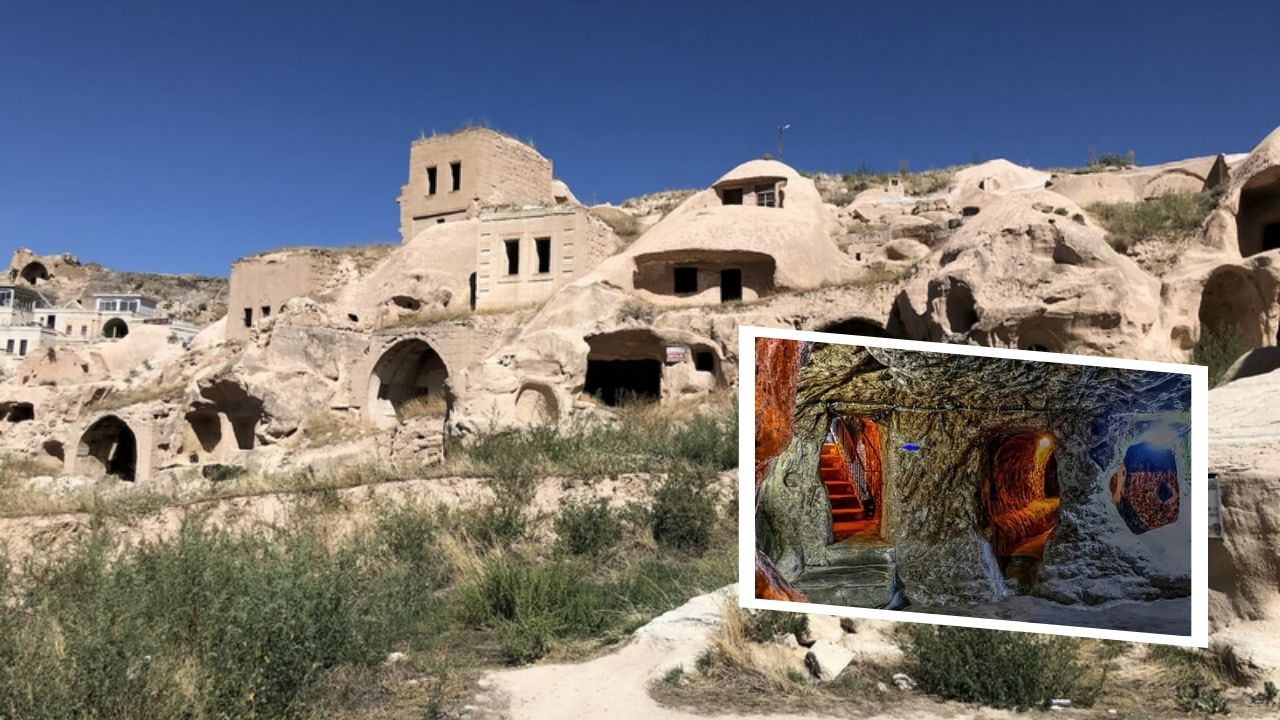


Discovery In Turkey, The Amazing 18-Level Underground City Was An Engineering Fortress Designed To Survive Months Of Siege.
In 1963, a resident of the city of Derinkuyu, Turkey, made a surprising discovery while remodeling his basement. When he knocked down a wall, he didn’t find an extra room, but rather a dark tunnel. This tunnel was the entrance to Derinkuyu, an impressive 18-level underground city, a lost metropolis capable of housing up to 20,000 people, their livestock, and supplies, at a depth of 85 meters, as detailed by Wikipedia.
The complex was not a simple cave, but an advanced engineering solution, built to protect its inhabitants from invaders and persecution over the centuries. With a history that spans millennia, from the Phrygians to the Byzantine era Christians, the city functioned as a self-sufficient refuge, complete with ventilation systems, water wells, and complex defense mechanisms, before being abandoned and forgotten in the 20th century.
The Accidental Discovery Of A Lost World
The rediscovery of Derinkuyu in 1963 was purely accidental. A local resident, during a simple home renovation, opened a passage to a complex that had been completely lost to memory. Local reports suggest that the disappearance of chickens through a crack may have sparked curiosity, leading to the discovery of the mysterious room and the tunnel. What he found was the top of a vast network that had been abandoned decades earlier.
-
11-Year-Old Entrepreneur Sells 60 Homemade Sweets Daily, Mastering Cost Calculation, Social Media Promotion, and Client Negotiation Since Age 7

-
Peruvian Mountain’s 5,200 Aligned Holes May Unveil Ancient Indigenous Market for Corn and Cotton
-
The Little-Known Story of a Home-Built Airplane That Promised Freedom but Faced Safety Issues After Numerous Accidents

-
He Didn’t Build a Plane, But Spent Decades Trying to Make Bicycles Fly with Wings and Pedals; Remaining Models Tell This Unusual Story in Germany



The city’s oblivion is almost as fascinating as its existence. Wikipedia points out that the city was actively used by the Greek Christian community of Cappadocia until 1923. With the forced population exchange between Greece and Turkey, this community, which held the practical and cultural knowledge of the complex, was removed. In just 40 years, the memory of a city for 20,000 people disappeared, to the point where its entrance became just an unknown hole in a basement.
Survival Engineering: Vertical Urbanism

The construction of Derinkuyu was only possible thanks to the unique geology of Cappadocia. The region is covered by tuff, a soft volcanic rock that can be excavated with rudimentary tools, yet is surprisingly stable to prevent collapses, even after millennia. Tomorrow City describes the design as “vertical and troglodyte urbanism”, a world built by the subtraction of rock, not by the addition of structures. The city grew downward, level by level, as the need for security increased.
Life support for 20,000 people was the main concern. According to Tomorrow City, the city featured an ingenious ventilation system: 52 main ventilation shafts, some with a depth of 85 meters, and over 15,000 smaller ducts. This created a constant airflow. Additionally, the main water well drew water from an underground river and was not connected to surface sources, preventing enemies from poisoning the supply during a siege.
What Was Life Like In The 18 Underground Levels?
Life in Derinkuyu was highly organized, with each level having specific functions, as detailed by Made in Turkey Tours. The upper levels (1st and 2nd) were logistical, housing stables for livestock. This location was strategic: kept odors and toxic gases away from living areas below and facilitated access for the animals. Wine and olive oil presses were also located near the surface for easier transport of crops.
Made in Turkey Tours also highlights the internal organization. The second floor contained a missionary school with a vaulted ceiling, indicating the importance of education and religion. The intermediate levels (3rd and 4th) were the heart of residential life, with communal kitchens, dining halls, and vast food storage rooms. In the deeper levels, there was a cross-shaped chapel and even a dungeon, ensuring the protection of the most valuable assets: faith, water, and safety.
An Impenetrable Fortress
Derinkuyu was not a passive shelter; it was an active military fortress. Its most iconic defense feature was the rolling stone doors. These were massive discs, similar to millstones, weighing up to half a ton. According to Made in Turkey Tours, they could only be moved from the inside, sealing off entire passages. A central hole allowed defenders to attack invaders with spears while remaining protected.
The layout itself was a weapon. The tunnels were intentionally designed to be narrow and low-ceilinged. This forced any invader to advance in single file, bent over and completely vulnerable to ambushes from the defenders. The labyrinthine design, filled with confusing twists and dead ends, was a psychological weapon designed to disorient and trap any army unfamiliar with the city.
Who Built The Metropolis And Why?
The city was not the work of a single civilization, but a “evolutionary fortress”, adapted by successive cultures. Wikipedia states that although the exact origins are debated, the most accepted theory attributes the initial large-scale construction to the Phrygians, around the 8th and 7th centuries B.C., known for their rock-built architecture. Others speculate that simpler caves may date back to the Hittite era, thousands of years earlier.
The city reached its peak and maximum expansion during the Byzantine era (5th to 11th centuries A.D.). Christians fleeing persecution from the Romans and later from Arab invaders during the Arab-Byzantine wars found and massively expanded the structures. They were the ones who added the numerous chapels and the missionary school, transforming Derinkuyu into a bastion of the Christian faith, used as a safe refuge until its final abandonment in 1923.
A Legacy Of Resilience
Today, Derinkuyu is a UNESCO World Heritage Site, although only a small fraction of its 18 levels is open to the public. The city is more than an archaeological wonder; it is a profound monument to human resilience, demonstrating the ingenuity and determination required to create a self-sufficient sanctuary in darkness, capable of preserving an entire culture against existential threats.
What impresses you most about Derinkuyu: the engineering to sustain 20,000 people alive or the defense strategy with half-ton doors? Could you live in such a place to escape a threat? Share your thoughts in the comments.