Portuguese
  Spanish


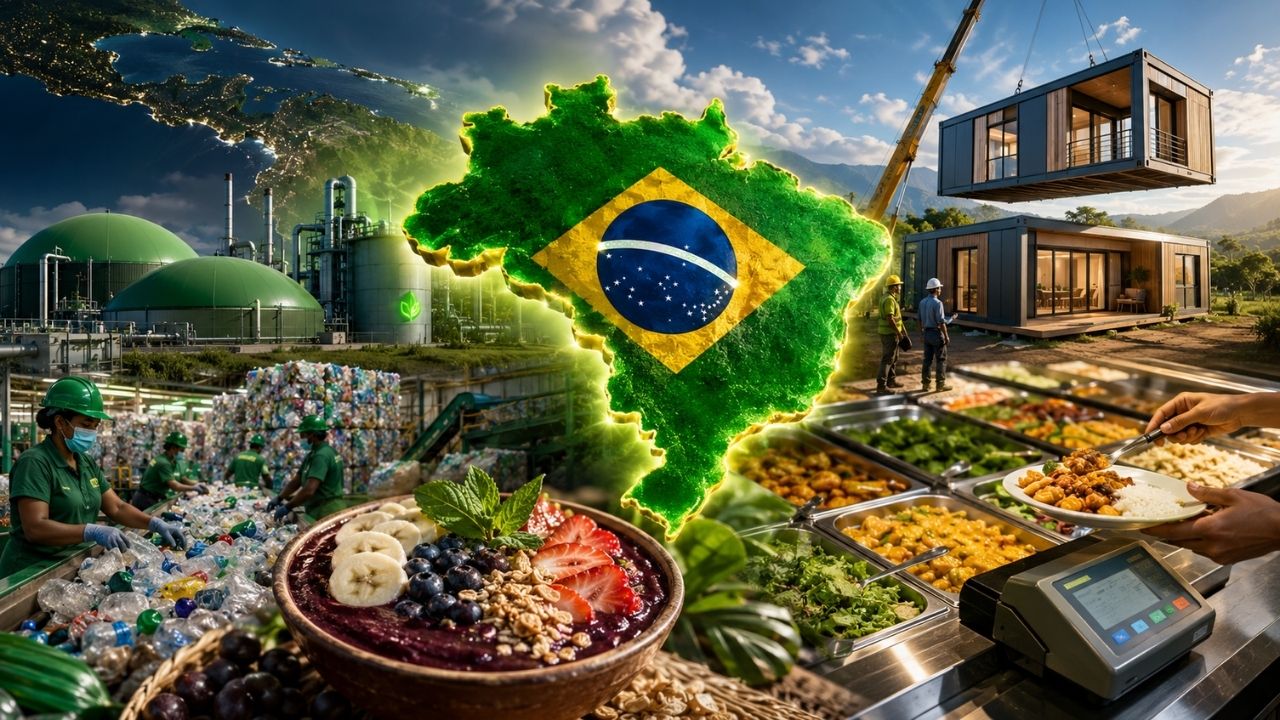

Video from the American channel Mentalidad Rentable, published on 03/27/2026, lists businesses that Brazil would have transformed into professional models, such as açaí, pay-by-weight restaurants, modular homes, banking correspondents, recycling, and biogas, using scale, technology, and processes to solve local demands before other Latin American markets with strong regional economic appeal.
The businesses that Brazil professionalized before much of Latin America became the subject of a video in Spanish published by the American channel Mentalidad Rentable on 03/27/2026. The analysis presents 20 Brazilian models distributed among food, technology, construction, health, wellness, and circular economy.
The central argument of the channel is that Brazil not only created local solutions but transformed common regional problems into organized chains, with equipment, processes, brands, certifications, and scale. The reading does not treat the country as a magical exception, but as a large and complex market where models need to function under real pressure.
Brazil appears as a business laboratory on a continental scale
The video begins by highlighting the size of Brazil as part of the explanation. The country is presented as one of the largest economies in the world, with a continental territory and a highly productive agricultural industry. Official data from IBGE included in the source indicates an estimated resident population of 213.4 million people in 2025 and a territorial area exceeding 8.5 million km².
-
Dog Goes Viral for Buying Its Own Food and Carrying the Bag Home in Its Mouth

-
Unfinished 150-Year-Old Church in Brazil’s Bahia Stands Without a Roof After Railway Shifted Alagoinhas’ Center

-
Viking Textile Factory Unearthed in Denmark Reveals Ancient International Trade Links
-
Bruno Guimarães, 28, Misses Crucial Penalty Against Norway in World Cup After Replacing Vinicius Jr.



This scale matters because many Brazilian businesses are born facing distance, informality, tropical climate, difficult logistics, income inequality, and very different regional markets. When a model manages to operate in this environment, it tends to develop more robust processes than solutions created only for small niches.
Açaí, guaraná, and cachaça show the strength of the agro-industry
In the food and agro-industry segment, the channel cites the processing of açaí as an example of how Brazil transformed an Amazonian fruit into a global product. The analysis mentions depulpers, pasteurizers, freezing, packaging, and export as parts of an industrial chain that added value to the product.
Processed guarana and certified artisanal cachaça also appear. The common point among these businesses is not just the raw material, but the ability to create identity, processing, standardization, and a premium market from traditional products.
Pay-by-weight restaurant became a system, not just a buffet
Among the most Brazilian models mentioned by the channel is the pay-by-weight restaurant. The logic is simple: the customer assembles their plate at the buffet and pays by the weight consumed. However, the video argues that the difference lies in the operational professionalization of the model.
Without individual orders at the table, with shorter waiting times and high turnover at lunch, the pay-by-weight restaurant appears as a system of efficiency. The channel points out that Latin America may have similar formats informally, but few countries have developed the same level of process, presentation, and standardization as Brazil.
Bank correspondents show financial reach


In the area of technology and services, the video highlights bank correspondents as a model of financial inclusion. This figure allows businesses such as pharmacies, supermarkets, lottery outlets, and other points to offer basic banking services through partnerships with financial institutions.
The provided source also includes data from the Central Bank on the series of bank correspondents in Brazil, reinforcing that it is a formal structure monitored by the financial system. The differential of this type of business is bringing banking services to locations where a traditional branch would be expensive or unfeasible.
Education, preventive health, and condominiums became scalable services
The channel also points to franchises of early childhood education, subscription-based preventive health clinics, and professional condominium management as businesses that have gained traction in Brazil. In common, they transform recurring needs into organized services, with brand, process, and service routine.
In the case of condominiums, for example, the video highlights accounting, billing, maintenance, service contracting, and communication with residents as activities that can be professionalized. It is a sector that may not seem attractive at first glance, but it grows as cities become more vertical and buildings require more technical management.
Construction appears as one of the strongest sectors
In the construction and materials sector, the channel mentions steel frame and wood frame systems, prefabricated modular houses, concrete blocks with industrial waste, and professional waterproofing. These businesses appear as a response to recurring problems: slow construction, housing deficit, humidity, waste, and material costs.
Modular houses are highlighted because they combine factory production, quality control, and shorter timelines compared to conventional methods. The video treats industrialized construction as a field in which Brazil has advanced more than many neighbors, especially through the creation of suppliers, workforce, and production systems.
Modular houses and machine rental show industrial logic
The manufacturing of modular houses is presented as an already relevant market in Brazil, with growth associated with the search for faster construction. The channel also mentions platforms and companies for renting construction machinery as another example of professionalization.
The logic is similar: instead of buying an expensive machine for occasional use, small builders and contractors can rent for the necessary time. This type of business reduces entry barriers and allows smaller projects to access equipment that was previously restricted to larger companies.
Health and wellness enter as high-value markets
The video also dedicates a section to health and wellness, mentioning advanced aesthetic clinics, compounding pharmacies, clinical and functional nutrition, and specialized veterinary diagnostics. These are businesses that rely on technical training, protocols, equipment, and consumer perception of value.
Advanced aesthetics appear as a high-revenue sector, while compounding pharmacies are described as a model for personalizing medications, supplements, and cosmetics. In these cases, Brazil is presented as a market that created a density of professionals, services, and demand before other countries in the region.
Recycling and biogas close the list with circular economy
In the circular economy and sustainability section, the channel mentions formal recycling cooperatives and biodigesters for agro-industrial waste. These businesses transform materials that could be an environmental problem into inputs, energy, fertilizer, or industrial raw materials.
In the case of recycling, the video highlights the formalization of cooperatives, use of presses, compactors, and sales to the industry. As for biogas, the logic is to convert organic waste from farms and agro-industrial operations into energy and digestate. The central point is the change in perspective: waste stops being a cost and becomes an economic asset.
Not all models are easy to copy
Despite the optimistic tone of the video, copying these businesses doesn’t depend solely on entrepreneurial will. Some require regulation, investment, minimum scale, technical assistance, certification, supply chain, and access to consumer markets.
There are also data cited by the channel that need to be read as part of an opportunity analysis, not as a guarantee of results. The fact that a model worked in Brazil does not mean it will automatically work in any Latin American country without local adaptation.
Brazil became a reference because it solved repeated problems
The strength of the list lies in showing that many Brazilian businesses did not arise from luxury or trends, but from concrete needs: fast food, housing, financial access, urban management, waste, maintenance of works, accessible health, and agro-industrial production.
When these needs are faced for decades, companies, machines, standards, suppliers, and specialized professionals emerge. This accumulation is what the American channel draws attention to: Brazil would have professionalized solutions that in other places still operate in a fragmented or informal way.
What these businesses reveal about opportunities in Latin America
The Mentalidad Rentable list places Brazil as a showcase of businesses that grew because they solved local problems with scale. Açaí, buffet restaurants, modular homes, banking correspondents, recycling, and biogas are different examples, but united by the same logic: turning real demand into a professional process.
The question that remains is which of these models has the best chance of expanding to other Latin American countries: food, construction, financial services, health, or circular economy? Which Brazilian business would you bet on as the next big exportable model in the region? Leave your opinion in the comments.