





 Portuguese
  English
  Spanish
  4 min of reading
  0 comments


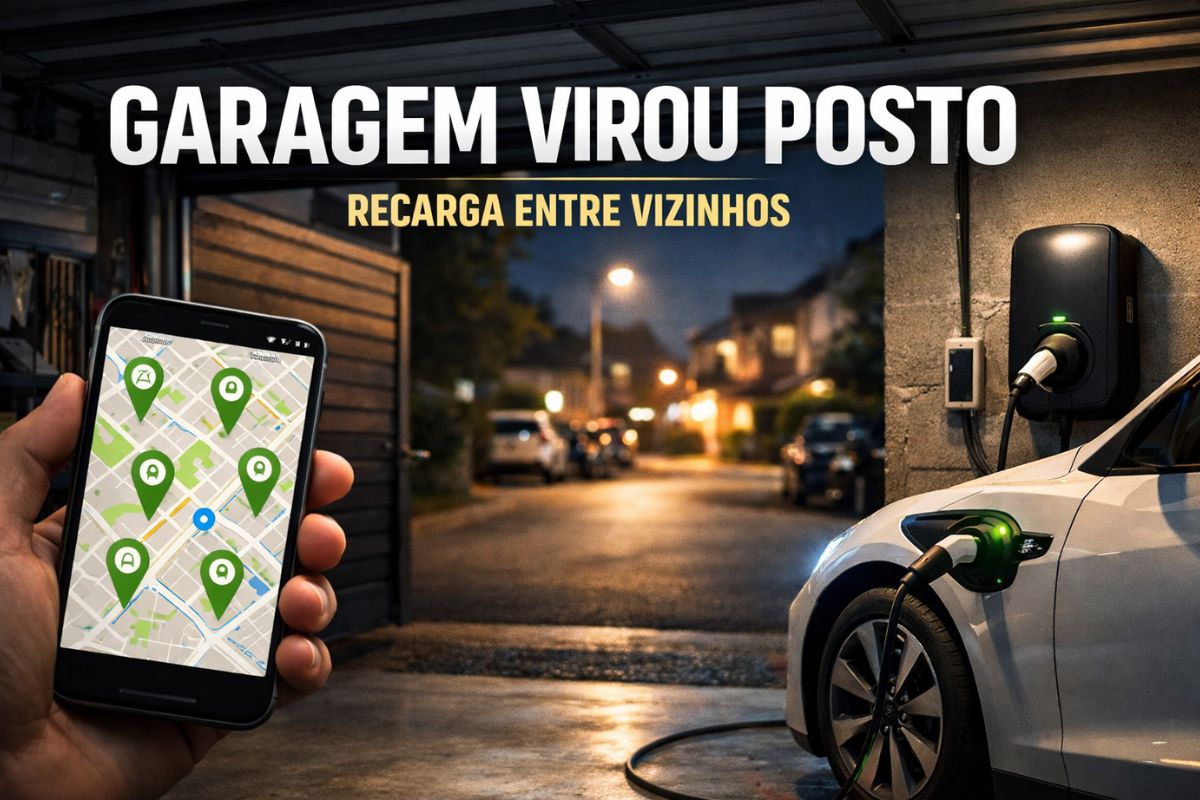
With a Residential Charger Sharing System, BYD Transforms Electric Car Owners into Gas Station Attendants in Their Own Garages, Creates a Parallel Charging Network Among Neighbors, Helps Pay for the Wallbox, and Reduces Range Anxiety in Daily Use, Without Relying on Expensive Public Charging Stations.
In 2025, while the market still discusses the lack of charging points and the fear of being stranded on the street, BYD decides to change the game for electric vehicles in China. The automaker has begun allowing residential charger owners to become “gas station attendants” in their own garages, offering energy to other drivers of the brand through the official app.
In practice, BYD creates a parallel charging infrastructure, spread throughout neighborhoods and condominiums, using something that already exists and usually remains idle: the wallboxes installed in homes and buildings where the car spends most of the day away. Instead of relying solely on large public stations, the driver finds energy on the corner of their home.
How BYD’s “Airbnb” for Chargers Works
BYD’s system follows a platform logic: those who have a charger at home register the equipment in the app, provide the approximate address, available hours, and open their garage door for other drivers of the brand.
-
The 2012 Mitsubishi Pajero Dakar diesel shows 314,000 km and still draws attention for its reputation for durability; the seven-seater 4×4 SUV handles trails, but signs of severe use may conceal losses for used car buyers.

-
Peugeot publicly acknowledged the errors of the PureTech engine, which caused serious failures in hundreds of thousands of cars, and introduced the new Turbo 100 as a definitive solution, a 1.2 turbo tested for over 3 million kilometers that replaces the faulty belt with a more durable chain.

-
Automatic cars become ‘cheap’ in Brazil, and models from Toyota, Hyundai, Nissan, and Honda appear for R$ 65,000 with up to 120 hp, CVT transmission, 482 liters of trunk space, keyless entry, and six airbags to tackle traffic without a clutch.
-
Honda revives a classic from Brazilian streets with a new name, TFT panel, and reprogrammed engine in the 2027 lineup; see the first impressions of the CB500 Hornet, which arrives with 49.6 hp, 4.5 kgf.m torque, 6-speed gearbox, 175 kg, and Showa suspension on Brazilian streets.


On the other side, those in need of energy use the app to locate the nearest points.
Once there is a “match,” the driver and the charger owner communicate directly, agree on the cost of the charge, and set the time and duration of use.
BYD does not intermediate the payment nor charge a commission. The company positions itself as a major facilitator, connecting supply and demand for energy within its own customer community, without building a single new charging station.
Why Turning Car Owners into Gas Station Attendants Makes Sense
In many cities, the residential charger remains idle for much of the day, especially when the car is out on the road or the owner is at work. This means expensive equipment, connected to the grid, but underutilized.
By encouraging sharing, BYD increases the usage rate of chargers and helps the owner dilute the cost of installation, which can be significant.
Moreover, the system creates a recurring additional income for those who have already invested in the infrastructure. Instead of being just a fixed cost, the wallbox becomes a small neighborhood business, serving neighbors, friends, and other BYD owners who travel through the area.
Advantages for Those Who Still Don’t Have a Wallbox
For those who have not managed or chosen not to install their own charger, the benefit is immediate.
The possibility of charging the car near home, in another garage, reduces dependence on public stations that are often scarce, have lines, and charge higher fees.
In residential neighborhoods and condominiums, the tendency is for prices to be more friendly, especially when energy is used outside peak hours.
The driver begins to see the neighborhood as a network of distributed charging points, instead of constantly searching for a spot in a few charging stations scattered around the city.
The Chinese Race for Complete Electric Ecosystems
Other Chinese brands are already following a similar path. Nio and Xpeng offer sharing platforms with dynamic pricing and automated payments via app, integrated into the overall electric vehicle experience.
The difference, according to analysts, is that BYD fits this feature into an even broader ecosystem vision, where vehicle, battery, software, and charging are part of the same package.
While many manufacturers treat charging as an external problem, delegating it to independent networks or the government, BYD chooses to address directly the consumer’s biggest fear: range anxiety.
It’s not just about charging faster but about making charging predictable, close, and easy to fit into the routine.
From Long Trips to Daily Use: Two Fronts of Attack
Recently, BYD has also been highlighting ultra-fast charging technologies capable of taking the battery of some models from 0 to over 50% in just a few minutes, aimed primarily at longer trips and stops on highways.
This front targets the classic “vacation road” scenario, where the driver cannot be stuck for hours at a charging point.
Meanwhile, residential charger sharing operates on another front, more quietly and powerfully: everyday use, which accounts for the majority of charging over the life of the vehicle.
By combining fast charging on routes with a network within neighborhoods, BYD aims to cover everything from daily commutes to long-distance travel in a single strategic design.
What This Means for Markets Like Brazil
Although the service is still restricted to China, the idea speaks directly to the reality of countries like Brazil.
Today, residential charging is the cornerstone of the experience for those already driving electric here, while residents of buildings face discussions about the condominium, technical limitations of the internal network, and costs for installing individual points.
In such a scenario, a model of charger sharing within the same condominium or neighborhood could unlock the adoption of electric vehicles, allowing more people to use the existing infrastructure in a few apartments, paying for their consumption without relying on endless meetings or collective works.
And you, would you rent or use a neighbor’s garage charger if it helped make electric cars more viable in your daily life?









-

-

2 people reacted to this.