






 Portuguese
  Spanish


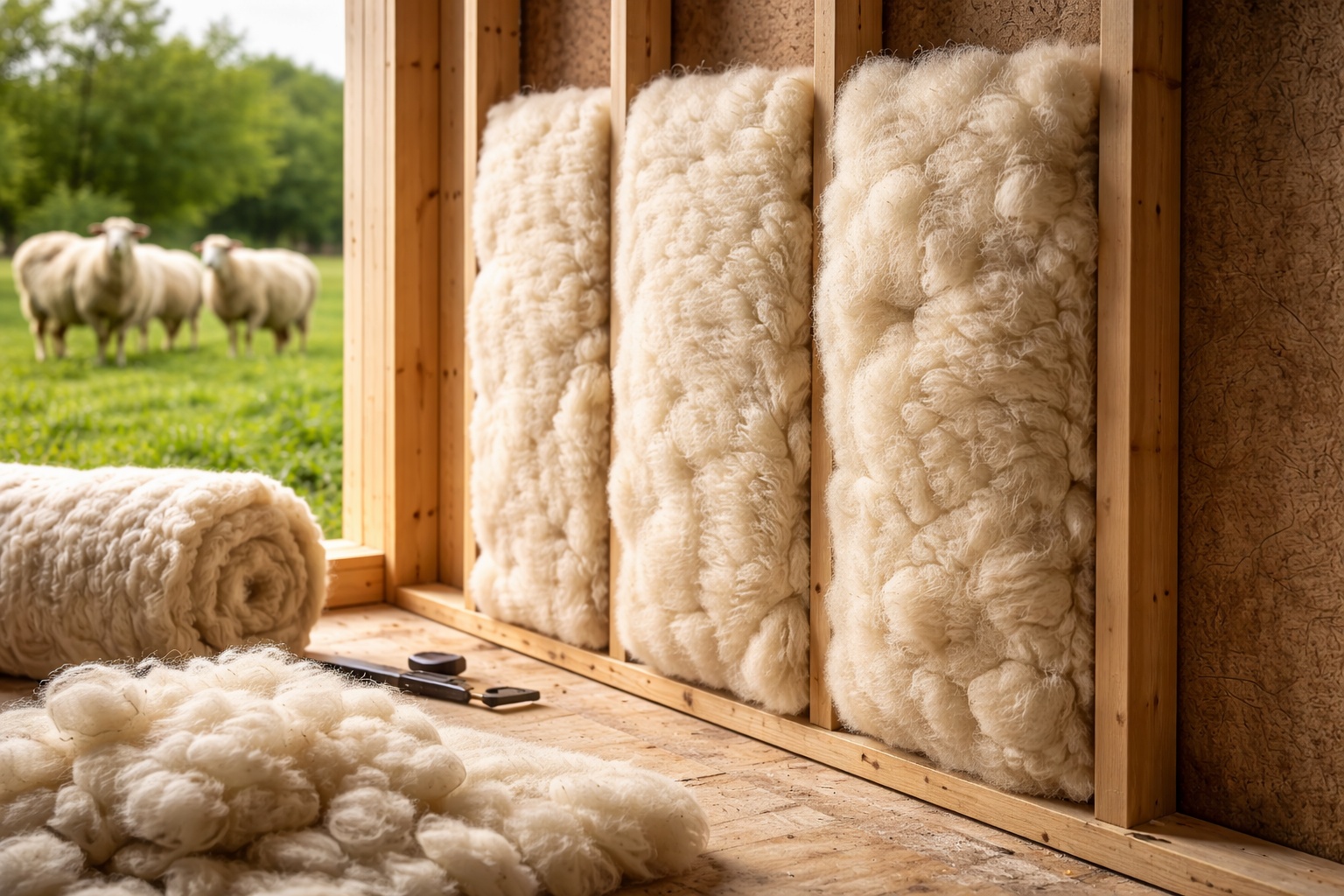

Panels Made With Sheep Wool Insulate Houses With Thermal And Acoustic Efficiency, Replace Industrial Materials And Advance Sustainable Construction.
In the construction industry, insulators such as fiberglass, polystyrene (EPS), and polyurethane (PU) have dominated the market for decades. However, in countries like New Zealand, the United Kingdom, and France, an old and unexpected material has started to occupy this same space: sheep wool, transformed into thermal-acoustic insulation panels for use in houses and buildings.
This movement did not emerge out of fashion, but rather due to a set of real technical factors: good thermal efficiency, high acoustic performance, natural moisture regulation, and low environmental impact compared to traditional industrial insulators. Today, manufacturers such as Thermafleece (United Kingdom) and New Zealand companies linked to the sheep sector already supply panels for residential and commercial construction.
What Makes Sheep Wool A Technical Insulator?
Although it seems counterintuitive to think of wool inside walls, the physical behavior of the material helps explain how this works in practice.
-
Chinese Residential Building Surrounded by Circular Overpass After Residents Reject Compensation

-
After 79 Months and $145 Million Investment, Nepal Set to Open First 2.7 km Road Tunnel to Ease Traffic in Kathmandu Valley

-
In China, 23 Families Spent Over 4 Years Carving a 1.2 km Road Through a Cliff to Overcome Isolation and Transform a Remote Village

-
Giant 3,600-ton Crane Breaks Two World Records by Installing World’s Largest Single-Piece Forged and Welded Hydrogenation Reactor, Weighing 3,037 Tons, in Chinese Petrochemical Plant in Just Six Days




Wool has wavy and interlocked fibers that trap air, creating small internal chambers. This still air reduces heat transfer by conduction and convection, generating natural thermal insulation.
Technical tests from European manufacturers show average values of thermal conductivity between 0.035 and 0.04 W/m·K, which are comparable to fiberglass (0.032 to 0.040 W/m·K) widely used in residential construction. In other words: it insulates practically the same way, but with an animal origin.
Furthermore, wool has a unique behavior related to moisture: it absorbs and releases vapor without losing thermal performance.
This is due to the presence of keratin, a protein that regulates water and allows the material to act as a moisture “buffer” within the walls, something desirable in oceanic climates like those in New Zealand and the United Kingdom.
How Is Wool Produced For The Construction Industry?
The wool used in these panels is not the same as that intended for the textile sector. Technically, it comes from batches classified as “coarse wool”, which have thicker fibers and lower market value for clothing.
In other words, the construction sector creates value for a material that was previously underutilized, which explains the interest from agriculture.
The typical process follows stages such as:
- cutting and sorting wool
- washing and removing grease (lanolin)
- carding and pest treatment
- pressing into batts or panels
- cutting into shapes for construction
The final result is flexible mats or semi-rigid panels installed between wooden or metal studs, just like traditional insulators.
Where Is This Type Of Construction Happening?
Although the use of wool as an insulator has existed since the 20th century, the most significant growth has occurred in three regions:
- New Zealand — a country with a large sheep herd and agricultural tradition; wool for construction has become a new value chain.
- United Kingdom — thermal retrofit programs for old houses have driven materials with better moisture control.
- France — bio-construction companies have included wool in their catalogs for renovations and ecological buildings.
In humid and cold climates, this type of insulator offers an additional advantage: it reduces the risk of mold, as it allows the wall to “breathe” without accumulating water.
Advantages Perceived By Builders
In practice, those who work with the material often cite three strong points:
Ease Of Handling
Unlike fiberglass, which can cause skin and respiratory irritation, sheep wool is handled without special PPE during the assembly phase.
Above-Average Acoustics
The structure of the fibers provides efficient sound absorption, making it common in small studios, residences, and acoustic renovations.
Thermal Stability
The behavior of wool in relation to moisture and its stable thermal conductivity help maintain a more consistent internal temperature, which is highly valued in temperate climates.
What Is The Difference In Relation To Fiberglass And EPS?
The most direct comparison is with fiberglass, due to thermal similarity, but the differences are clear:
| Property | Sheep Wool | Fiberglass |
|---|---|---|
| Thermal Conductivity | ~0.035–0.04 W/m·K | ~0.032–0.040 W/m·K |
| Skin Irritant | No | Yes |
| Moisture Regulation | Excellent | Low |
| Fire Resistance | Treated | Treated |
| Sustainability | High | Medium |
| Environmental Impact | Low | Medium |
EPS, in turn, has better thermal conductivity, but does not regulate moisture and does not offer comparable acoustic absorption.
The Environmental Aspect As A Technical Argument

Sheep wool has been adopted not only for its physical properties but because it reduces environmental impacts. For each cubic meter of installed insulation, a material is used that:
- does not depend on mineral extraction,
- does not require high temperatures for production (like glass),
- can be reused at the end of its useful life,
- comes from an already existing agricultural chain.
This has attracted sustainable architecture, retrofit projects, and energy-efficient designs.
And The Future Of This Technology?
Currently, the global volume is still small, but growth is occurring for three reasons:
- increasingly stringent European energy regulations, which require efficient insulation,
- value placed on low-carbon materials, including through certifications,
- new uses in the acoustic construction market.
For countries in the southern hemisphere with large sheep herds — such as Uruguay, Argentina, and Australia — the material creates a rare opportunity: to convert a rural byproduct into a technical component of civil construction, something that would have been unthinkable 20 years ago.


