Portuguese
  Spanish


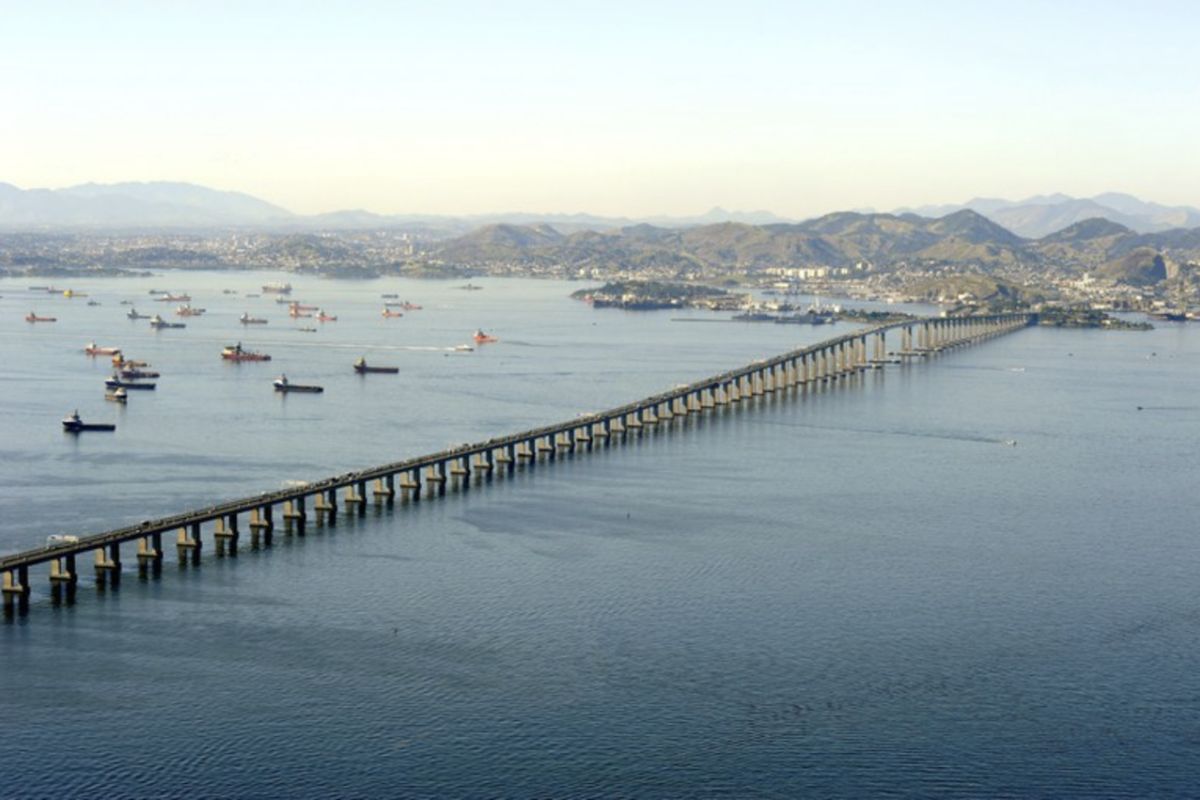


An Analysis of the History, Monumental Engineering, Records, and Socioeconomic Impact of the Rio-Niterói Bridge, a National Icon.
The Rio-Niterói Bridge, officially the President Costa e Silva Bridge, completed 50 years on March 4, 2024. More than just a route, it is a landmark of Brazilian engineering and a transformative symbol of the metropolitan landscape of Rio de Janeiro. Connecting the cities of Rio and Niterói over the Guanabara Bay, its history is rich and its impact, profound.
This article explores the trajectory of the Rio-Niterói Bridge. We will detail its conception, the challenges of its construction, its relevance in the global engineering landscape, and its socioeconomic legacy. A journey through the history of this Brazilian giant, based on a comprehensive analysis.
The History of the Rio-Niterói Bridge: From Necessity to Symbol of a Nation
Before the Rio-Niterói Bridge, crossing the Guanabara Bay was a challenge. The crossing required a land trip of over 100 km or the use of slow ferries. These options were bottlenecks for development. The bridge was designed to modernize this link, responding to a growing demand for fluidity.
-
Facing high rent, couple transforms parents’ garage into a fully functional apartment, creating a complete home at a fraction of the market cost.

-
MIT Scientists Develop Method to Transform CO₂ into a Construction Ally, Boosting Cement Strength by 13% in 24 Hours for More Sustainable Infrastructure

-
Canadian City Builds 8 Tiny Homes in 72 Hours for Homeless Youth, Plans 40 Affordable Houses for Female-Led Families Amid Housing Crisis

-
45-year-old Brazilian mother of 9 and grandmother of 12 receives 27 m² house made from recycled plastic, built in 15 hours with interlocking blocks and a recycled roof.


Several alternatives were studied, including an underwater tunnel. The chosen design aimed to optimize traffic and connect to BR-101. Its official name, President Costa e Silva Bridge, honors the president under whose government construction began, between 1968 and 1969. This name still generates debates, reflecting the complex military period. The government of the time viewed the project as a “showcase” of modernization and national strength.
The Challenges and Innovations in the Construction of the Rio-Niterói Bridge
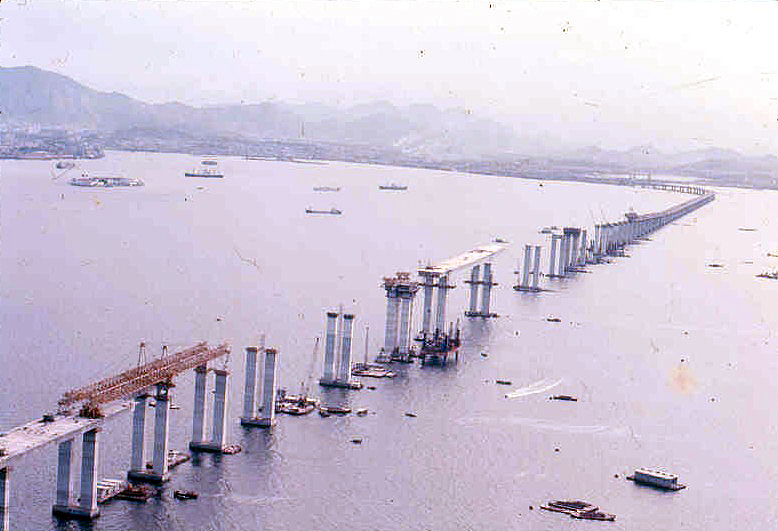
The dimensions of the Rio-Niterói Bridge attest to its grandeur. Its total length is 13.29 kilometers (13,290 meters). The width is 27 meters, and the main span has a free height of 72 meters for navigation and a length of 300 meters. This main span was the epicenter of the engineering challenges.
The construction, from 1968 to 1974, was an epic. The structural project in concrete was led by Antônio Alves de Noronha Filho and Benjamin Ernani Diaz. The metal span was designed by the American firm H.N.T.B. The execution, after setbacks, was entrusted to the Guanabara Construction Consortium Ltd. (CCGL). Pioneering techniques were used, such as employing an IBM 1130 computer for structural calculations and the prefabrication of concrete slabs. The assembly of the main span was a remarkable feat. The deep underwater foundations and incidents, such as the sinking of a platform in 1970 that resulted in eight fatalities, marked the project. The official number of deaths was 33, but unofficial estimates are higher.
Records and International Comparisons
Upon its completion in 1974, the Rio-Niterói Bridge was one of the longest in the world. Today, at 13.29 km, it ranks as the 11th longest globally, in a ranking dominated by Chinese railway viaducts.
However, the significance of the Rio-Niterói Bridge lies in specific technical records:
- Longest bridge in the Southern Hemisphere.
- Longest continuous straight beam span in the world (300 meters long and 72 meters high).
- The most important prestressed structure in the Americas (over 2,150 km of prestressing cables).
- One of the largest bridges in the world by spatial volume (built area).
- Largest assembly of steel structures in the world (at the time of the main span’s construction).
Modern Management, Continuous Maintenance, and Living Memory
Fifty years later, the Rio-Niterói Bridge remains vital. Since 2015, it has been managed by Ecoponte (EcoRodovias group). Around 150,000 vehicles and 400,000 people cross it daily. The toll is updated periodically.
Safety and longevity are ensured by sophisticated maintenance. The Synchronized Dynamic Dampers (ADS) system in the main span reduced oscillations caused by wind. Pioneering monitoring and testing methods ensure structural integrity. In recognition of its history, the Rio-Niterói Bridge Memorial was inaugurated, displaying documents, photos, and interactive resources, celebrating this icon of national engineering.