






 Portuguese
  Spanish
  4 min of reading
  0 comments


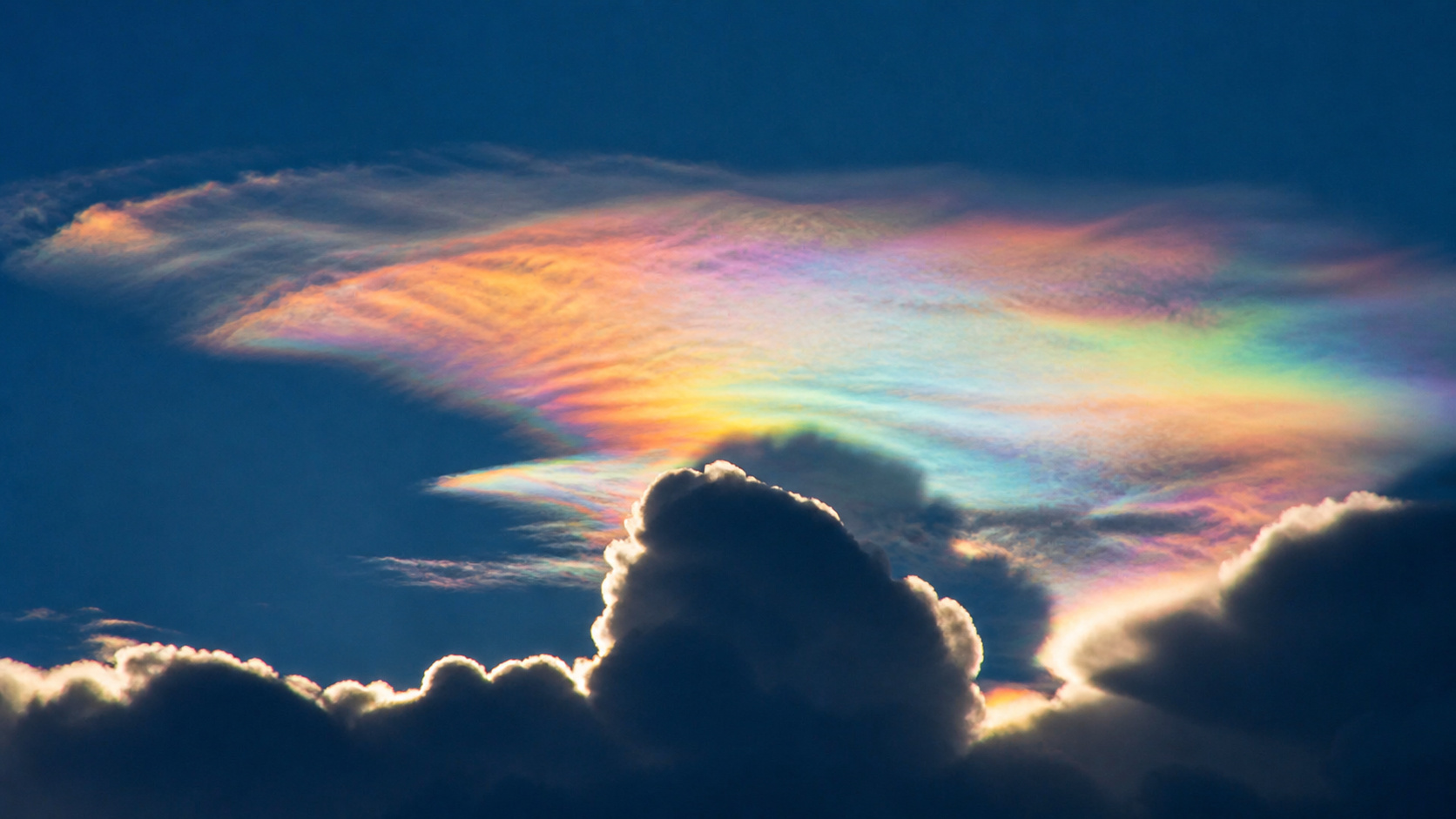
Unusual appearance in the Asian sky draws global attention, goes viral on social media, and raises curiosity about optical phenomena little known by modern atmospheric science
A “rainbow” cloud surprised residents and quickly gained prominence on social media after appearing over the Bogor region, Indonesia, on May 1st. The impressive record, taken in the afternoon, revealed a sky tinged with intense colors like green, pink, and blue, creating a visual spectacle that sparked curiosity worldwide.
The information was released by “G1”, with expert analysis and scientific data support, in addition to complementary explanations from international bodies such as NASA, which detail how this type of phenomenon occurs in the atmosphere. Although it seems extraordinary, the so-called iridescent cloud has a well-defined physical explanation, although its occurrence is considered rare.
Furthermore, the phenomenon went viral not only for its beauty but also for the visual impact caused by the images shared online. As a result, thousands of people began to question whether the event was real or the result of digital manipulation, which reinforces the importance of understanding the scientific processes behind this natural spectacle.
-
The War of Jenkins’ Ear: How a Severed Ear Sparked One of the 18th Century’s Most Unusual Conflicts

-
The True Story of Beavers Parachuted into Idaho: A Post-WWII Mission Using Planes and Special Crates to Relocate 76 Animals to a Remote U.S. Region
-
Trailblazing Brazilian Mother of Three Becomes First Woman to Drive BYD Electric Truck, Inspiring Her Daughter to Follow Suit

-
6-Year-Old Boy Finds 1,000-Year-Old Viking Sword During School Activity in Norway


How light diffraction creates the ‘rainbow’ cloud in the sky
To understand the emergence of the “rainbow” cloud, it is essential to comprehend the role of sunlight and its interaction with the atmosphere. This phenomenon, scientifically known as iridescence, occurs when sunlight passes through small water droplets or ice crystals present in clouds.
In this process, light diffraction occurs, a physical effect that scatters the different wavelengths of solar radiation. As a consequence, colors separate, forming vibrant and varied hues within the cloud itself. Unlike a traditional rainbow, which depends on refraction in larger raindrops, iridescence manifests irregularly, creating colored patches directly in the cloud formations.
According to experts, this phenomenon appears more frequently in thin, newly formed clouds, especially altocumulus, cirrocumulus, and cirrus types. However, for the effect to be visible, the water or ice particles must be very similar in size — an unusual atmospheric condition, which explains its rarity.
Furthermore, the geometry of the phenomenon is extremely specific. Sunlight needs to hit these particles at a precise angle for chromatic decomposition to occur visibly to the human eye. Therefore, the mere presence of suitable clouds is not enough; multiple conditions must align simultaneously.
Why the phenomenon is rare and appears even more intense on social media
Although the iridescent cloud is a real phenomenon, its visual intensity can vary greatly depending on observation conditions. According to meteorologist César Soares, from Climatempo, the images captured in Indonesia are legitimate, but the perception of colors can be amplified by technological factors.
This happens because cell phone cameras frequently use automatic filters or saturation adjustments, which intensifies the recorded colors. As a result, videos shared on social media may display more vibrant tones than those perceived with the naked eye.
Still, the phenomenon remains fascinating from a scientific and visual point of view. After all, it demonstrates how the interaction between light, atmospheric particles, and geometric conditions can generate surprising effects in the sky.
Consequently, events like this reinforce the public’s growing interest in natural phenomena and atmospheric science, showing that many mysteries still remain to be explored even in seemingly simple processes.
What differentiates an iridescent cloud from a traditional rainbow
Despite being visually similar, the “rainbow” cloud and the classic rainbow have distinct physical origins. While the traditional rainbow arises from the refraction and reflection of light in larger raindrops, forming a well-defined arc, iridescence occurs through diffraction in much smaller particles.
Furthermore, the rainbow depends on a specific position of the observer in relation to the Sun and rain, while the iridescent cloud can appear in different parts of the sky, provided that the light and particle conditions are adequate.
Therefore, although both phenomena involve the decomposition of sunlight, their physical and visual mechanisms are quite different. This distinction helps to understand why the iridescent cloud is less common and, often, more surprising for those who observe it.
Have you ever seen a rare phenomenon in the sky that made you doubt if it was real or seemed out of the ordinary?






-

1 person reacted to this.