Portuguese
  Spanish


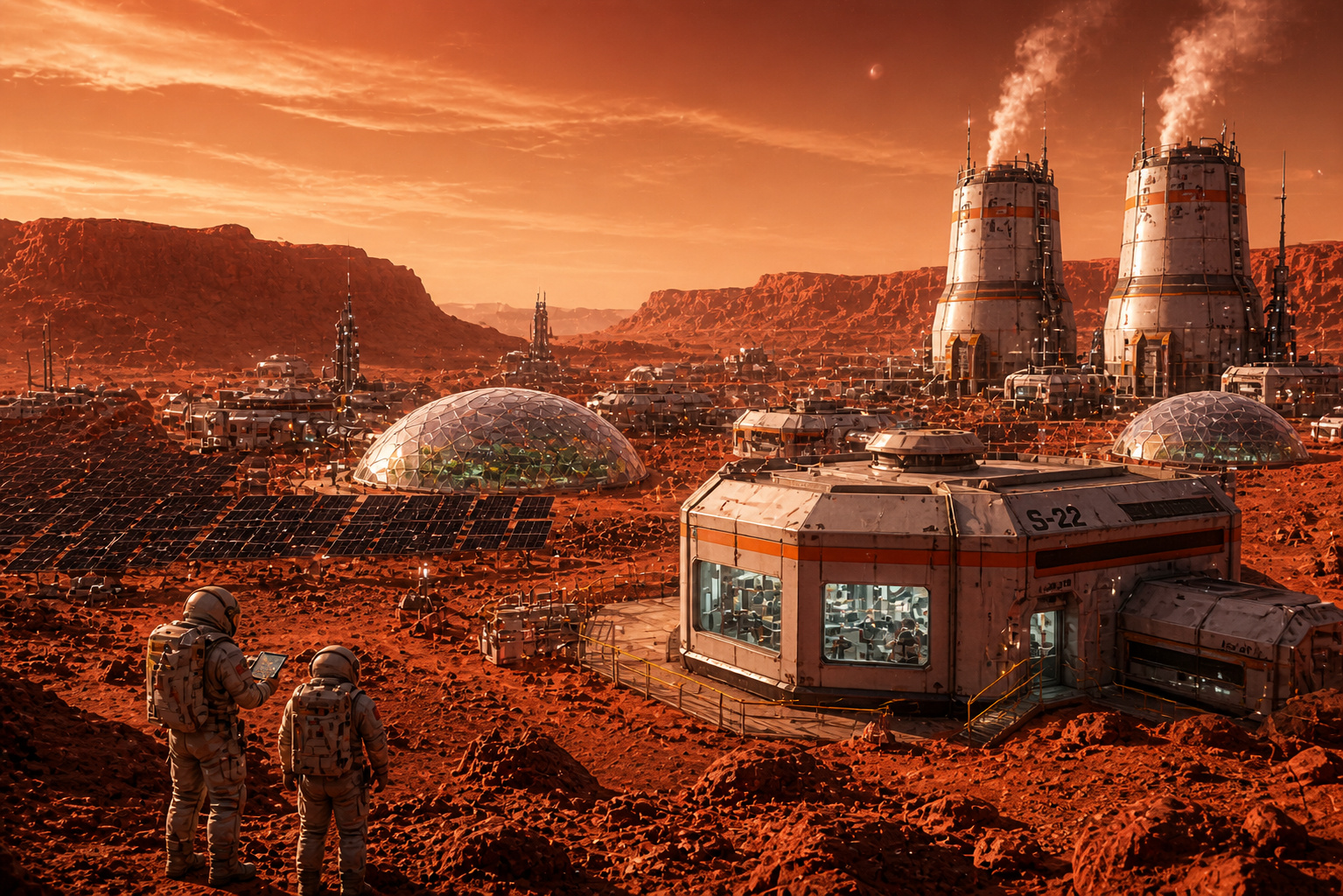

According to researchers from the University of Science and Technology of China, the integration of these technologies could completely transform how space missions are planned. Instead of relying exclusively on terrestrial supplies, future bases could operate autonomously.
Consequently, this would reduce logistical costs and increase the safety of operations. After all, transporting resources from Earth to Mars is extremely expensive and limited.
The future of space exploration and the challenges that still exist
-
LG Unveils XBOOM Stage 501 Portable Speaker with 25-Hour Battery, AI Karaoke, and Sound by will.i.am in Brazil

-
Scientists Warn San Andreas Fault Holds Highest Seismic Tension in 1,000 Years, Renewing Fears of “The Big One” Megaquake on U.S. West Coast

-
Brazil Advances with 14-X Hypersonic Project to Achieve Speeds Over Mach 5, Surpassing Concorde, After Two Decades of Research
-
Archaeologists Uncover 1,200-Year-Old Gold Treasure in Saudi Arabia, Ownership Remains a Mystery




Despite the great potential of this technology, scientists make it clear that there is still a long way to go. All presented solutions are still in the experimental phase and require additional testing.
Furthermore, factors such as energy efficiency, system durability, and adaptation to Mars’ extreme conditions still need to be improved. Nevertheless, the progress already represents a significant step towards more sustainable crewed missions.
The expectation is that ISRU will play a fundamental role in the coming decades. As new technologies are developed, the exploration of Mars could become an increasingly closer reality.
Therefore, generating energy with local resources is not just a technological innovation, but also a key piece for the future of humanity beyond Earth. If successful, this approach could open doors to a new era of space exploration.
Do you believe humanity will be able to live on Mars in the coming decades, or are we still far from that reality?

This concept already has practical applications on a smaller scale. Similar technologies are used on the International Space Station (ISS). However, the big challenge now is to expand this capability to meet the demands of a mission to Mars.
According to researchers from the University of Science and Technology of China, the integration of these technologies could completely transform how space missions are planned. Instead of relying exclusively on terrestrial supplies, future bases could operate autonomously.
Consequently, this would reduce logistical costs and increase the safety of operations. After all, transporting resources from Earth to Mars is extremely expensive and limited.
The future of space exploration and the challenges that still exist
Despite the great potential of this technology, scientists make it clear that there is still a long way to go. All presented solutions are still in the experimental phase and require additional testing.
Furthermore, factors such as energy efficiency, system durability, and adaptation to Mars’ extreme conditions still need to be improved. Nevertheless, the progress already represents a significant step towards more sustainable crewed missions.
The expectation is that ISRU will play a fundamental role in the coming decades. As new technologies are developed, the exploration of Mars could become an increasingly closer reality.
Therefore, generating energy with local resources is not just a technological innovation, but also a key piece for the future of humanity beyond Earth. If successful, this approach could open doors to a new era of space exploration.
Do you believe humanity will be able to live on Mars in the coming decades, or are we still far from that reality?
New system proposes transforming the Red Planet’s thin atmosphere into electricity, heat, and fuel, paving the way for self-sufficient bases and more viable space missions in the future
The possibility of generating energy on Mars using the planet’s own resources is no longer just theory and is beginning to take real shape within science. A recent study indicates that the Martian atmosphere, despite being extremely thin, could become a strategic source for producing electricity, heat, and even fuel.
The information was published by “National Science Review,” as detailed in a study conducted by a team of scientists from China, who presented an innovative approach based on the concept of In Situ Resource Utilization (ISRU). This strategy aims to reduce dependence on materials sent from Earth, one of the main challenges for long-duration crewed missions.
Furthermore, the project proposes an integration of technologies capable of sustaining habitats, laboratories, and life support systems on the Red Planet. This way, the exploration of Mars can become not only more efficient but also economically viable over the coming decades.
How energy generation on Mars works with local resources
To understand how this technology can work, it is important to observe the characteristics of the Martian atmosphere. Although it is predominantly composed of carbon dioxide (CO₂), its low pressure makes the direct use of this resource a significant challenge.
However, scientists propose a system capable of capturing and compressing this air. This process increases the density of CO₂, making its use in energy reactions possible. For this, three main methods have been suggested: mechanical compression, cryogenic trapping, and thermal adsorption.
Despite this, each of these methods still presents limitations. Some face low efficiency, while others have not yet been fully tested under real conditions. Nevertheless, all show potential to enable the use of the Martian atmosphere as an energy source.
After air capture, the system proposes the use of nuclear microreactors. These devices would be responsible for providing continuous energy, regardless of external conditions, such as dust storms or the absence of sunlight.
Furthermore, the generated energy can be stored in adapted batteries, ensuring stability in supply over time. This point is essential, as Mars presents extreme conditions that require highly reliable systems.
Another key component of the system is the Sabatier Reactor. This equipment converts captured CO₂ into methane and water. Methane can be used as fuel, while water can be reused in various applications, including life support and oxygen production.
Integration of technologies and the role of ISRU in space missions
The proposal goes beyond energy generation. It involves a complete ecosystem based on the utilization of local resources. In addition to CO₂, the study also highlights the use of subsurface ice and Martian soil.
Ice can be transformed into potable water and oxygen through electrolysis. The soil can be used in the construction of structures, further reducing the need to transport materials from Earth.
This concept already has practical applications on a smaller scale. Similar technologies are used on the International Space Station (ISS). However, the big challenge now is to expand this capability to meet the demands of a mission to Mars.
According to researchers from the University of Science and Technology of China, the integration of these technologies could completely transform how space missions are planned. Instead of relying exclusively on terrestrial supplies, future bases could operate autonomously.
Consequently, this would reduce logistical costs and increase the safety of operations. After all, transporting resources from Earth to Mars is extremely expensive and limited.
The future of space exploration and the challenges that still exist
Despite the great potential of this technology, scientists make it clear that there is still a long way to go. All presented solutions are still in the experimental phase and require additional testing.
Furthermore, factors such as energy efficiency, system durability, and adaptation to Mars’ extreme conditions still need to be improved. Nevertheless, the progress already represents a significant step towards more sustainable crewed missions.
The expectation is that ISRU will play a fundamental role in the coming decades. As new technologies are developed, the exploration of Mars could become an increasingly closer reality.
Therefore, generating energy with local resources is not just a technological innovation, but also a key piece for the future of humanity beyond Earth. If successful, this approach could open doors to a new era of space exploration.
Do you believe humanity will be able to live on Mars in the coming decades, or are we still far from that reality?