





 Portuguese
  English
  Spanish
  4 min of reading
  0 comments


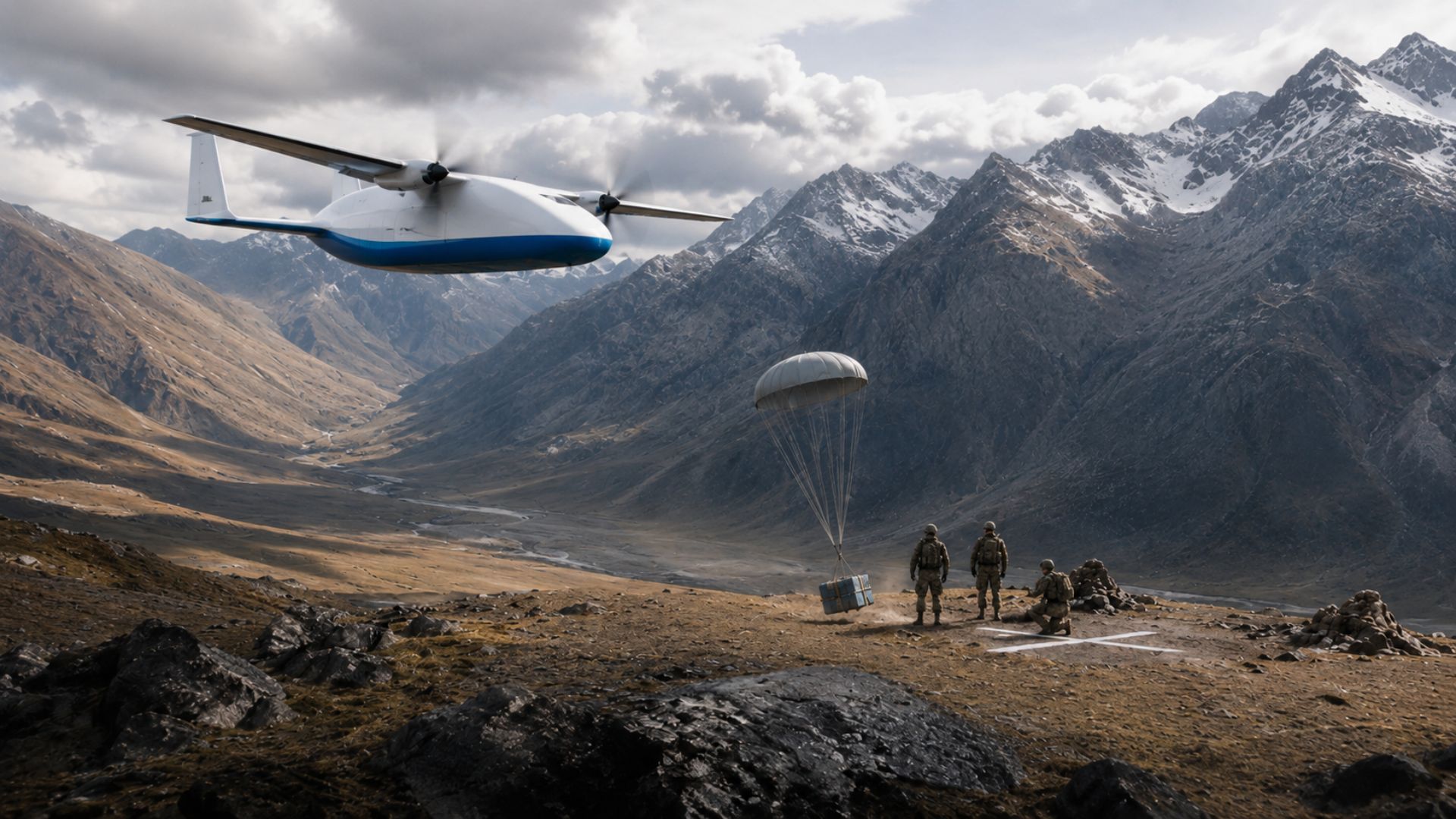
Pyka, from California, presented a precision aerial launch feature for the autonomous DropShip aircraft. In a test flight, it dropped 90-kilogram loads, landing about 15 meters from the target. However, the numbers are from the company itself, and official tests are yet to come.
The American Pyka demonstrated that the autonomous DropShip aircraft, without a pilot on board, can launch 90-kilogram loads that land about 15 meters from the target, aiming to resupply troops in hard-to-reach locations. The company presented a precision aerial launch feature that allows supplies to be delivered without anyone piloting the plane. Pyka itself says the technology can help US and allied forces when traditional supply routes fail.
According to the report, the demonstration reflects a larger shift in military logistics. Defense leaders have warned that future conflicts may compromise access to traditional transport networks, increasing the demand for autonomous and flexible alternatives. It is in this scenario that Pyka, based in California, positions the DropShip. The numbers, however, come from the company itself.
What the autonomous DropShip aircraft demonstrated
Pyka’s autonomous aircraft was made to reach places where regular trucks and planes cannot. The company, based in California, created a precision aerial launch feature for the DropShip, capable of delivering supplies without a pilot on board. In a test flight, the device dropped several 90-kilogram loads from 90 meters high, and the material landed about 15 meters from the intended point, according to the company.
-
Young Hawaiian recycles 1.8 million cans and bottles and uses the money to fund college scholarships: Genshu Price diverted 63,000 kilograms of waste from landfills and turned each five-cent deposit into university hope.

-
Scientists create “electrochemical bath” that can recover up to 95% of the power of used batteries, cut recycling costs by 56%, and transform lithium-ion waste into a new weapon against dependence on critical minerals.

-
Now it’s a reality: researchers at Unicamp develop AI capable of identifying anxiety with 80% accuracy directly on a smartwatch, paving the way for continuous mental health monitoring with low energy consumption.

-
The submerged wall that saved Venice 154 times may already be numbered: after spending billions on flood barriers, the city is pursuing a plan B as the sea advances, threatening to engulf the lagoon and potentially turning the Italian postcard into stagnant water.




The stated focus is logistics in conflict zones. According to the report, Pyka claims that the system can help American and allied forces transport essential cargo on long-distance missions when traditional routes are cut off or become unavailable. Defense leaders have been warning that future wars may compromise transport networks, which explains the search for more autonomous and flexible logistics.
The numbers that Pyka attributes to the aircraft


On paper, the technical specifications are impressive, but they come from the manufacturer. According to Interesting Engineering, published on June 11, the autonomous aircraft DropShip was designed as a heavy cargo platform, with a maximum takeoff weight of 725 kilograms and a capacity to carry up to 295 kilograms of cargo. The hybrid model needs only 168 meters of runway to take off with maximum load.
The promised range is the big announced advantage. According to the company, the aircraft makes same-day deliveries within a radius of 3,200 kilometers, has a ferry range of up to 5,600 kilometers, and can travel more than 1,600 kilometers carrying 227 kilograms. The cruising speed is around 139 km/h, potentially reaching about 167 km/h, and the service ceiling reaches 6,100 meters above sea level. However, all these data have not yet undergone independent verification.
An accelerated development, according to the company
Pyka highlights the speed with which it took the project off the drawing board. The company claims that the DropShip made its maiden flight just six months after the program began, and evolved from the first flight to the autonomous precision air launch in eight months. It’s an unusual pace for an autonomous aircraft of this size.
The secret, according to the manufacturer, is the reuse of technology. According to the report, Pyka attributes this speed to the foundation that already powers its commercial aircraft, with engineers adapting existing autonomous systems to accelerate development and testing. It’s the same reuse logic that other companies have been adopting to shorten timelines.
From troops to disaster zones, with evaluations still ahead
Pyka envisions uses for the autonomous aircraft far beyond cargo transport. Michael Norcia, CEO and co-founder of the company, stated that “until now, there was no safe, economical, or practical way to deliver essential supplies” autonomously and directly to a point hundreds or thousands of kilometers away. For him, operators could deliver fuel, water, medical supplies, and spare parts exactly where needed, transforming logistics in remote regions, disaster zones, and contested environments.
Even so, the real test is yet to come. According to the report, in addition to cargo, the DropShip can support intelligence, surveillance and reconnaissance missions, communications, and expeditionary energy, thanks to a reconfigurable mission computer. The company says it will continue expanding the flight envelope before customer evaluations and exercises with the US government later this year, meaning the operational validation of the autonomous aircraft has not yet occurred.
Pyka’s demonstration shows an autonomous aircraft capable of dropping 90-kilogram loads with a landing about 15 meters from the target, designed to resupply troops where common routes do not work. The announced technical specifications are ambitious, from the 3,200-kilometer range to the development in just a few months, and the uses range from transporting fuel and medicines to disaster zones. The detail is that almost everything comes from the company’s own numbers, and the exercises with the US government, scheduled for later this year, will determine if the promise holds true.
And you, do you believe that autonomous aircraft like the DropShip will really change resupply logistics, or is it still too early to talk about a revolution? Share your opinion and exchange ideas with other readers, respecting different views on the military use of autonomous technology.






Be the first to react!