






 Portuguese
  Spanish
  4 min of reading
  0 comments


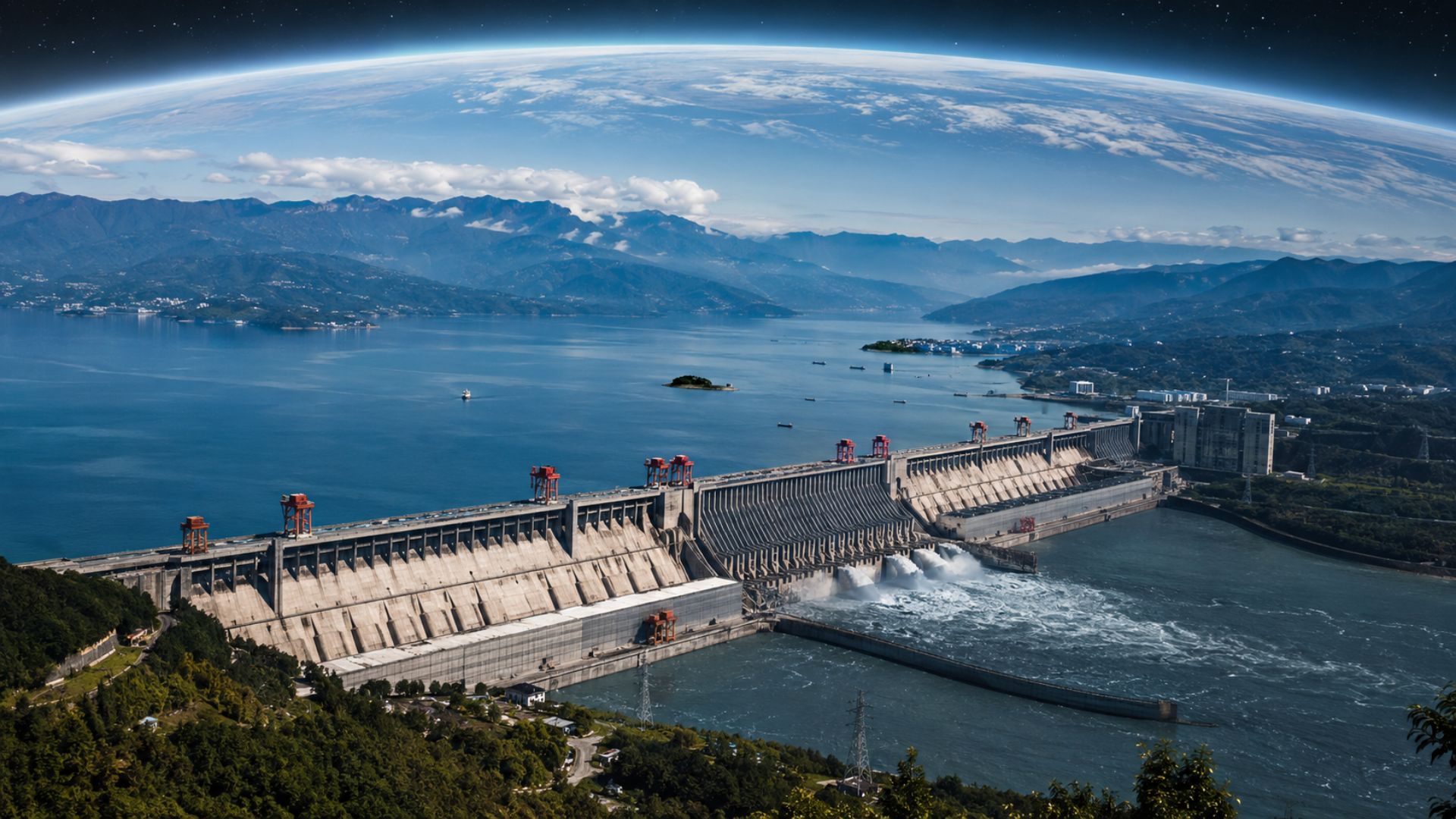
The numbers of the Three Gorges Dam

The structure is 2,335 meters long and 185 meters high. Its 32 turbines of 700 MW each add up to an installed capacity of 22,500 MW, in addition to two smaller generators of 50 MW that provide energy for the plant itself. In 2020, after intense monsoon rains, the Three Gorges Dam broke the annual generation record of Itaipu, which had been 103 TWh since 2016, producing nearly 112 TWh of electricity.
Despite its enormous dimensions, the Three Gorges Dam produces only 1% of China’s annual electricity, a fact that puts the country’s energy consumption into perspective. The megastructure also includes a ship lift that allows navigation on the river, maintaining the Yangtze’s transportation function even with the interruption of the natural flow.
How the Three Gorges Dam affects Earth’s rotation
The physical mechanism is called the moment of inertia, a quantity that describes a body’s resistance to changes in its rotation. When 40 trillion liters of water are concentrated at a specific point on Earth’s surface by the Three Gorges Dam, the planet’s mass distribution changes, and this alters, even if imperceptibly, the rotation speed.
-
A doctor from Minas Gerais warns that sleeping with the fan pointed at the body all night is not as harmless as you think; it dries out the respiratory tract, causes mucus buildup, spreads dust mites, and can even irritate the cornea of the eyes.

-
Ecuadorian volcano at 6,268 meters is more than 2,000 meters closer to space than Everest, which is 8,848 meters, because the Earth is wider at the equator.
-
Public school students in the hinterlands of Maranhão create a bioinsecticide with neem and castor to protect corn crops, transform rural waste into biogas and biofertilizer, and bring sustainable technology to producers at ExpoSertão.

-
Ötzi, the 5,300-year-old mummy found in the Alps, reveals a still active microbiome, and the Iceman’s yeast points to an energy-saving fermentation.


The classic example is a skater who spins faster when crossing their arms close to their body. Conversely, when mass moves away from the rotation axis, the spin slows down. The Three Gorges Dam concentrates a massive amount of water at a latitude that amplifies the effect. The result calculated by NASA is an increase of 0.06 microseconds in the day’s duration, an insignificant value for daily life but measurable for science. NASA first warned about the phenomenon in 2005.
Other examples of human activities that alter rotation
The Three Gorges Dam is not the only example of human interference in Earth’s rotation. Between 1993 and 2010, the extraction of approximately 2,150 gigatons of groundwater for consumption, agriculture, and industry raised the sea level by more than six millimeters and shifted Earth’s rotation axis 80 centimeters eastward.
The 2004 tsunami in Indonesia, caused by an earthquake between the India and Myanmar plates, had the opposite effect: it shifted the North Pole about 2.5 centimeters eastward and accelerated the rotation, reducing the day’s duration by 2.68 microseconds. The comparison shows that natural phenomena still have a much greater impact than human works, but the trend is that the sum of human activities will become increasingly relevant.
The dam that will be three times larger
China is already building the future Medog hydroelectric power plant in Tibet, located on the Yarlung Tsangpo River. Construction began in 2025, and when completed in 2035, it will be the most powerful dam on the planet, three times larger than the Three Gorges Dam, raising questions about the cumulative impact of multiple megastructures on Earth’s rotation and Asia’s river ecosystems.
The scale of China’s energy ambitions is difficult to comprehend. If the Three Gorges Dam, with all its magnitude, produces only 1% of the country’s electricity, the Medog plant will need to be three times larger to make a significant difference in the energy matrix. For the planet, each new megadam is a demonstration that human engineering already operates on scales that nature perceives, as NASA proved by calculating the effect of the 40 trillion liters of the Three Gorges Dam.
Did you know that the Three Gorges Dam is so large that it can slow down Earth’s rotation? What impresses you more: the 40 trillion liters, the generation record, or the future dam three times larger? Tell us in the comments.




Be the first to react!