






 Portuguese
  Spanish


The ReciclAr project uses controlled thermal treatment to remove the resin and preserve the fibers with their basic properties, according to the fair’s organization. The technique was demonstrated in laboratory samples and remains a proof of concept, still far from an industrial-scale application.
The victory was announced on March 20, 2026, at the closing ceremony of the 24th edition of the Brazilian Science and Engineering Fair, Febrace, held at the University of São Paulo, USP. Student Júlia Ramos Genzini, from Colégio Dante Alighieri in São Paulo’s capital, took 1st place in the Engineering category with the ReciclAr project, dedicated to recycling wind turbine blades, competing with 297 finalist projects from all over the country, according to the official announcement from Febrace.
The reason a basic education student is tackling this problem is simple: wind turbine blades are among the most difficult waste to recycle on the planet. According to Febrace, the project proposes a solution for the reuse of glass fibers from wind turbines, a material that is difficult to recycle and tends to accumulate in landfills and impact the environment. Júlia was guided by professor Juliana de Carvalho Izidoro and co-guided by Cristiane Rodrigues Caetano Tavolaro, according to the fair’s organization.
How the ReciclAr method separates the glass fiber from the resin
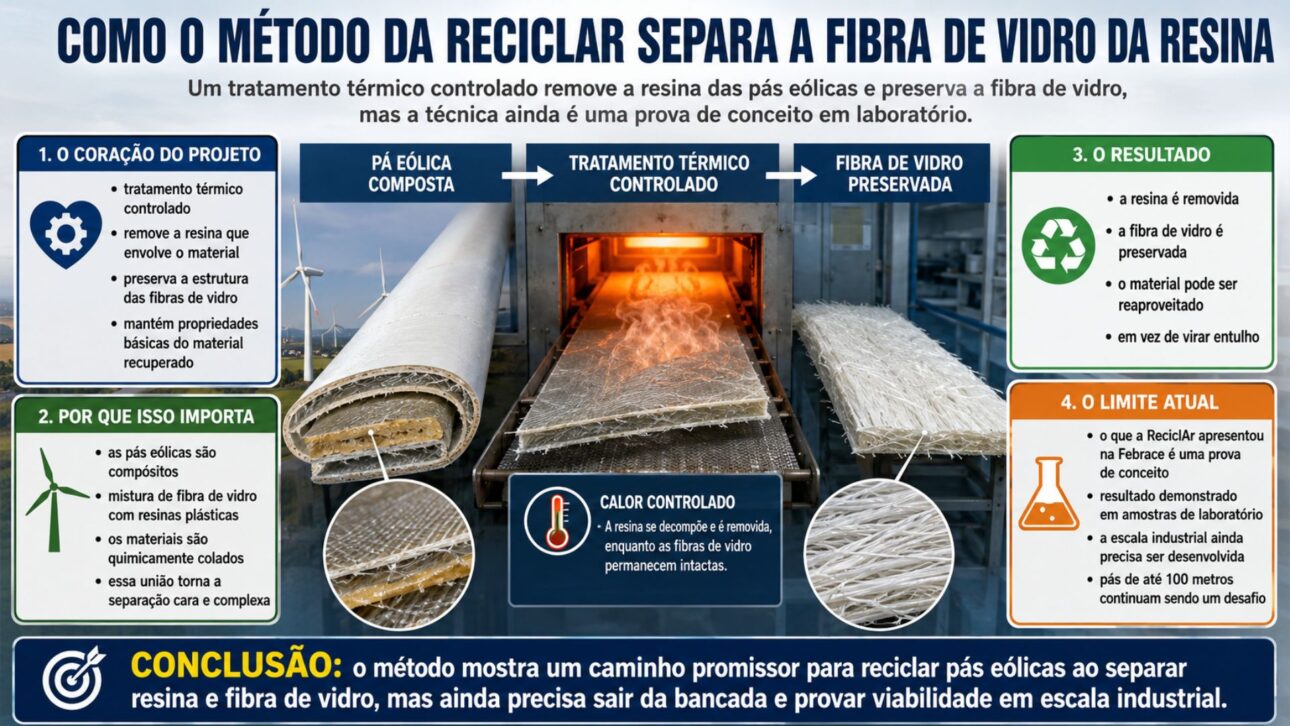
According to the official description released by Febrace, the process developed by the student managed to remove the resin that surrounds the blade material while preserving the structure of the glass fibers, maintaining their basic properties, an essential condition for the recovered material to be reused instead of becoming debris.
-
Crab Trapped in Plastic Bottle for 62 Days Near Okinawa Highlights Little-Known Impact of Marine Pollution on Small Animals

-
Esperanza’s Bamboo Barrier in Oaxaca Redirects River and Reduces Erosion by 85% in Five Years

-
Family Builds Homemade Wind Turbine to Power Off-Grid Home, Video Reaches 555,000 Views on Ngô Thị Huyền’s Channel
-
Indian Brand Creates Sneakers from Recycled PET Bottles and Discarded Tires, Repurposing Over 1 Million Bottles and Raising $4 Million for Expansion



This result addresses exactly the point that hinders the recycling of wind turbine blades worldwide.
The blades are made of composites, a mixture of fiberglass with chemically bonded plastic resins to withstand decades of wind and weather, and it is this glue that makes the separation of materials expensive and complex.
The strict label is valid: what ReciclAr presented at Febrace is a proof of concept demonstrated in laboratory samples, and the distance between the bench and an industrial plant capable of processing blades up to 100 meters still needs to be covered.
Who is the awarded student and the school that dominated Febrace 2026
Júlia Ramos Genzini represents a generation that the fair’s organization itself says is more mature in the face of contemporary challenges.
The general coordinator of Febrace, Professor Roseli de Deus Lopes, stated at the winners’ announcement that the results of 2026 reflect not only the quality of the projects but also the maturity of the students, in an edition marked by sustainable solutions based on waste and the use of artificial intelligence.
Colégio Dante Alighieri, by the way, had more than one champion in the same edition.
According to Febrace, another project from the São Paulo school, SafeSkies, for detecting balloons with artificial intelligence, took 1st place in Exact and Earth Sciences and a spot in the Brazilian delegation of Regeneron ISEF, the world’s largest pre-university science fair, where it won awards in May, in Phoenix, United States, as announced by Febrace and CNPq.
The size of the waste that ReciclAr wants to avoid


Wind turbine blades typically have a lifespan of between 20 and 30 years, and the first major generation of parks in the world is now reaching retirement.
The reference study on the subject, signed by researchers Pu Liu and Claire Barlow from the University of Cambridge, and published in the scientific journal Waste Management, projects 43 million tons of accumulated blade waste on the planet by 2050, a number that is an estimate of the scenario and not a foregone conclusion.
Brazil has a direct interest in this race.
The country operates about 33.7 gigawatts of wind capacity, according to consolidated data from ABEEólica and GWEC, and a survey by the newspaper Tribuna do Norte based on ANEEL shows that, in Rio Grande do Norte alone, 10 parks with 705 blades enter the phase of repowering or dismantling by 2032.
Today, the most common solution in the country is to crush the blades and send the residue to cement factories, a destination that utilizes the material but does not recover the fiberglass, exactly what the award-winning technique at Febrace aims to do.
From the school bench to the industry, there is still a long way to go
No school award alone transforms an experiment into a production line, and it’s honest to say that.
Febrace itself, promoted by the Polytechnic School of USP and conducted by the Technological Integrated Systems Laboratory, LSI-TEC, functions as a showcase for scientific initiation: the 2026 edition received over 3,000 projects submitted and selected 297 finalists, according to the organization.
What the award guarantees to ReciclAr is academic validation and visibility, not a contract with the wind industry.
Even so, the student’s movement points in the direction the entire sector is heading.
Global turbine manufacturers have announced goals for recyclable blades and zero waste for the coming decades, all still in the realm of commitments, and research centers around the world are testing thermal and chemical routes to recover fiberglass.
The difference is that, in this case, the initiative came from the bench of a Brazilian school and directly confronted a problem that the billion-dollar clean energy industry has not yet solved.
One fiberglass recovered at a time
The story of Júlia Ramos Genzini connects the two ends that the CPG reader follows every day: the rapid expansion of wind energy and the environmental cost that comes due when the turbines age.
If the ReciclAr technique or any other recycling route scales in time, Brazil has the chance to set up this chain before the mountain of retired blades forms in the Northeast.
And you, do you believe that solutions born in science fairs like Febrace can reach the industry or is the path of innovation in Brazil still too long? Leave your opinion in the comments and join the conversation, always with respect for different opinions.


