






 Portuguese
  Spanish


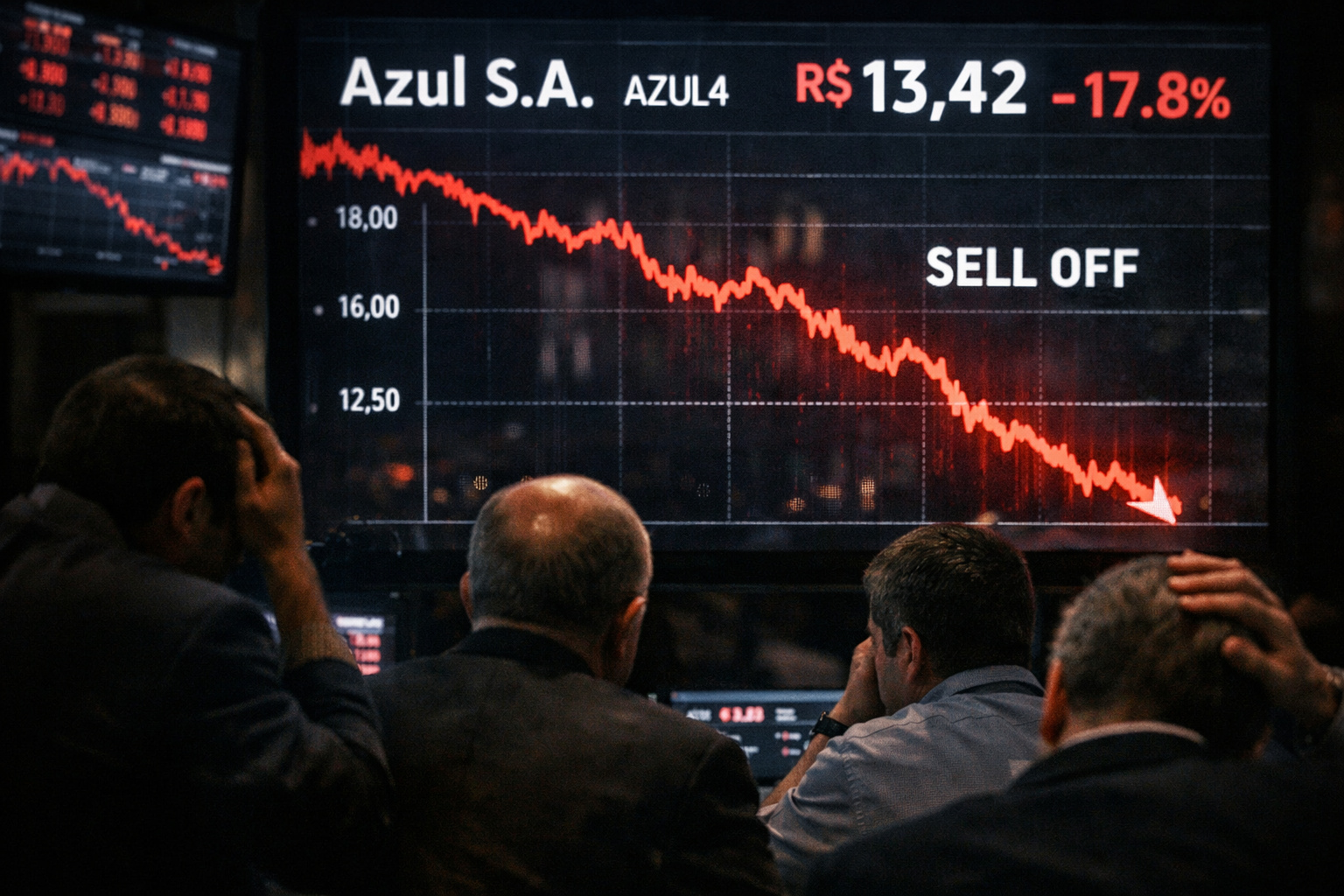
Market Reacts to Chapter 11 Progress, Debt-to-Equity Conversions, and the Arrival of New Investors, While Current Shareholders Face Significant Dilution and Uncertainty About the Airline’s Future

Azul’s shares (AZUL54) experienced one of the most turbulent days in their recent history. In the trading session on Friday (2), the airline’s stock fell approximately 50%, trading at around R$ 9.02, in a move that shocked investors and raised alerts in the market.
In the last five trading sessions, the accumulated loss is nearing 67%, reflecting a combination of financial, legal, and structural factors. While there is no single cause for the downfall, the progress of the Chapter 11 bankruptcy proceedings in the United States has come to capture attention and strongly pressure stock prices.
-
Major Brazilian Supermarkets, Including Carrefour and Assaí, May Close Earlier to Prevent Price Increases

-
Coca-Cola Shuts Down 100-Year-Old Factory in the U.S., Impacting 85 Workers and Shaking Local Community with Historic Consequences
-
Bianca Andrade Invests $30 Million of Her Own Money in Boca Rosa, Launches Over 100 Products in a Year, Aiming for $400 Million by 2026
-
Belo Horizonte Becomes First Brazilian City to Fund Housing, Utilities for 100 Homeless Families with $900,000 Initiative


This information was reported by specialized media from the financial market and confirmed by official communications from the company itself, as well as analyses from banks and investment firms closely monitoring the case.
Chapter 11 Accelerates Restructuring but Increases Risk for Shareholders
First of all, it is important to understand the context. Azul has been making progress in its Chapter 11 bankruptcy process in the United States, utilizing mechanisms provided in the Chapter 11 bankruptcy legislation. This model allows companies to continue operating while reorganizing debts and capital structure.
However, although the process brings financial breathing room to the company, it imposes a high cost on current shareholders. The main one is dilution.
Since the end of December, Azul has been traded in lots of 10 thousand shares, under the ticker AZUL54. This change is part of a strategy to convert debts into equity. To do this, the company will need to issue a significant volume of new shares, which will significantly reduce the stake of those already positioned in the stock.
According to an analysis by Bradesco BBI, the price set for this conversion indicates a relevant dilution of current shareholders’ equity, a scenario that the market has begun to price more aggressively in recent days.
Thus, even with the improvement in the company’s liquidity, the investor sees their percentage of ownership shrink rapidly, which helps explain the strong selling pressure observed in the stock market.
End of Preferred Shares and Entry of United Expand Dilution

Additionally, Azul called for assemblies on January 12 with a sensitive proposal: the end of preferred shares (AZUL4). If approved, the measure will convert all the company’s capital into common shares (AZUL3).
According to management, this conversion is a requirement of the recovery plan approved by the U.S. court. The company had already communicated this intention to the market through a material fact disclosed in December.
By doing so, Azul seeks to simplify its share structure. At the same time, it advances to a crucial stage of the reorganization process, which involves capitalizing credits, renegotiating debts, and redefining the rights among shareholders and creditors.
However, for current common shareholders, the impact is direct. There will be a significant increase in the number of shares with voting rights in circulation, which reduces the individual decision-making power of each investor.
At the same time, another move contributed to the increase in dilution. Last week, Cade approved, without restrictions, a strategic operation between Azul and United Airlines. Under the transaction, the American company committed to invest around US$ 100 million in common shares of Azul.
This investment will raise United’s economic stake from approximately 2.02% to about 8%. The agreement involves two coordinated operations: a public offering of shares up to US$ 650 million, open to the market and approved by U.S. courts, and a capital increase directed at strategic partners.
Although the entry of a global player strengthens the company in the long term, in the short term the market reacted to the inevitable side effect: more shares in circulation and greater dilution.
Operational Numbers Are Positive but Don’t Stop the Plunge
Meanwhile, Azul recently released its preliminary operational data for November, which shows a company still operationally active. During the period, the company recorded total net revenue of R$ 1.817 billion.
The adjusted operational result, disregarding non-recurring items related to reorganization, amounted to R$ 392.1 million, with an operating margin of 21.6%. The Adjusted Ebitda reached R$ 621.8 million, reflecting a margin of 34.2%.
By the end of November, the company’s cash totaled R$ 1.348 billion, while accounts receivable amounted to R$ 3.749 billion. According to Azul, the numbers are preliminary, unaudited, and aim to keep the market informed about the financial evolution during the restructuring process.
Still, despite the positive operational indicators, the market placed more weight on structural risk than on short-term performance. In times like this, investors tend to react less to results and more to changes in share capital and shareholder rights.
As a result, the stock continued to free fall, reflecting a classic movement of risk aversion and portfolio repositioning.
Given a restructuring that saves the company but severely penalizes the investor, do you still see room to trust in Azul’s future or would you prefer to sit out until the end of this process?







-

-

3 people reacted to this.