






 Portuguese
  Spanish


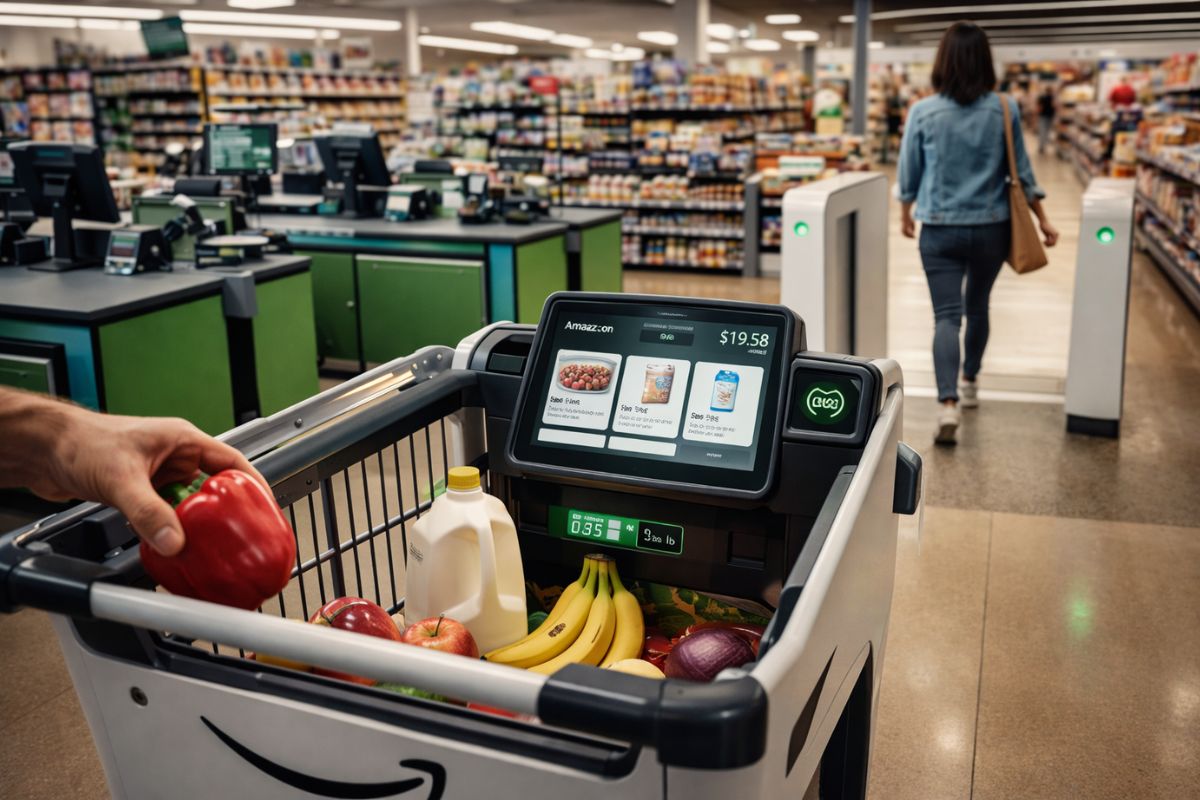


At Whole Foods Market, In The United States, Amazon Accelerates The End Of Supermarket Checkout By Expanding The Dash Cart, A Smart Cart With Computer Vision, Sensors, And A Scale For Fresh Produce, A Real-Time Total Display, And Contactless Payment, Redesigned To Be Lighter And Larger By 2026 Gradually.
The discussion about supermarket checkouts has gained a new player in physical stores in the United States. Amazon has begun to expand the Dash Cart at Whole Foods Market with the promise of reducing the final step of shopping to a simple gesture, bringing the payment closer and moving on.
The move touches on a sensitive point in retail: the intersection of technology and service. When the exit becomes just an exit, without a line, the store layout changes, and the role of the supermarket cashier ceases to be the center of the process.
How The Dash Cart Tries To Replace The Checkout Step
The Dash Cart is a smart cart that allows customers to scan items while shopping and, at the end, leave the store without going through traditional supermarket checkouts.
-
Experts Warn: Aging NASA Launch Facilities Could Hinder Artemis Moon Mission Progress

-
Self-Driving Harvester Now Operating in Brazil’s Vast Farmlands
-
Astronomers Discover Two Giant Exoplanets as Light as Cotton Candy, Challenging Current Scientific Models 1,110 Light-Years from Earth
-
NASA’s Plan to Dump ISS Debris in Ocean Sparks Environmental Concerns Among Scientists


It features cameras, sensors, and computer vision software to identify products as they are placed in the cart.
In the new version, a barcode reader has been repositioned and made more sensitive, with the intention of speeding up recognition.
The integrated screen acts as a scoreboard for the purchase, displaying the price of each item and the total accumulated in real time, with automatic updates when something is removed.
Fresh Produce In The Cart And Weight Turning Into Price
One point that often hinders fluidity at supermarket checkouts is fresh produce, due to weighing.
Amazon has added a scale to the Dash Cart to allow fruits and vegetables to be weighed directly in the cart, without a separate step.
According to the system’s description, sensors and artificial intelligence accurately calculate the price based on the measured weight.
The promise is to remove the last invisible line, the one where the customer has to stop at some point in the store just to weigh and label.
Where The Expansion Started And What Changes By 2026
The new version of the Dash Cart began to be implemented in Whole Foods Market stores in McKinney, Texas, Reston, Virginia, and Westford, Massachusetts.
The reported plan is to roll out the model to dozens of units by the end of 2026, still focused on the U.S. market.
Amazon claims that the redesign came from customer suggestions and focused on saving time and practicality.
The cart is about 25% lighter and its capacity has been increased by 40%, and it features an automatic charging system when parked, an operational detail that supports scaling in a full store.
Why Amazon Changed Its Course Regarding Just Walk Out
The Dash Cart system was initially developed in 2020 as an alternative to traditional checkout formats.
It also serves as a partial replacement for Just Walk Out technology, which relied on ceiling-mounted cameras to identify items taken from shelves.
The smart cart shifts the identification to the equipment itself, combining computer vision with sensors at the point where the product enters the purchase.
It’s a change in architecture within the store, because the capturing shifts from the ceiling to following the customer, item by item, along the journey.
Contactless Payment And The Exit That Changes Service
At the final moment, the Dash Cart accepts contactless payment via credit card, digital services, or the Amazon account linked to the cart.
After that, the customer heads to an exclusive area and leaves the store without passing through supermarket checkouts, lines, or conversation.
The issue for the sector isn’t just technological but also about consumer culture.
The silence of the checkout may please some and annoy others, and retail will have to measure what is gained in speed and what is lost in human interaction, especially in stores that have always used the cashier as a point of guidance and assistance.
What Could Become Standard And What Still Hinders The Global Shift
Amazon is already using similar technology in Amazon Fresh units and Whole Foods Market itself as a strategy to reduce lines and optimize flow.
The expansion of the Dash Cart reinforces the digitalization of physical retail and brings the in-store shopping experience closer to the automated logic of e-commerce.
At the same time, becoming a global standard depends on factors that do not show up in the showcase, such as implementation costs, cart maintenance, layout adaptation, and public acceptance.
Not every supermarket wants to make efficiency the rule, and not every customer wants a shopping experience guided by screens and sensors, without the cashier intermediary.
Brazil Out Of The Route, For Now
So far, there is no forecast for a launch in Brazil. However, that does not prevent the discussion about supermarket checkouts from reaching the Brazilian retail sector, as advancements in large U.S. chains are often observed by competitors and technology providers.
If the Dash Cart consolidates at Whole Foods Market by 2026, it will become a reference showcase.
The question for the reader is not whether the technology exists, but whether it fits the way of shopping, the level of service expected, and the social role that the cashier still plays in many cities.
What would you miss in a store without supermarket checkouts, lines, and conversation, and in what situations would contactless payment on the Dash Cart be a real relief, not just another step on the screen?


Ja tem para comprar no Brasil?