






 Portuguese
  Spanish
  4 min of reading
  1 comment


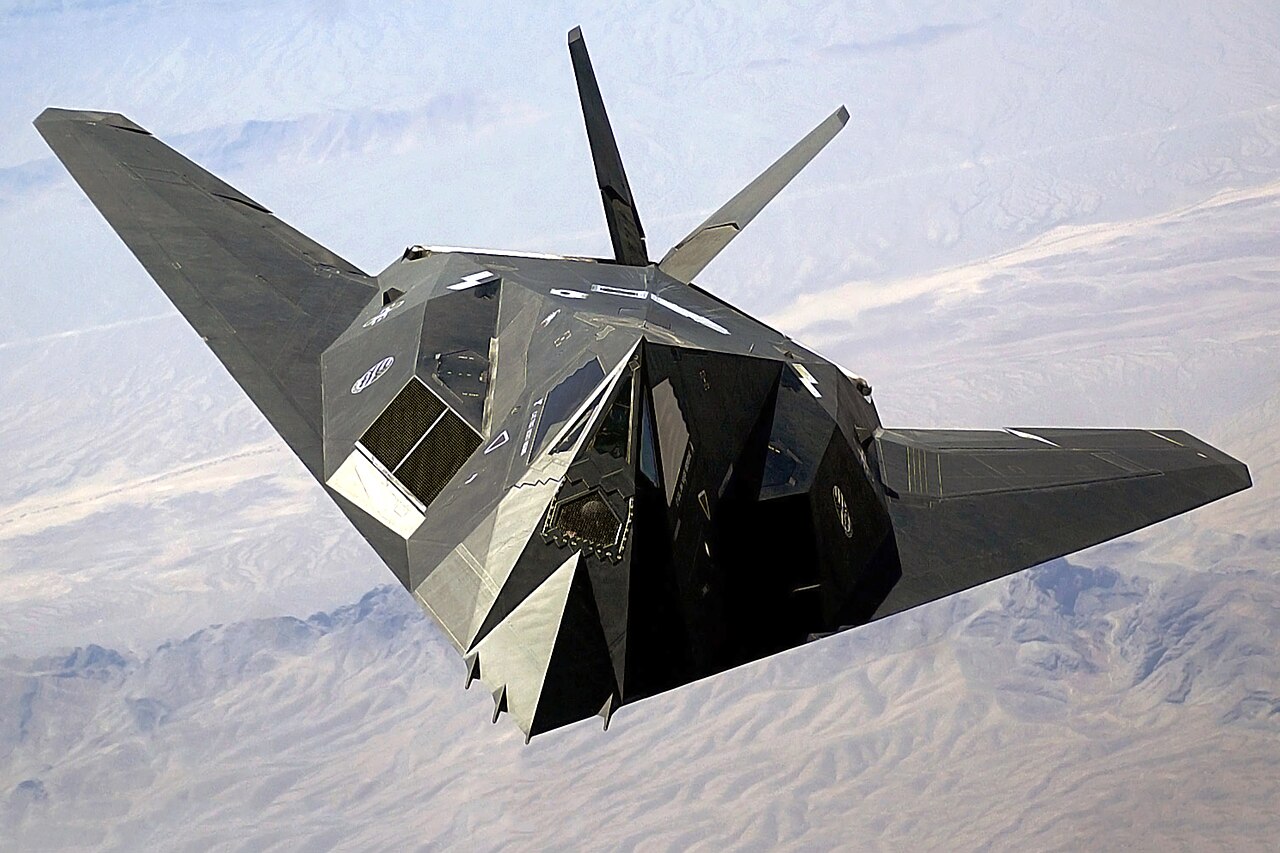


Unstable, Computer-Dependent, and Invisible to Radar, the F-117 Nighthawk Showed That an “Impossible” Aircraft Could Bypass Air Defenses and Change Modern Warfare.
When the F-117 Nighthawk was revealed to the public at the end of the 1980s, its appearance caused immediate bewilderment. Harsh lines, angular surfaces, absence of traditional aerodynamic curves, and a look that resembled a geometric object more than an aircraft. That was not a result of engineering oversight. It was exactly the opposite. The F-117 was designed to sacrifice almost everything — including flight stability in exchange for something that no other operational aircraft possessed at that time: practical invisibility to enemy radar.
The result was one of the most radical designs in the history of military aviation.
An Aircraft Designed Not to Appear
In the 1970s, engineers from Lockheed Skunk Works reached an uncomfortable conclusion: to drastically reduce the radar signature, it would be necessary to completely abandon the classic aerodynamic shapes used since World War II.
-
The military spaceplane that almost took the Cold War into orbit: Boeing X-20 Dyna-Soar was designed to re-enter above Mach 20, fly for up to 40 hours, land like a plane, and transform Titan rockets into a gateway to a new era of orbital warfare.

-
FAB bets on national drones and increases investments to strengthen the Brazilian aerospace industry

-
Six times, a luminous crescent the size of the Moon startled the Soviet sky at dusk: it seemed like a wave of UFOs, but it was a secret orbital weapon created to attack the United States via the South Pole and evade Cold War radars.

-
The United States government approved a potential sale of 100 portable Stinger anti-aircraft missiles to the Brazilian Army, in a package estimated at around 330 million dollars that still depends on negotiations between the two countries.




Smooth curves reflected radar waves back to the source. Flat surfaces, angled at calculated degrees, dispersed those waves away.
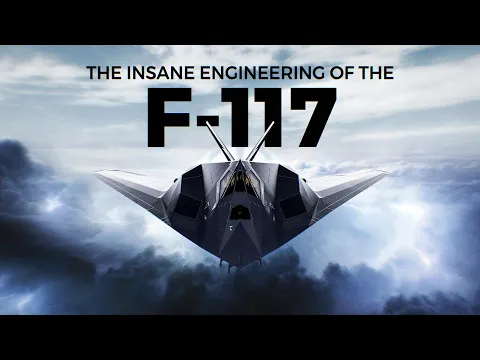

The F-117 was born from this logic. Its faceted shape was mathematically optimized to break radar signal returns, not to fly efficiently. Every panel, every angle, and every edge existed to deceive sensors, even if it made the aircraft inherently difficult to control.
Total Instability: An Aircraft That Does Not Fly By Itself
The price of extreme stealth was high. Aerodynamically, the F-117 was deeply unstable. In manual flight, without electronic assistance, it simply could not stay in the air long enough to complete any mission.
The solution came from computing. The Nighthawk was one of the first combat aircraft to rely entirely on a quadruple digital fly-by-wire system, which made constant corrections, dozens of times per second, to keep the aircraft stable. The pilot did not “fly” the plane in the traditional sense. He issued commands, and the computer decided how to execute them without losing control.
If the electronic systems failed, flying became practically impossible.
Stealth Above All
In addition to its extreme geometry, the F-117 incorporated a series of solutions designed exclusively to reduce its detectability.
The air intakes were concealed and coated to mask engine heat. Weapons were carried internally, avoiding external surfaces that reflected radar. Even the fuselage materials were chosen to absorb some of the electromagnetic waves.
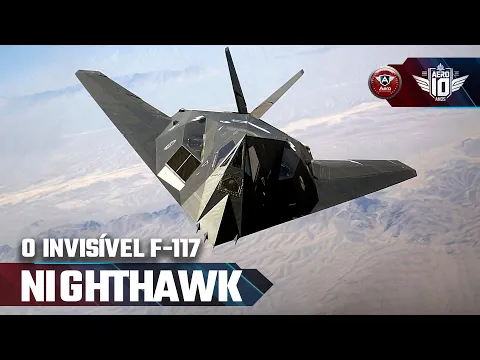
The result was not absolute invisibility, but something revolutionary for the time: the F-117 could bypass dense air defense systems without being detected in time to be intercepted.
Surgical Strike, Not Air Combat
The Nighthawk was not designed for dogfights. It did not carry cannons, air-to-air missiles, nor did it have great maneuverability. Its mission was different: deep penetration into enemy territory, attacking high-value strategic targets, and exiting without being seen.
Equipped with laser-guided bombs, the F-117 became a precision strike platform, capable of destroying bunkers, command centers, radars, and critical infrastructure with a few aircraft, something unthinkable in previous doctrines that relied on large formations and heavy escorts.
The Combat Debut That Shocked the World
The crowning achievement of the F-117 came during the Gulf War in 1991. While hundreds of coalition aircraft operated under constant threat from anti-air missiles, the Nighthawk conducted nighttime missions over Baghdad, one of the most defended cities on the planet at that time.
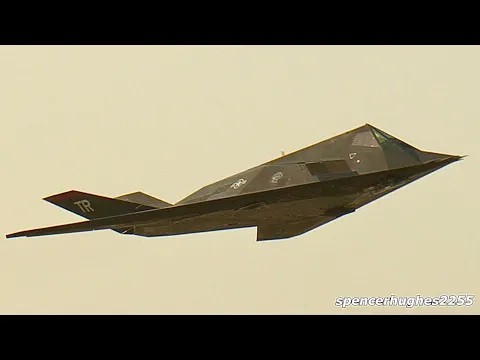
Even flying repeatedly over highly protected zones, the F-117 maintained an impressive survival rate. It demonstrated, in practice, that stealth could replace quantity, profoundly changing the way air wars would be planned from then on.
Limitations, Fall, and Lessons Learned
Despite its success, the F-117 was not invulnerable. In 1999, during the Kosovo War, one unit was shot down by Serbian defenses that exploited predictable flight patterns and stealth limitations against low-frequency radars.
The incident did not invalidate the concept, but it showed that stealth is not magic, but rather a tactical advantage dependent on doctrine, planning, and surprise.
With the advancement of more versatile stealth aircraft, like the B-2 Spirit and later the F-22, the Nighthawk began to be phased out. In 2008, it was officially retired from active service.
The Legacy of an “Impossible” Aircraft
The impact of the F-117 goes far beyond its operational life. It proved that computers could compensate for poor aerodynamics, that stealth was a real strategic weapon, and that the future of military aviation would not be defined solely by speed or maneuverability.
Every modern stealth fighter carries part of the Nighthawk’s DNA. The aircraft that “could not fly by itself” paved the way for an era where air warfare would be conducted, above all, in the invisible spectrum of sensors and algorithms.




Fez tudo isso, até que um equipamento obsoleto derrubou ele