






 Portuguese
  Spanish


Amid the advance of desertification and pressure on agricultural areas, Ethiopia has turned reforestation into a large-scale national policy, with billion-dollar goals and public mobilizations accompanied by international organizations.
The restoration of forests has become one of Ethiopia’s main strategies to recover degraded soils, reduce the effects of desertification, and enhance the country’s ability to face extreme climate events.
Within this strategy, the Ethiopian government implemented the Green Legacy, a national program that combines seedling planting, landscape recovery, water conservation, and protection of vulnerable areas.
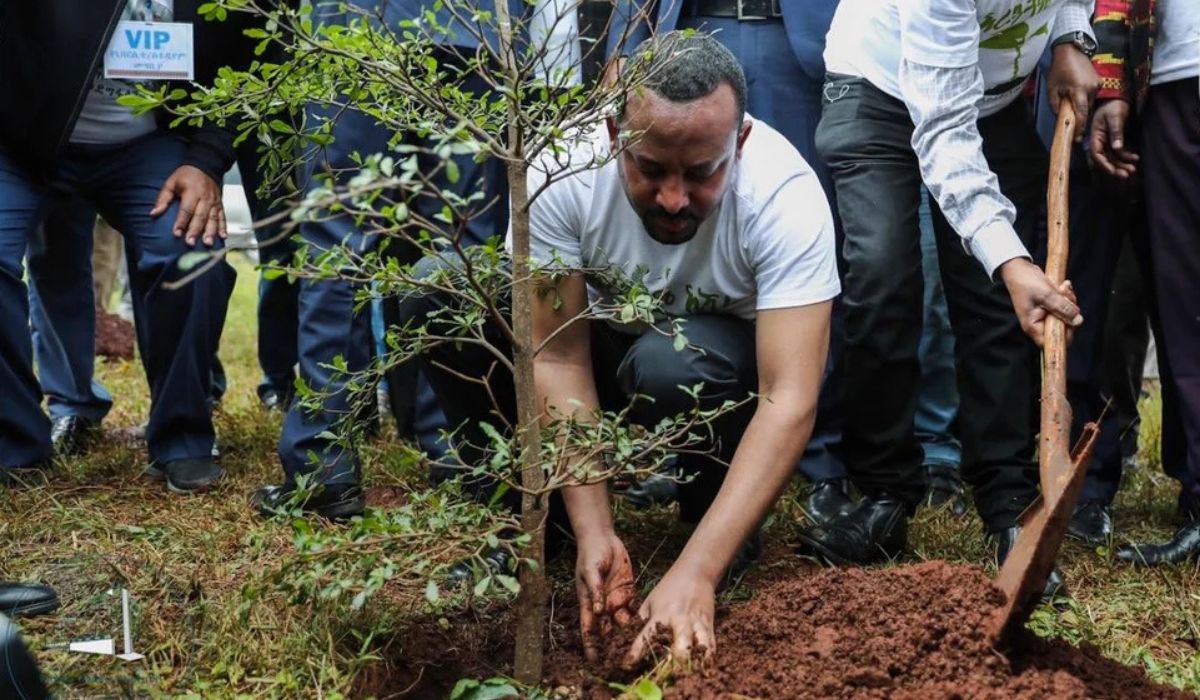
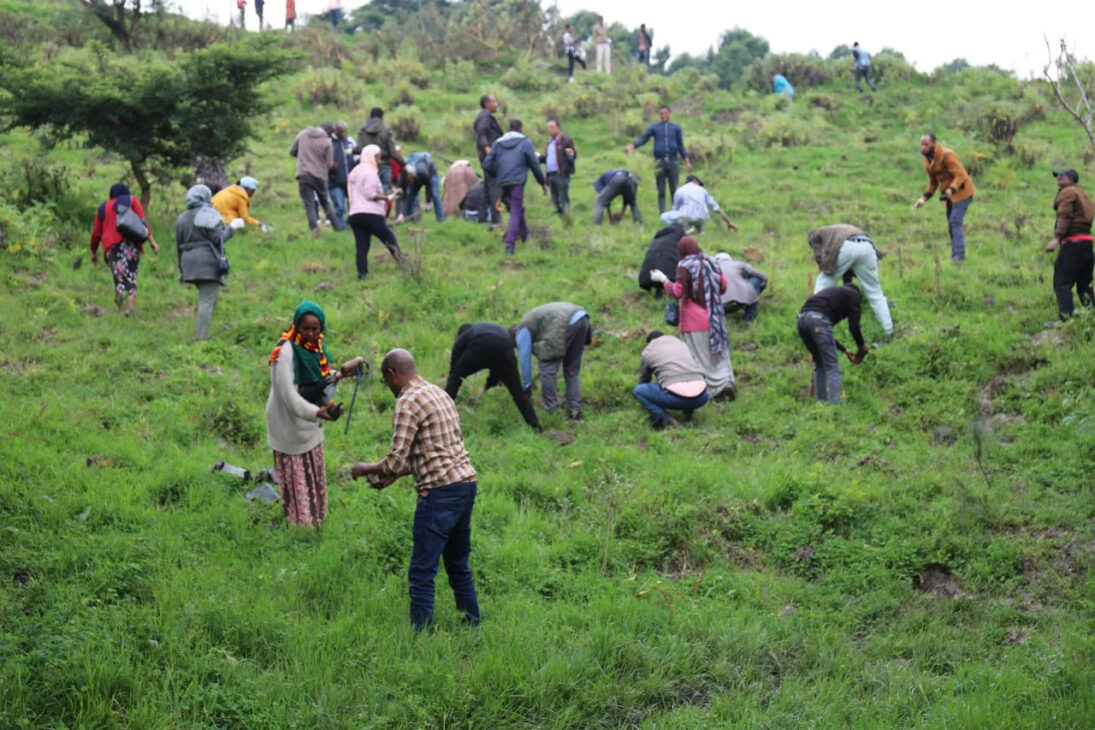
One of the most well-known episodes of this policy occurred in July 2019, when Ethiopia announced the planting of more than 350 million seedlings in 12 hours during a mobilization held at more than a thousand locations across the country.
-
Crab Trapped in Plastic Bottle for 62 Days Near Okinawa Highlights Little-Known Impact of Marine Pollution on Small Animals

-
Esperanza’s Bamboo Barrier in Oaxaca Redirects River and Reduces Erosion by 85% in Five Years

-
Family Builds Homemade Wind Turbine to Power Off-Grid Home, Video Reaches 555,000 Views on Ngô Thị Huyền’s Channel
-
Indian Brand Creates Sneakers from Recycled PET Bottles and Discarded Tires, Repurposing Over 1 Million Bottles and Raising $4 Million for Expansion



The action was presented by the Ethiopian government as part of a campaign to recover degraded areas, reduce soil erosion, and tackle the effects of desertification.
According to the World Economic Forum, the result exceeded the initial goal, which was to plant 200 million seedlings in a single day.
The mark also surpassed the record attributed to India, which had planted 66 million trees in 12 hours in 2017, according to the same entity.
The effort involved volunteers, public servants, students, religious communities, and residents from different regions of Ethiopia.
In parts of the country, classes and work were suspended to increase public participation during the rainy season, a period considered more favorable for planting.
Green Legacy brought reforestation to a national scale
The Green Legacy was launched by Prime Minister Abiy Ahmed Ali, who took office in Ethiopia in 2018.
The official proposal brings together actions of reforestation, recovery of degraded landscapes, water conservation, soil protection, and planting of forest, fruit, agroforestry, and ornamental species.
The campaign gained international visibility because it was carried out in a country with a history of droughts, pressure on rural areas, and strong dependence on agriculture.
Ethiopia has more than 120 million inhabitants, and a large part of the population depends directly or indirectly on agriculture for income and food.
Abiy Ahmed also gained international recognition in 2019 when he received the Nobel Peace Prize.
The award recognized efforts in international cooperation and, in particular, the initiative to seek a solution to the border conflict between Ethiopia and Eritrea.
Loss of forests helps explain the scale of the program
The loss of forest cover is one of the factors that help explain the scale of the program.
According to a survey cited by the World Economic Forum based on the organization Farm Africa, Ethiopian forests once covered about 35% of the territory at the beginning of the 20th century.
In later periods, this percentage dropped to less than 4%.
Among the causes cited are agricultural expansion, logging, population growth, and the use of firewood as an energy source.
These factors increased pressure on natural areas and contributed to soil degradation in different regions of the country.
The removal of vegetation also reduces the soil’s ability to retain water and can increase erosion processes.
In rural areas, this scenario affects agricultural productivity and increases the vulnerability of communities that rely on the land for food production.
The United Nations Food and Agriculture Organization reported in February 2026 that Ethiopia has advanced in monitoring emissions and removals of greenhouse gases related to deforestation, forest degradation, reforestation, and afforestation.
National reports are used to measure the country’s results between 2018 and 2022.
Goal of 50 billion trees underwent updates
The 2019 campaign was presented by the government as a stage of a broader program.
That year, the goal was to plant four billion seedlings by the end of the rainy season in October, with the participation of civilians, public servants, and local organizations.
In the following years, the Ethiopian government maintained new rounds of mobilization.
In July 2025, the Associated Press reported that the country launched a national campaign to attempt to plant 700 million seedlings in a single day under the Green Legacy.
On the same occasion, Ethiopian authorities stated that about 40 billion seedlings had been planted since 2019 and that the goal for that year was to reach 7.5 billion.
These numbers are attributed to the Ethiopian government and depend on technical monitoring to assess the real effect on environmental restoration.
Experts consulted by the Associated Press highlighted that planting alone does not guarantee reforestation.
For the initiative to produce lasting results, it is necessary to monitor the survival of the seedlings, select suitable species for each area, preserve biodiversity, and maintain management actions after planting.
This caveat is relevant because some of the seedlings may die due to lack of water, competition with other plants, insufficient management, or unfavorable climatic conditions.
For this reason, the evaluation of a forest restoration policy depends not only on the number of seedlings planted but also on the permanence of the trees over the years.
Environmental fund seeks to sustain restoration
The United Nations Environment Programme stated in 2026 that Ethiopia is already facing impacts associated with climate change, such as rising temperatures, irregular rainfall, recurring droughts and floods, and land degradation.
The agency also announced an initiative of US$ 9.8 million to strengthen climate resilience linked to the Green Legacy, in partnership with the Ethiopian government and environmental institutions.
In a statement cited by UNEP, Ato Kebede Yimam, director-general of the Ethiopian Forestry Development, stated that the initiative seeks to strengthen ecosystems, create green jobs, improve food security, and increase the participation of women and youth.
The statement shows how the program has come to be presented by authorities and international organizations as a climate adaptation policy, not just as a planting campaign.
In addition to social mobilization, Ethiopia has created mechanisms to finance the restoration of degraded areas.
The World Resources Institute reported that the Ethiopian Parliament approved, on December 24, 2024, a special fund for landscape restoration, allocating 0.5% to 1% of the annual federal budget.
The estimated amount associated with the measure is about US$ 40 million to US$ 80 million per year for environmental restoration actions.
The funding is pointed out by experts as one of the necessary points to transform planting campaigns into permanent landscape recovery programs.
Survival of seedlings remains a central point
The announcement of 350 million seedlings in 12 hours made Ethiopia an international reference in mass planting campaigns, according to organizations that followed the case.
At the same time, the episode also raised technical questions about independent verification, seedling survival rate, and effective long-term environmental impact.
According to the World Economic Forum, studies published in the journal Nature estimate that about 15 billion trees are cut down each year worldwide.
The entity also cites data from WWF linking deforestation to more than 15% of global greenhouse gas emissions.
In this context, forest restoration initiatives have become part of national strategies to tackle the climate crisis.
Conservation experts, however, often point out that reforestation needs to occur alongside the protection of existing forests, reduction of deforestation, and cutting greenhouse gas emissions.
The target of 50 billion trees appears in public sources with different deadlines.
The Associated Press reported in 2025 that the Green Legacy aimed to reach 50 billion trees by 2026.
Meanwhile, the World Resources Institute, also in 2025, cited the target of 50 billion by 2030, with more than 32 billion seedlings planted by then.
The Ethiopian experience brings together popular mobilization, public funding, environmental monitoring, and large-scale restoration goals.
The data that still needs monitoring is the survival of the planted seedlings and how much they can actually convert into lasting forest cover.


