






 Portuguese
  Spanish
  5 min of reading
  0 comments


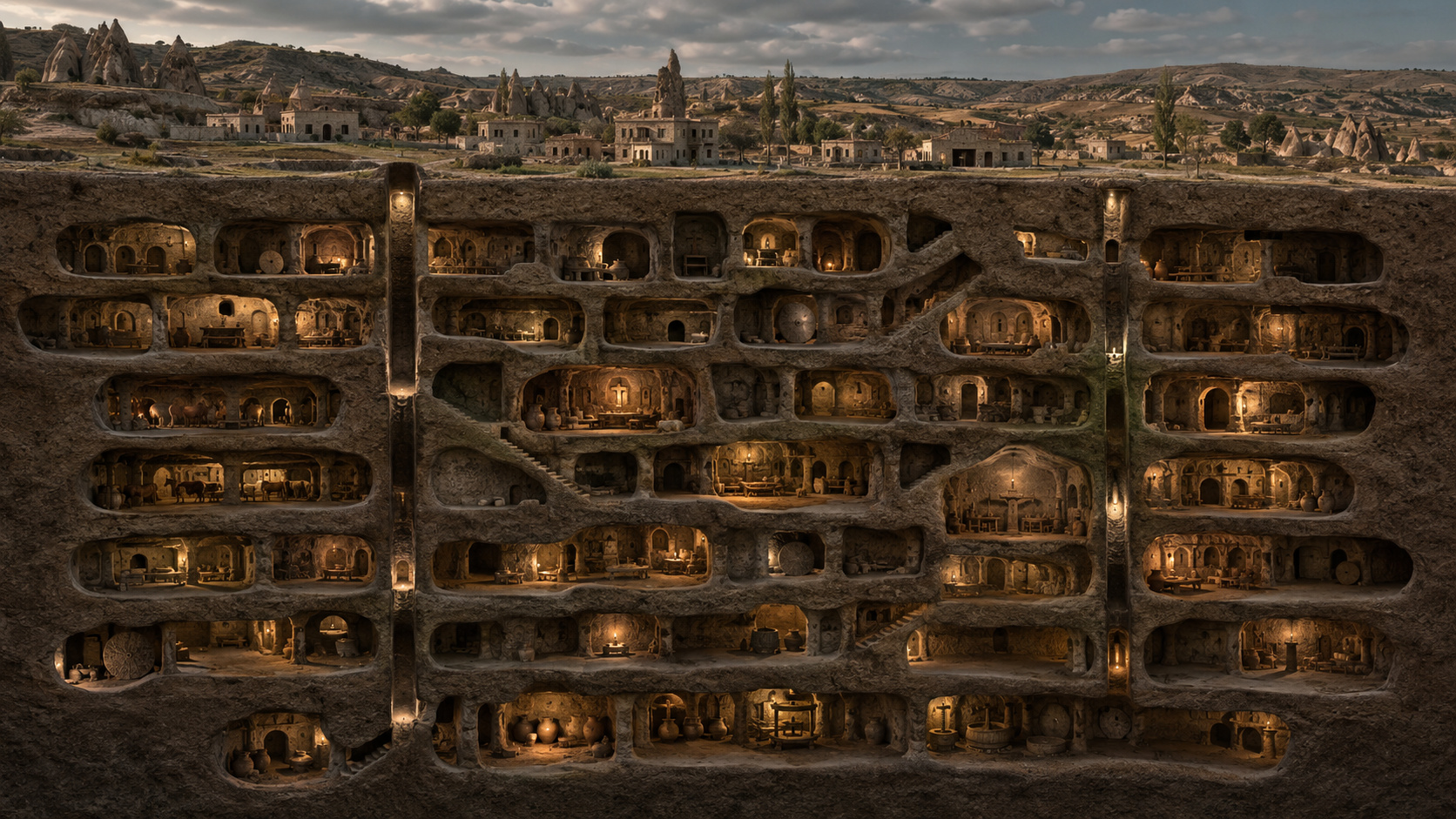
Derinkuyu, in Cappadocia, was rediscovered in 1963 and impresses with up to 18 levels, 85 meters deep, and space for 20,000 people.
In 1963, a resident of Derinkuyu, in the Cappadocia region of Turkey, was demolishing a wall in his basement when he found an unexpected passage. The opening led to corridors, chambers, and tunnels that revealed a vast underground city, described by Atlas Obscura as large enough to house up to 20,000 people, with up to 18 levels below the surface. The complex is now known as one of the most impressive archaeological discoveries ever made by chance.
The strength of this discovery lies not only in the chance of the hammer blow but in what it brought to light: an underground system carved into the heart of a volcanic landscape that, according to UNESCO, is part of one of the largest and most remarkable sets of rock-carved dwellings in the world. In Derinkuyu, the underground was transformed into a refuge, infrastructure, and survival strategy in a region that lived under military pressure and displacements over the centuries.
Hammer blow in the basement revealed an underground city hidden for centuries in Cappadocia
According to Atlas Obscura, the discovery happened when an anonymous resident broke through a basement wall and found a tunnel leading to new corridors and halls. The publication states that the complex was rediscovered in this way in 1963, and that the underground city had been abandoned and forgotten for generations, even while remaining beneath seemingly ordinary houses in the modern city.
-
Mother of 5 children started selling homemade pamonha door-to-door and today earns about R$ 250,000 per month with a factory that produces 1,500 units per day and sells to several Brazilian states.

-
The shortcut that Greece dreamed of for 2,000 years cuts through a strip of rock in the Mediterranean, connects two seas, and still impresses ships that pass squeezed between the stone walls.
-
Traffic sign with two cars together, white background and four diagonal lines: see what it means
-
Carrefour chain exits, and a new supermarket chain enters with R$ 25 million in a traditional building, generating 150 jobs and a plan of R$ 433 million to grow in wholesale retail in Porto Alegre.


What emerged from this find was a space much larger than a simple hideout. Atlas Obscura describes Derinkuyu as an underground city capable of accommodating 20,000 people, while the official portal Turkish Museums, linked to Turkey’s museum system, reports that the site reaches about 85 meters deep.
The combination of human scale and depth helps explain why Derinkuyu has become the most well-known symbol of Cappadocia’s underground cities.


More than an archaeological curiosity, the discovery revealed an extremely sophisticated model of underground occupation.
Instead of small isolated caves, Derinkuyu exposed a planned complex, with residential, defensive, religious, and storage functions, excavated in a way to support an entire community below ground.
Volcanic rock of Cappadocia allowed the excavation of tunnels, churches, and dwellings underground
UNESCO explains that Cappadocia is set in a volcanic landscape shaped by erosion, famous for the so-called “fairy chimneys” and its rock formations carved over the centuries. Atlas Obscura details that the region was covered by deposits of volcanic ash that turned into tuff, a relatively soft rock for excavation and, at the same time, stable enough to support large underground structures.
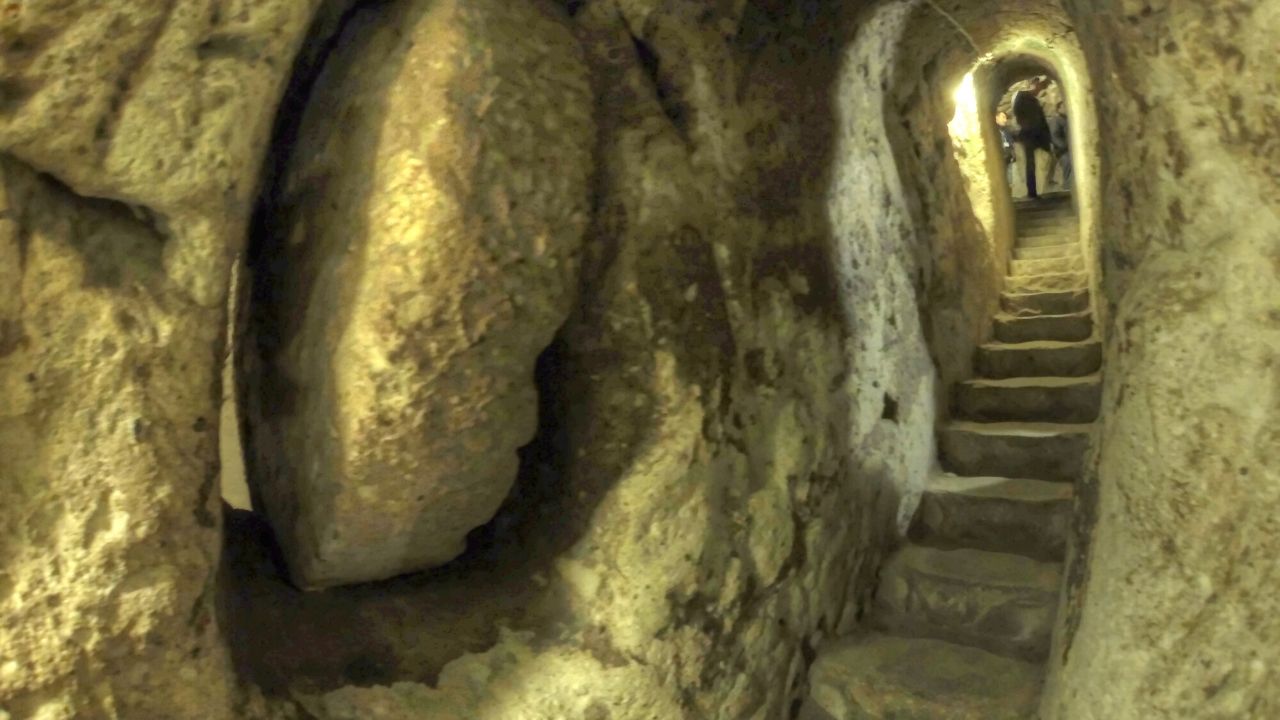
This geological condition was decisive for the emergence of underground cities like Derinkuyu. UNESCO states that Christian communities in the region began to gather in troglodyte villages and underground cities to resist invasions, especially during the period of Arab pressure.
The ease of excavating the rock, combined with the need for protection, transformed the underground into an architectural and military solution.
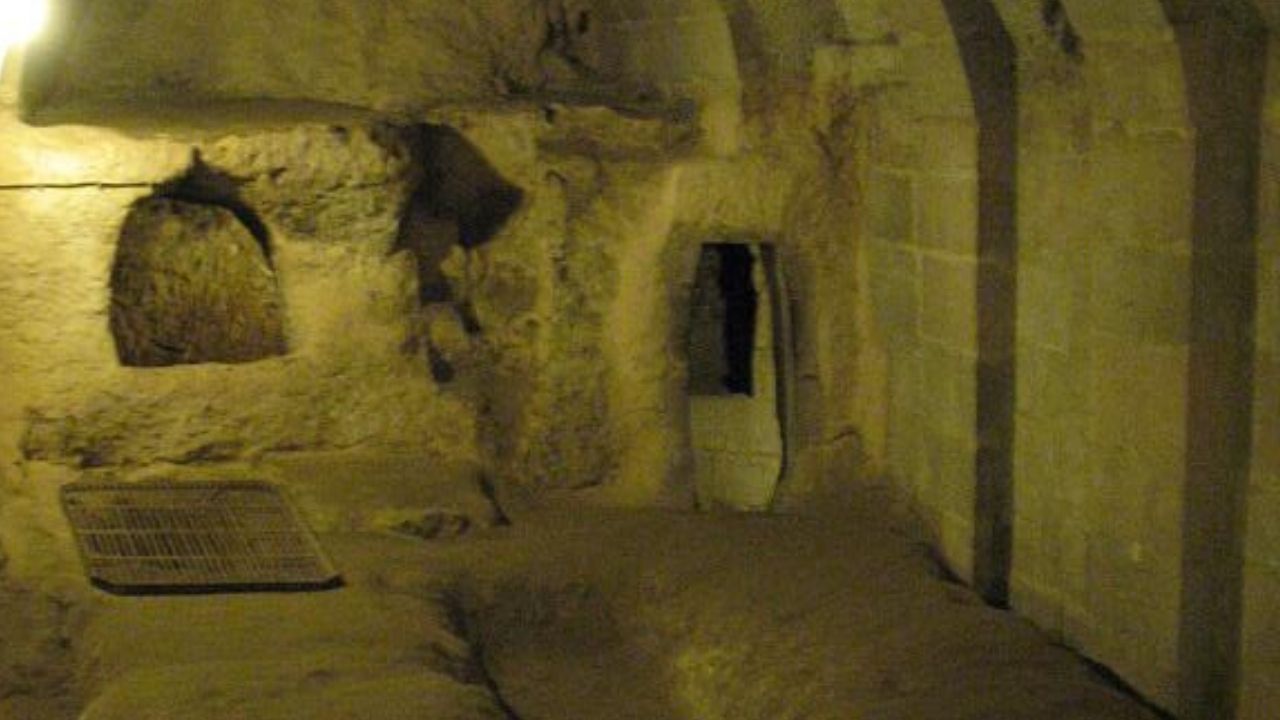
The exact origin of the first excavations is still not a consensus. Atlas Obscura notes that the historical record about Derinkuyu is not definitive and mentions hypotheses ranging from the Hittites to the Phrygians, as well as later expansions linked to Christian communities. What appears more confidently in the sources is that the complex was used and remodeled by different groups over time.
Derinkuyu had a school, church, water wells, and stone doors against invaders
The official portal Turkish Museums informs that Derinkuyu gathers typical elements of a complete underground city, with stables, wine cellars, church, food preparation areas, and even a missionary school on the second floor, whose barrel-vaulted ceiling is described as unusual for this type of structure. The same text also highlights a cross-shaped church on the lower levels and records that only 10% of the complex opened in 1965 can be visited today.
The defensive logic of the city is also impressive. According to Atlas Obscura, Derinkuyu had enormous circular stone doors that could be rolled from the inside to block passage, while the Turkish Museums site mentions large stone cylinders used to seal the tunnels. The narrow architecture of the passages and the internal closure made the city a difficult refuge to invade.
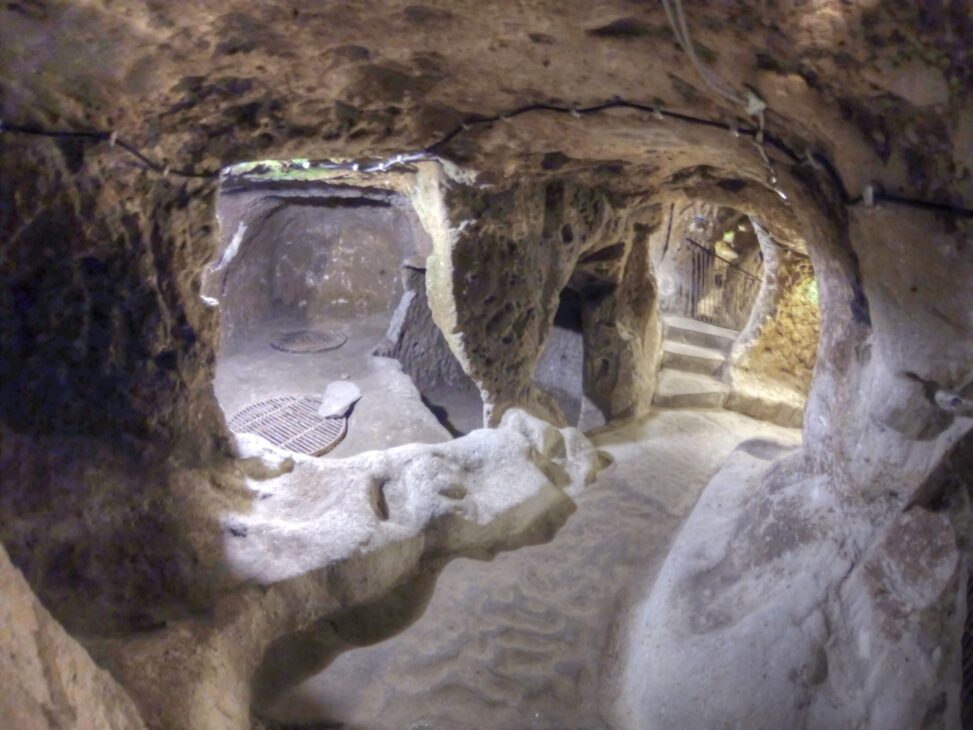
The water and ventilation infrastructure was another crucial point. Turkish Museums reports that a ventilation shaft about 55 meters also functioned as a water well, and that some wells were designed to avoid poisoning during sieges.
This shows that Derinkuyu was not just an emergency hideout, but a structure designed to sustain prolonged underground permanence.
The underground city of Derinkuyu became one of the most impressive archaeological sites in Turkey
Today, Derinkuyu is part of the Göreme National Park and the Rock Sites of Cappadocia, inscribed by UNESCO as a World Heritage Site in 1985.
The organization includes Derinkuyu and Kaymaklı among the underground cities that help make Cappadocia one of the most remarkable complexes of rock-carved dwellings on the planet.

The archaeological significance of Derinkuyu lies precisely in the combination of factors that rarely appear together on the same scale: accidental discovery, extraordinary depth, defensive architecture, internal infrastructure, and prolonged historical use.
What began with the demolition of a common wall revealed a buried city that helps explain how ancient peoples transformed the geology of Cappadocia into defense, shelter, and collective survival.


Be the first to react!