






 Portuguese
  Spanish
  6 min of reading
  0 comments


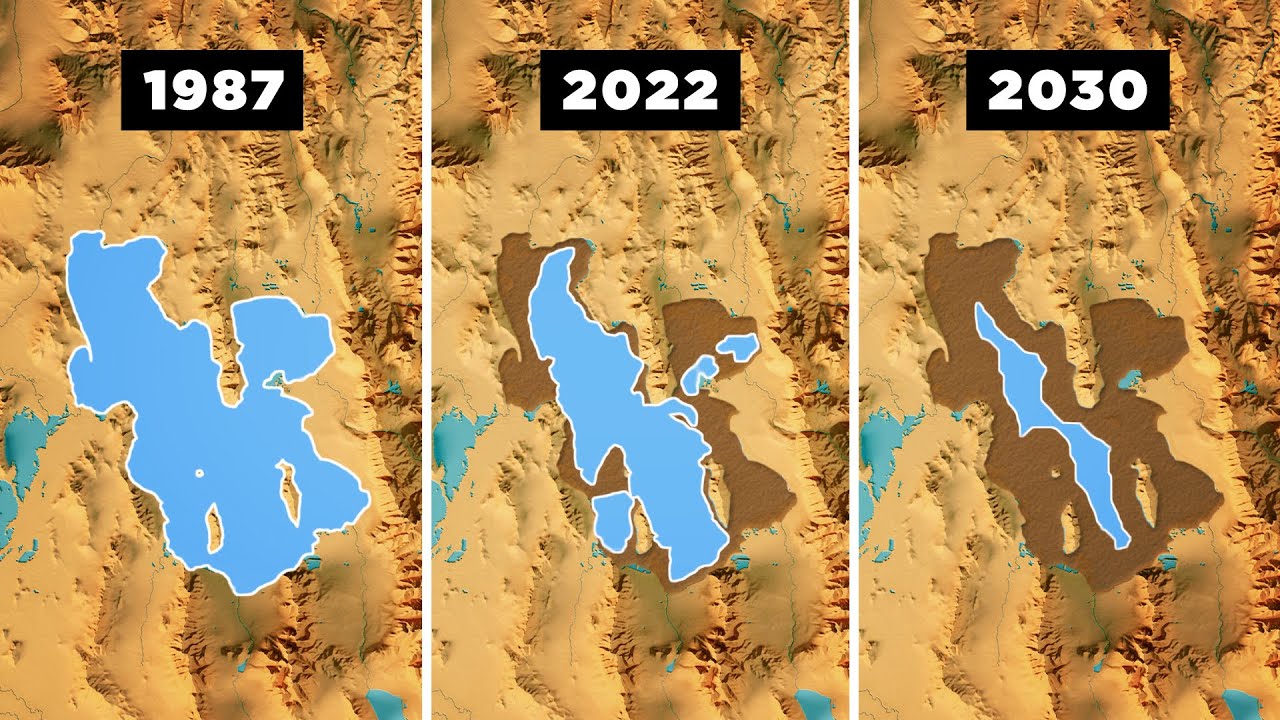
Great Salt Lake lost 73% of water, exposes dust with toxic metals and threatens birds, economy, and public health in Utah.
The Great Salt Lake of Utah has entered a critical phase that can no longer be treated as a natural fluctuation of a lake in an arid region. Researchers associated with Brigham Young University stated in a January 2023 report that the lake had already lost 73% of its water and 60% of its surface area, while Utah’s official state portal describes the scenario as a direct threat to the environment, economy, and air quality of the region.
The problem is no longer just the water recession. As the lake shrinks, the dry bed becomes more exposed to the wind, salinity rises, the base of the food chain collapses, and the risk of contaminated dust advances over a densely populated area in northern Utah. The USGS, United States Geological Survey, states that this dust may pose a health risk, especially in communities near the lake and among young children.
Great Salt Lake of Utah already operates below the range considered healthy
The most forceful warning came from the report “Emergency measures needed to rescue Great Salt Lake from ongoing collapse,” published by Brigham Young University.
-
Children give more meaning to life, but not more happiness: study with over 5,500 people in 10 countries reveals surprising discovery about well-being, relationships, and the true impact of parenting throughout life.

-
New Philips Air Fryer Series 4000 arrives with only 24 cm in width, vertical dual basket, and technology that synchronizes the preparation of two different dishes to be ready at exactly the same time.
-
Owner of a 980 m² house in Paraná installs 48 solar panels for R$ 70,000 and sees electricity bill drop from R$ 1,200 to around R$ 200 per month.

-
The largest supermarket chain in the country, Mercadona, opens a semi-automated warehouse worth R$ 320 million with 70 robots and 32,000 m², where products go to employees to speed up to 5,000 orders per day in the new Vallecas hive.




The document states that, at the observed rate of loss, the lake “as we know it” could disappear in five years, attributing the collapse mainly to excessive water use in the basin, exacerbated by drought and warming. The same report says that the lake has been recording an average deficit of 1.2 million acre-feet per year since 2020.


The official strategic plan of the state reinforces that the lake needs to return to the range of 4,198 to 4,205 feet above sea level to be considered healthy.
Below 4,192 feet, the document classifies the situation as having severe adverse effects. In January 2024, the plan itself recorded the lake around 4,192.5 feet, still outside the healthy zone.
This framing is decisive because it changes the reading of the phenomenon. It is not just a lake smaller than normal, but an ecological system that has already entered a degraded operational level, with cascading impacts on water, air, biodiversity, and the regional economy.
Dry bed with arsenic, lead, and other metals turns lake recession into an air threat
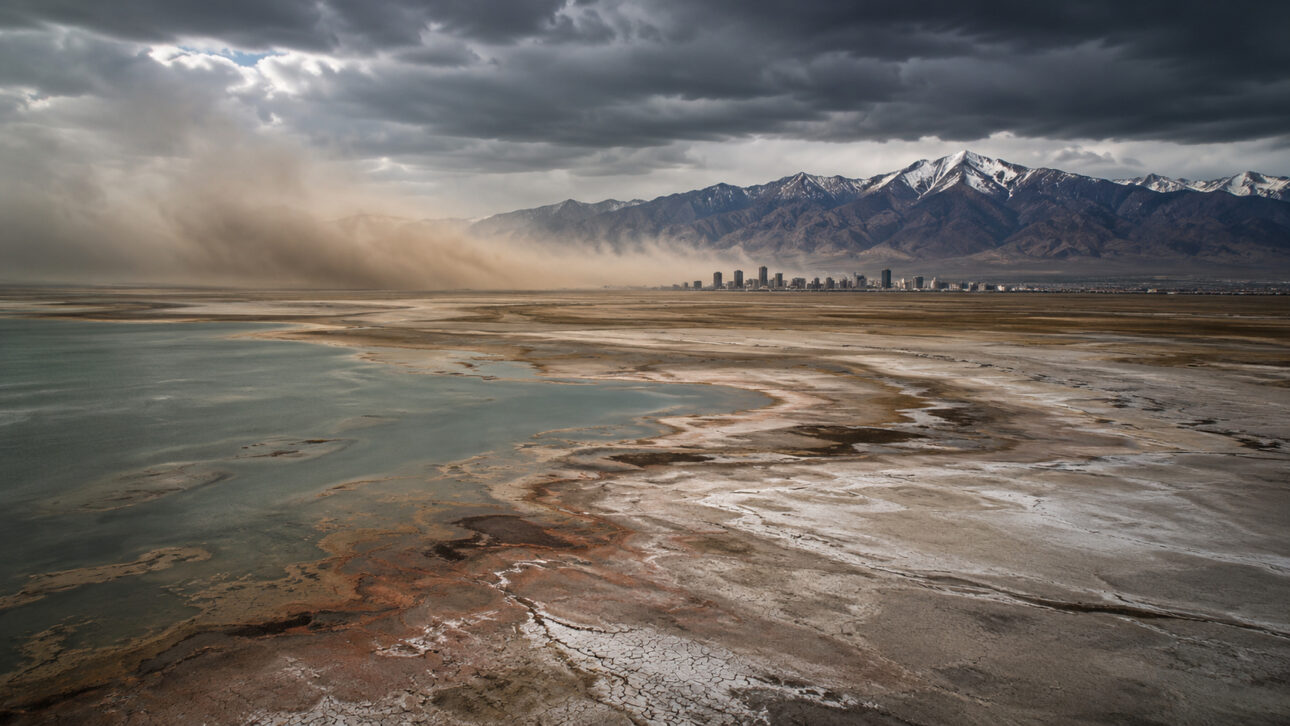
The most concerning part of the crisis is not just the water that disappeared, but what was left on the ground. The BYU report states that sediments from the Great Salt Lake have already recorded pollutants such as arsenic, cadmium, mercury, nickel, chromium, lead, copper, and selenium, among other contaminants.
According to researchers, these substances can be carried by dust particles smaller than 10 microns, small enough to easily circulate through the air.

The USGS adds that the exposed bed, especially in the regions of Farmington Bay and Bear River Bay, is concerning due to its proximity to population centers and the legacy of pollution associated with mining, treatment plant discharges, and agricultural runoff.
The agency states that the science on the exact effects of this dust on human health is still developing, but there is already evidence that it may contribute to health risks in northern Utah communities.
Among the points already identified, the federal agency highlights the greater vulnerability of children under 6 years old in scenarios of high soil and dust ingestion. The USGS also states that reducing the lake’s drying can have a direct effect on decreasing exposure to metals carried by dust.
High salinity threatens the base of the food chain and puts millions of migratory birds at risk
The recession of the Great Salt Lake affects not only the water volume but also alters the system’s chemistry. The official Utah portal informs that for the ecosystem of the lake’s southern arm to function properly, salinity should be between 120 and 160 grams per liter.
In the fall of 2022, however, this index reached 185 g/L, a level that the state’s strategic plan associates with clear signs of food web collapse.

This change is critical because organisms like brine shrimp and brine flies sustain a large part of the fauna that depends on the lake.
The state itself states that these small organisms are an essential food source for migratory birds and that, without them, long migrations would simply not be possible.
The potential impact is continental. Utah’s strategic plan reports that the Great Salt Lake receives 10 to 12 million birds per year, from 338 species, and functions as a vital link in the Pacific Flyway, the migratory route between North and South America. When the lake’s food base collapses, the problem ceases to be local and threatens an ecological mechanism on a hemispheric scale.
Lake crisis threatens jobs, wetlands, and part of Utah’s economy
The lake also supports significant economic activities. The BYU report estimates about $2.5 billion in direct economic activity per year, while the state’s strategic plan points to a historical contribution of over $1.3 billion annually and more than 7,700 jobs associated with the Great Salt Lake.
Although the surveys use different methodologies, they converge on a central point: the loss of the lake would not only be ecological but also economic.
The same BYU report states that the lake helps sustain 80% of Utah’s wetlands, while the state’s official portal describes the region as the largest concentration of vegetated wetlands in the state territory. This means that the shrinking of the lake simultaneously pressures habitat, biodiversity, recreation, salt mining, and air quality.
There is also a significant indirect effect on snow. The official Great Salt Lake portal reports that the so-called lake effect snow contributes 5% to 10% of Utah’s snow. In other words, the collapse of the lake threatens not only what is on its shore but also part of the climatic and economic regime of the surrounding mountains.
The solution exists but requires cutting consumption and returning water to the lake
The less complex side of this story is the diagnosis of the solution. For BYU researchers, the lake needs to receive about 1 million additional acre-feet per year to reverse its declining trajectory. The report states that this would require cutting water consumption in the basin by something between one-third and half, depending on future climatic conditions.
In Utah’s strategic plan, the logic is similar. The document shows that bringing the lake back to the lower limit of the healthy range, 4,198 feet, would require between 471,000 and 1.055 million acre-feet per year of additional water through conservation, depending on the recovery horizon and the hydrological scenario considered.
The collapse of the Great Salt Lake is not inevitable, but the cost of inaction grows as the lake loses water, exposes more sediment, and increases the risk of dust, extreme salinity, and ecological disruption.
As the USGS itself points out, the science on human impacts is still evolving, but there is already enough evidence to treat the problem as an ongoing environmental and public health crisis.





Be the first to react!