






 Portuguese
  Spanish
  5 min of reading
  0 comments


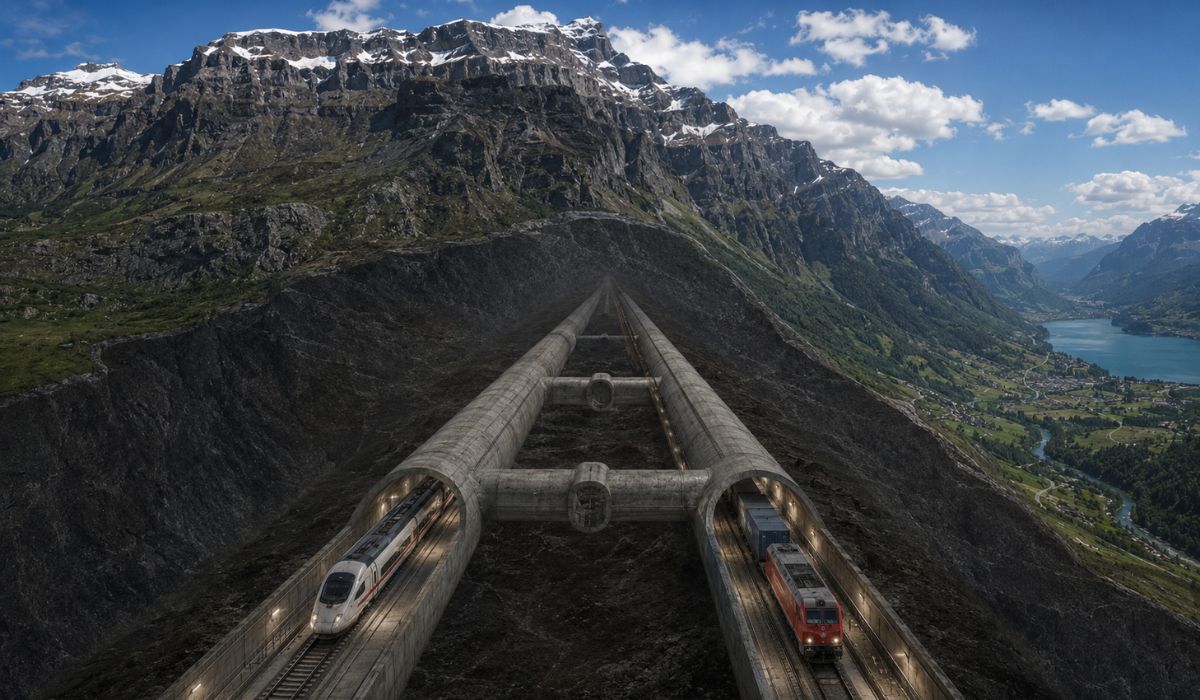
Under the Swiss Alps, a railway project crosses rocks, extreme heat, and decades of planning to connect strategic regions of Europe via a high-capacity underground route.
The Gotthard Base Tunnel in Switzerland is 57 kilometers long under the Alps and is touted by the Swiss government as the longest railway tunnel in the world.
The structure connects Erstfeld, in the canton of Uri, to Bodio, in the canton of Ticino, and began regular operation on December 11, 2016, after 17 years of construction, not counting exploratory work.
The passage changed the way passenger and freight trains cross the Swiss Alps.
-
With 1,415 m², a frontal view of the sea, and surrounded by skyscrapers, the mansion worth R$ 140 million bought by Luciano Hang is the last standing residence on the waterfront of the ‘Brazilian Dubai’ in Balneário Camboriú.

-
“Big Becky,” the 4,000-ton steel monster with the height of a four-story building, spent five years tearing through 10.2 km of solid rock beneath Niagara Falls to divert the river’s force and generate clean energy for 160,000 homes.

-
Humanoid robots appear on the streets of China asking for money with QR Code to pay for energy.

-
Luciano Hang buys for R$ 140 million the last mansion standing on the beachfront of the “Brazilian Dubai”: a 1,415 m² property with a front view of the sea, surrounded by skyscrapers in one of the most valuable square meters in the country, in Balneário Camboriú.



Before the new connection, a significant portion of the traffic relied on old mountain routes, with curves, ramps, and operational limitations.
With the base tunnel, trains began to use a lower, more direct route with less altitude variation.
The structure is part of the New Rail Link through the Alps, known by the acronym NRLA, a railway network also formed by the Lötschberg and Ceneri base tunnels.
According to the Federal Office of Transport, a Swiss government agency, the network’s proposal is to expand transalpine railway capacity, reduce travel times, and improve freight transport between northern and southern Europe.
Gotthard Tunnel created a more direct railway route through the Alps
The new connection reduced the railway route by about 30 kilometers between areas of the cantons of Uri and Ticino.
In a region marked by mountains, narrow valleys, and steep sections, this change had a direct effect on the circulation of trains crossing the alpine axis.
In freight transport, the route favors heavy compositions because it presents lower inclines than the old mountain lines.
As a result, trains can operate more regularly and, in certain sections, with less need for additional locomotives.
According to official project data, up to 260 freight trains can pass through the Gotthard Base Tunnel per day.
On the historic mountain route, the maximum capacity was 180 daily compositions.
The same documentation reports a capacity of up to 65 passenger trains per day in the tunnel.
Switzerland’s location also helps explain the corridor’s relevance.
The country is positioned between industrial regions of northern Europe and northern Italy, making the railway crossing through the Alps an important route for international freight transport.
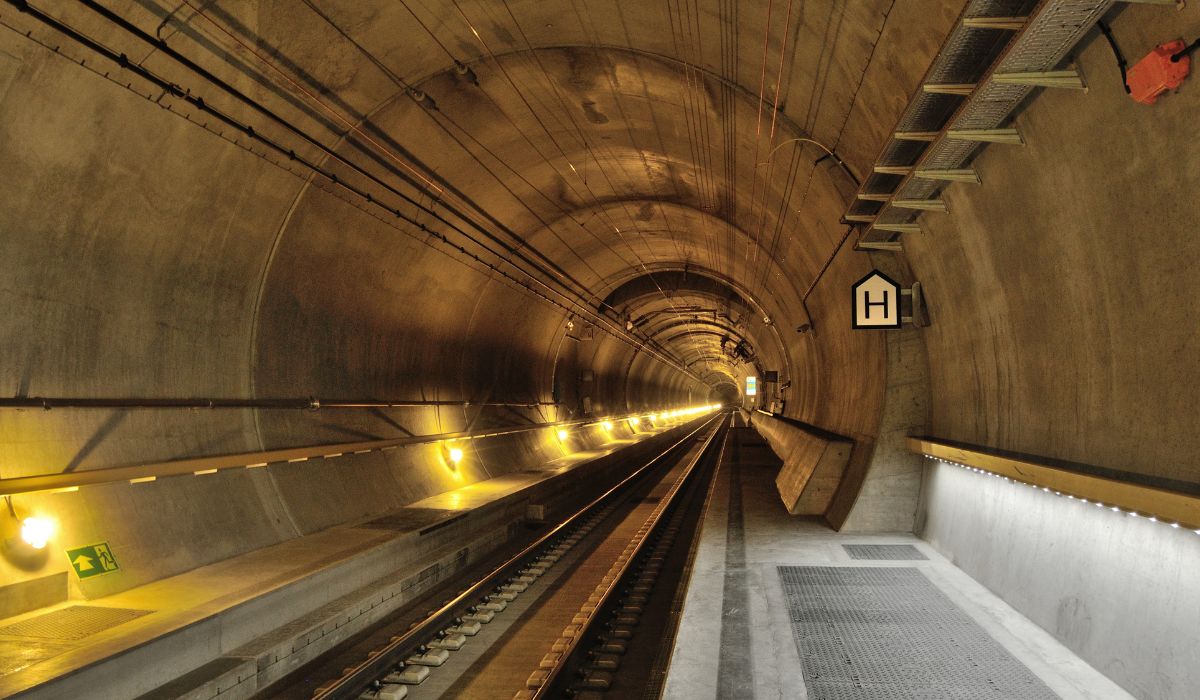
Underground structure has two parallel railway tubes
Although often referred to as a single passage, the Gotthard consists of two parallel railway tubes.
Each has one track and serves a main direction of circulation, which separates traffic flows and facilitates operational organization.
Between the two tubes, there are cross passages every 325 meters.
These accesses were designed for safety, evacuation, maintenance, and movement of technical teams if needed.
Adding up the main tunnels, accesses, safety passages, ventilation galleries, and other underground structures, the system reaches 152 kilometers excavated.
The main passage is 57 kilometers long, but the constructed set includes a larger network supporting railway operation.
The north portal is located in Erstfeld, in the canton of Uri.
The south portal is in Bodio, in the canton of Ticino.
Even crossing the Alps, the highest point of the tunnel is 550 meters above sea level, a level considered low for an alpine railway crossing.
Excavation faced 2,300 meters of rock and heat of 50°C
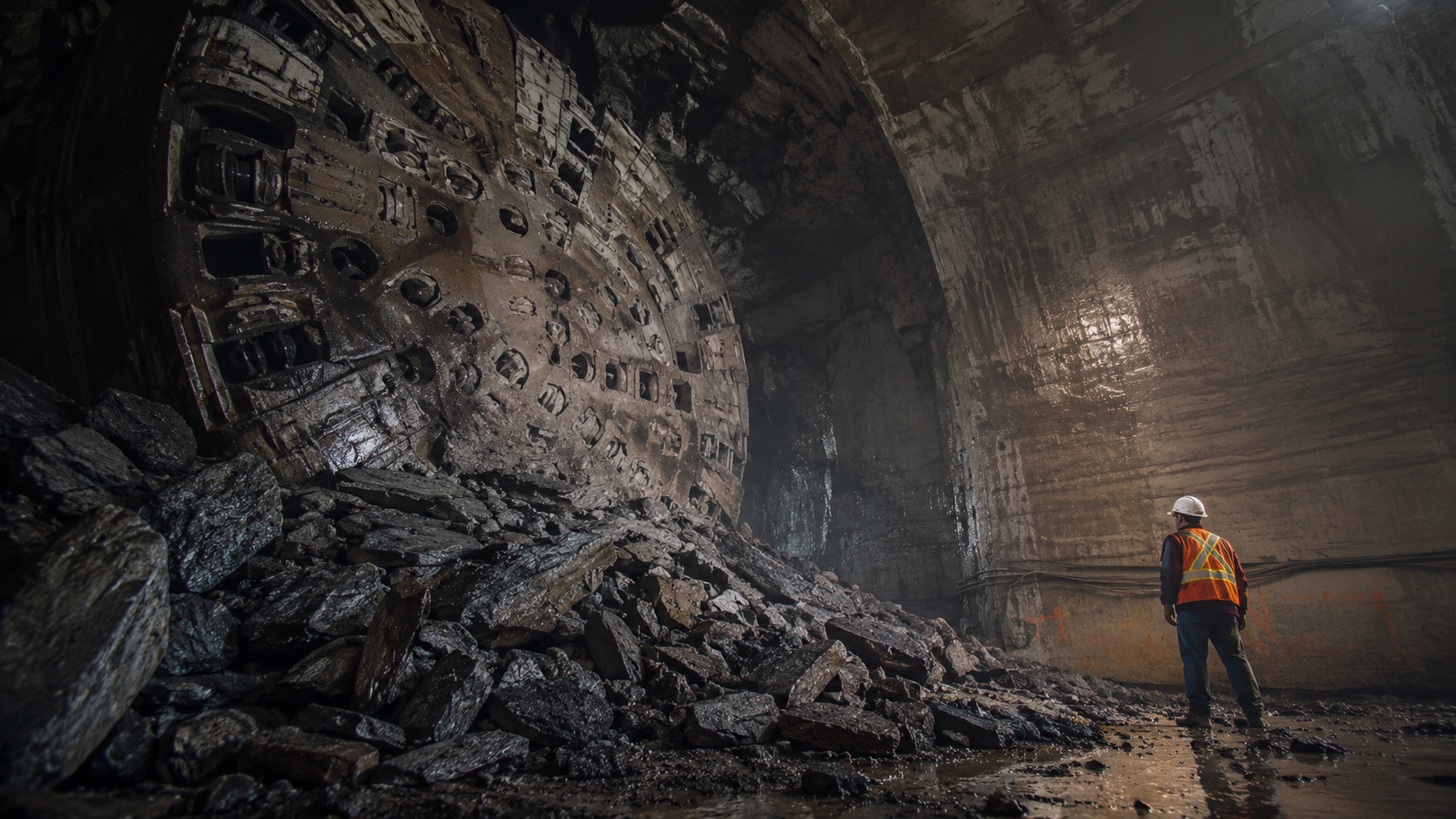
The construction combined mechanized excavation and conventional methods.
According to official technical material, tunnel boring machines accounted for 80% of the opening of the main tunnels, while the remaining 20% was executed with traditional techniques and controlled detonations.
Along the route, teams encountered different geological formations, including hard granite and more unstable sedimentary rocks.
In some points, there were even 2,300 meters of rock above the passage, a characteristic that also led the Federal Office of Transport to classify the Gotthard as the world’s deepest mountain railway tunnel.
Internal temperature was another technical challenge recorded by the project’s documentation.
During construction, the heat inside the mountain reached 50°C, which required ventilation and cooling systems in the deepest work fronts.
The progress of the excavation depended on constant monitoring of the terrain conditions.
Rock stability, drainage, concrete lining, and alignment of the work fronts needed to be monitored to reduce operational risks and avoid delays in execution.
Engineering precision guided the opening and operation of the tunnel
The Gotthard is often associated with engineering precision, but the rock was not cut by laser.
The main opening was carried out by tunnel boring machines and, in specific sections, by controlled detonations.
Lasers, sensors, and topographical surveys had another function: to measure, align, and control the dimensions of the work.
In a tunnel with dozens of kilometers, small accumulated deviations could compromise the meeting between the excavation fronts.
After the opening of the mountain, the same technical requirement extended to the railway systems.
Tracks, energy, signaling, drainage, communication, and emergency routes needed to follow defined parameters to allow the daily operation of the tunnel.
The system uses ETCS level 2 cab signaling, a technology adopted in European railways for continuous circulation control.
The programmed speed is 100 km/h for freight trains and up to 200 km/h for passengers, with a technical limit of 250 km/h for passenger compositions.

The project cost 12.2 billion Swiss francs
During construction, 28.2 million tons of excavated material were removed.
The effective cost of the Gotthard Base Tunnel reached 12.2 billion Swiss francs, according to official project data.
With the completion of the railway axis, including the Ceneri Base Tunnel, the journey between Zurich and Lugano became about 45 minutes shorter.
For passengers, the change reduced travel time between German-speaking Switzerland and Ticino.
For freight transport, the corridor began to offer a route with less interference from the limitations of the old alpine lines.
The ceremonial inauguration took place on June 1, 2016, with the presence of European authorities.
Regular operation began in December of the same year.
On September 2, 2024, the tunnel resumed operation without restrictions after repairs due to the derailment of a freight train that occurred on August 10, 2023, according to SBB, the Swiss railway operator.
Project integrates Swiss railway transport policy
The construction is also linked to public policy decisions approved by the Swiss population in votes.
Among them are measures related to the NRLA, the financing of railway modernization, and the levy on heavy vehicles.
The declared goal by the authorities was to shift part of the transalpine transport from roads to rails.
Overall, the Gotthard brings together an extensive underground structure, high railway capacity, and logistical function in a major European transit corridor.




Be the first to react!