Portuguese
  Spanish


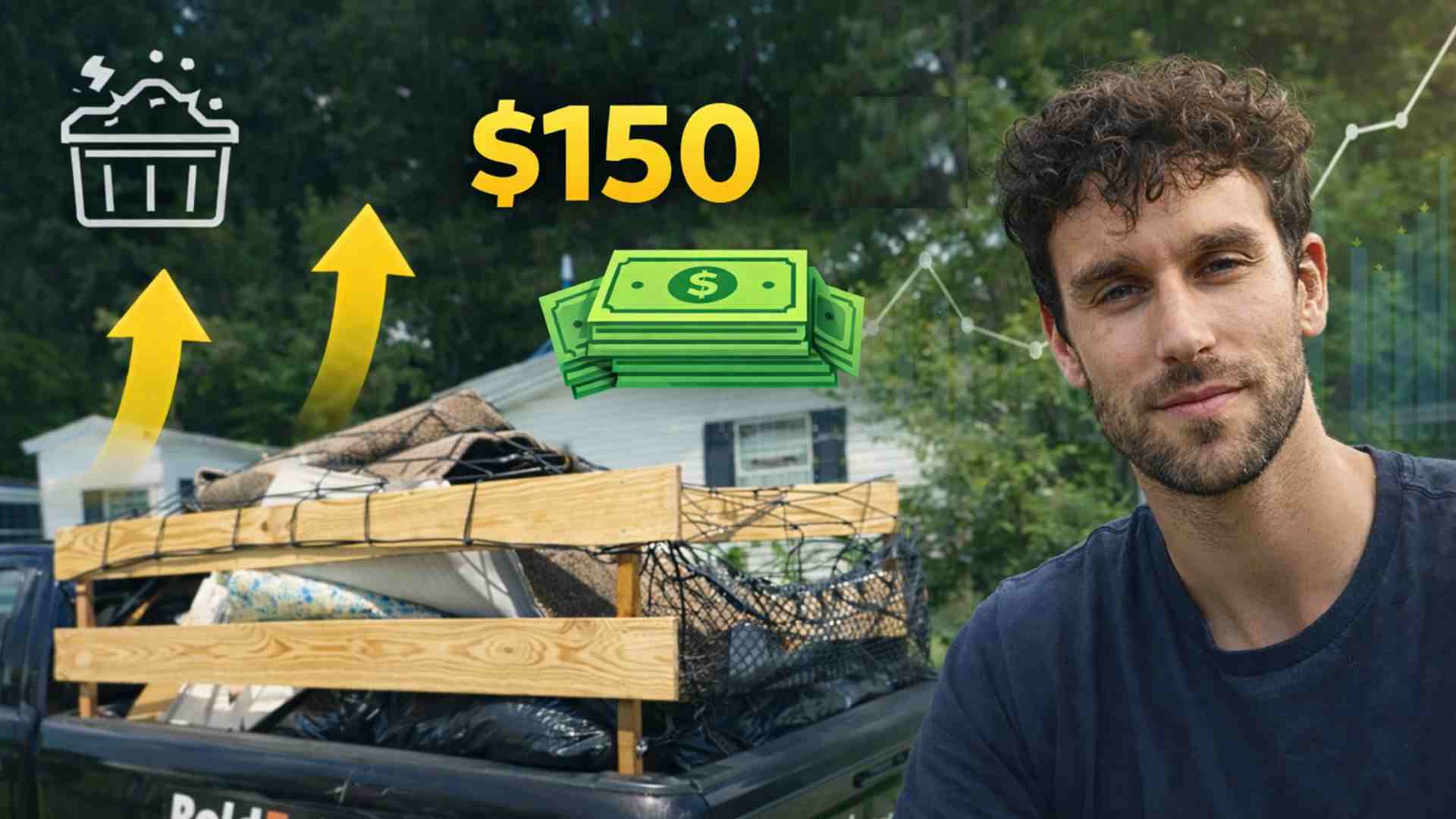

American Youtuber details how he entered the junk removal business without money, used free promotion, avoided debts in the beginning, and transformed a lean operation into a business that today earns about $150,000 a year in the United States
The American Youtuber Sam, from the Junk Removal Journey channel, presented a practical guide for those who want to enter the junk removal market in the United States, focusing on initial structure, quick customer acquisition, and financial control.
The central proposal is to start with a simple foundation, avoid costly mistakes, and use free promotion strategies before expanding the operation.
Sam stated that when he created his junk removal company about two years before the recording, he didn’t know which path to take to gain customers and expand the business.
-
Major Appliance Manufacturer Closes Factory in Argentina, Shifts Production to Brazil, and Restructures in Latin America with Mexico Closure, Investing Up to $165 Million

-
China to Revive $3.6 Billion Mega-Dam Project in Myanmar, Stalled Since 2011, Promising 6 GW Capacity and Completion in Eight Years

-
Foreign Company Wins Auction for Brazil’s First Immersed Tunnel, a $1.3 Billion Project with $14 Million Contract Under Federal Investigation

-
China’s Century Megaproject Wows the World: Massive Water Transfer Network Moves Water from Wet South to Arid North, with Ambitious Plans in the Tibetan Plateau Involving Giant Tunnels at Altitudes up to 4,000 Meters




He reported that he wasted time, energy, and money by betting on the wrong paths before finding a more efficient way to operate.
At the beginning of the explanation, he set aside broader legal details and summarized this step into two basic measures. The guidance was to open an LLC and obtain insurance to avoid severe losses in case of damages during the service, such as an accident on a hardwood floor valued at $50,000.
Google Business Profile and the first steps of junk removal
After the basic formalization, Sam pointed out the Google business profile as the most important first move for those starting in junk removal. The justification is that the first customers are worth more than immediate payment because they help build public reputation and trust for future hires.
He shared that at the beginning of the company, he often broke even on some jobs. Even so, he made it a point to ask for reviews on Google, as these opinions became decisive throughout the business journey and, in many cases, directly influenced the customer’s choice between his company and the competition.
The logic presented is that junk removal heavily relies on trust, especially for those who have not yet built a name in the market. Therefore, each initial service serves a dual purpose: it generates immediate revenue and strengthens the digital presence that can open new doors later on.
What vehicle to use to start in the business
When discussing the choice of vehicle, Sam said he had seen professionals using various types of trucks and vans for junk removal. Still, he recommended starting with a model that allows for future growth, rather than investing in something limited right from the start.
He reported that he started with a newer Ram 1500, equipped with a V6 engine, without understanding much about trucks. The experience was frustrating because, in practice, the vehicle had little power, and this mistake highlighted the importance of considering work capacity before making a purchase.
His recommendation is to look for a vehicle that can tow at least 10,000 pounds in the future. Sam explained that, in this type of activity, the trailer will typically not be loaded with more than 4,000 to 6,000 pounds, while the dump trailer he uses weighs about 4,400 pounds, making this capacity a conservative margin.
Among the models mentioned, he said that some versions of the F-150, Tundra, Silverado, and Ram 1500 can meet this need when they have the appropriate towing package. Even so, he stated that, in most cases, it is advisable to look for an F250 or a 2500, thinking about the moment when the entrepreneur wants to switch to a dump trailer.
Sam acknowledged that this type of equipment is expensive, but emphasized the practical gain in operation. He compared this investment to the alternative of manually unloading an 18-foot utility trailer, with plywood walls, in 95-degree heat and inside a smelly landfill throughout the summer.
For those who still cannot afford the minimum $20,000 to $30,000 needed to acquire a larger used vehicle, the guidance was to follow a gradual path. In this scenario, the recommendation is to buy at least a truck or SUV with a V8 engine and be prepared to sell or trade that vehicle later on.
He also advised those who still have another job to save as much as possible before starting the business. In his assessment, leaving work and starting with only a very worn-out vehicle and no trailer is a possibility, but it tends to bring financial strain for a period.
How to get clients quickly without relying on paid ads
In the part he classified as the most important, Sam explained how to seek clients when the business still has no reputation or history in the debris removal market. He mentioned Google Service Ads as an initial option to generate contacts, but noted that, without reviews on Google, even the verification badge usually does not convince many people.
In light of this, he organized five fronts of free promotion for the start of the operation. The list includes friends and followers on social media, Facebook and Nextdoor, Facebook Marketplace, street signs, and door-to-door flyers, as well as thrift stores.
In the first group, Sam encouraged the entrepreneur to overcome embarrassment and inform their own network of contacts about the new business. The guidance was to post on a personal profile, send messages to all contacts, and make the business known among family, friends, and acquaintances, because one person may not need the service but can refer someone else who does.
He compared this effect to a family tree, which expands from a few people to dozens and hundreds over time. The idea is that the business can also grow this way, as long as the owner makes it clear to their own social circle that they are available to work.
On Facebook, the suggested strategy was to repurpose the same presentation, adding personal photos, family images, logos, and even the dog, and publish it in local networking groups. Sam noted that many groups do not allow commercial promotion, but said that some accept this type of post.
Nextdoor emerged as his favorite option among social networks. The reason is that the platform allows posting almost any business-related content, as long as it is not done excessively, with a suggested frequency of about once a week.
On Facebook Marketplace, Sam said it is not possible to directly advertise services, because the platform removes this type of post. The workaround he suggested is to look for ads for free or cheap items and send a standard message offering quick pickup at an affordable price, in case the person wants to get rid of that item or other objects.
He stated that this approach does not always work, but yields more results than many people imagine. Sam even mentioned that he has received comments and emails from people reporting the effectiveness of this practice.
Signs in gardens and door-to-door flyers were treated as self-explanatory strategies. Sam mentioned using the company UZ Marketing, as he believes it offers good rates and satisfactory quality, and recommended installing signs in places like Home Depot and Lowe’s, because those consumers tend to be involved in projects that create mess and need cleaning.
Thrift stores appeared as a less obvious way to keep the phone ringing. The advice was to donate items to these places, build relationships with the counter staff, and leave business cards to be passed on to customers who need to get rid of old furniture, being careful to seek stores in wealthy areas to avoid requests for free pickups.
Profit, debt, and the business model he advocates
In addition to talking about clients and equipment, Sam focused much of the content on the profitability of debris removal. He stated that he prefers to earn $200,000 and end up with $90,000 in the final result rather than earning $1 million and ending up with the same amount on the bottom line of the business.
For him, many entrepreneurs worry too much about equipment, debt, and expansion, while ignoring the real profit. The risk, in this case, is buying a truck that does not fit the budget, financing a trailer that cannot be paid for, and hiring too early, compromising the financial health of the operation.
In the view presented, there are two paths to make debris removal profitable. The first is to operate alone, as an owner-operator, keeping costs low and dispensing with paid ads after the business has gained traction with free methods and a solid digital presence.
The second path, described as heavier, would be to invest everything in marketing, employees, and debt until the company grows to a point where smaller margins still generate a high return for the owner. Sam noted, however, that a larger business brings stress, more working hours, and a management cost that, in his assessment, needs to be taken into account.
He reported that he already feels quite pressured managing a routine of one, two, or three jobs per day on his own. Therefore, he said he does not see an automatic advantage in growing just to earn an additional amount that does not compensate for the loss of time, tranquility, and balance between personal life and work.
As a practical conclusion, Sam argued that the removal of clutter should be built slowly, with free publicity, mastery of marketing tools, and little debt at the beginning. At the end of the video, he also offered free 30-minute coaching sessions, in a number between five and ten, to guide people interested in starting or improving this type of business, focusing on avoiding mistakes he himself has already made.