Portuguese
  Spanish


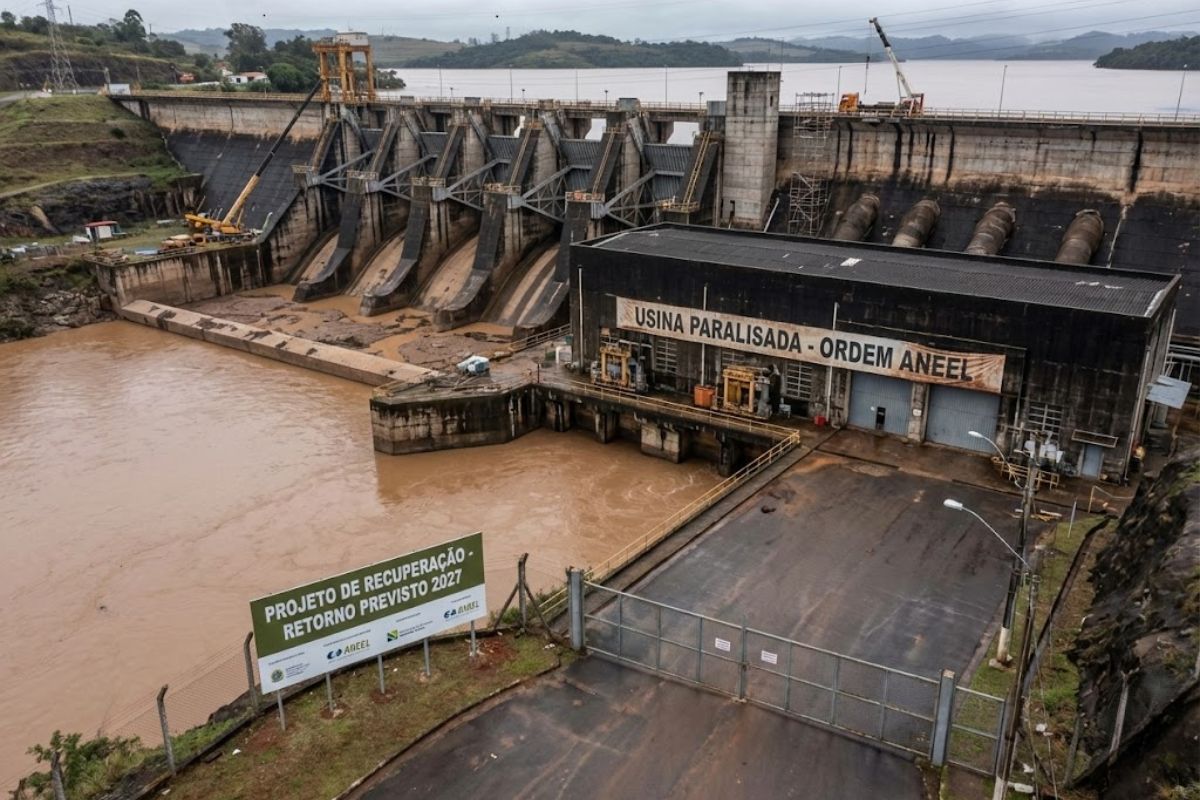


Commercial Suspension of Hydroelectric Plant UHE Jacuí Was Published on October 9, 2025 After More Than 12 Months of Unavailability Caused by the Floods in May 2024; Substation and Power House Flooded Stopped Six Units, Totaling 180 MW, and Modernization Work Continues Until 2027 in RS Now
The hydroelectric plant UHE Jacuí, in Salto do Jacuí, Rio Grande do Sul, had its commercial operation suspended by Aneel after being out of operation for more than 12 months due to the historic floods in May 2024 that flooded essential structures of the complex.
With six generating units deactivated and 180 MW of installed capacity out of the system, the plant operated by CEEE-G, controlled by CSN Energia, entered a modernization and repowering process. In the meantime, the company may have to purchase energy on the market to fulfill contracts until the completion of the work scheduled for 2027.
What Happened in the Floods of May 2024 and Why the Plant Stopped

The historic floods of May 2024 hit the electricity sector in Rio Grande do Sul, and in the case of UHE Jacuí, the effect was direct: the flood reached the substation and the power house, compromising generation capacity and rendering operation unfeasible.
-
Brazilian Startup Turns Coffee Grounds into Plant-Based Leather, Cutting Water Use by Over 50 Times for High-Impact Sustainable Fashion

-
Eco Invest Auction Aims to Unlock $10 Billion in Investments, Focusing on Green Fertilizers, Critical Minerals, Batteries, and AI for Clean Industry in Brazil

-
Half of Brazilians Prefer Lower Taxes with Private Health and Education, While 44% Opt for Higher Taxes for State-Provided Services, Datafolha Survey Reveals

-
Brazil’s Most Expensive Toll Rises to R$ 40.60 on Route from São Paulo to the Coast, Nearly Matching Bus Fare to Santos




Following this event, the company officially notified Aneel and the National System Operator, ONS, of the operational unavailability. The practical result was the shutdown of six generating units, removing 180 MW from the installed capacity of the enterprise.
Aneel Inspection in September 2024 and the Technical Evaluation
In September 2024, Aneel technicians conducted an onsite inspection at the hydroelectric plant. The report indicated that partial interventions would not guarantee safety or reliability, and the recommendation was for complete modernization of the complex.
The technical evaluation was significant because there is a regulatory limit: unavailability can be disregarded for a period, but after the 12-month deadline, the plant is treated as unavailable for commercial operation when there is no generation.
The Decision of October 2025 and the Publication in the Official Gazette
With the end of the 12-month regulatory period, Aneel formally decided to suspend the commercial operation of the hydroelectric plant. The decision was published in the Federal Official Gazette on October 9, 2025.
The agency also denied CEEE-G’s request for an emergency measure, which sought to maintain operational status until the completion of the works. In practice, the suspension technically acknowledges the unavailability, rather than keeping the plant as if it were able to generate.
What Changes in Practice for the Company and Energy Contracts
According to Aneel, the measure is not punitive. It is a technical acknowledgment that the plant is unavailable for electricity generation. The suspension does not reduce the physical guarantee of the enterprise and does not exclude UHE Jacuí from the Energy Reallocation Mechanism, MRE.
Even so, there is an operational and commercial impact. While it does not generate energy, the plant stops receiving energy allocation in the system. If it needs to fulfill sales contracts, the company may have to purchase energy from third parties, operating similarly to a trader during the period of unavailability.
Effect of Extreme Rains in 2024 on the Electric Sector in RS
The extreme rains of 2024 severely affected the electric sector in Rio Grande do Sul. At the time, Aneel monitored 426 generation enterprises in the state, including hydroelectric, thermal, wind, and solar plants.
Within this group, 44 hydroelectric plants underwent detailed inspection due to operational or safety risks. The agency emphasized that, even in cases of force majeure, such as extreme weather events, the suspension of commercial operation is applied when there is prolonged unavailability not accounted for in the calculation of the physical guarantee.
Timeline Until 2027 and the Total Time Without Generation Since 2024
According to the timeline presented by CEEE-G itself, UHE Jacuí is expected to remain offline until 2027, the period necessary for the completion of modernization.
This means that, since 2024, the plant will be about four years without generating energy, with six turbines idle and 180 MW unavailable, while commercial operation remains suspended and the company needs to manage contracts for purchasing energy on the market.
In your opinion, should the suspension of commercial operation in cases of extreme flooding have more flexible rules, or should the 12-month no-generation criterion remain as it is?