Understand the causes behind 510 tremors detected at extreme depths in East Antarctica and how the mystery intrigues scientists.
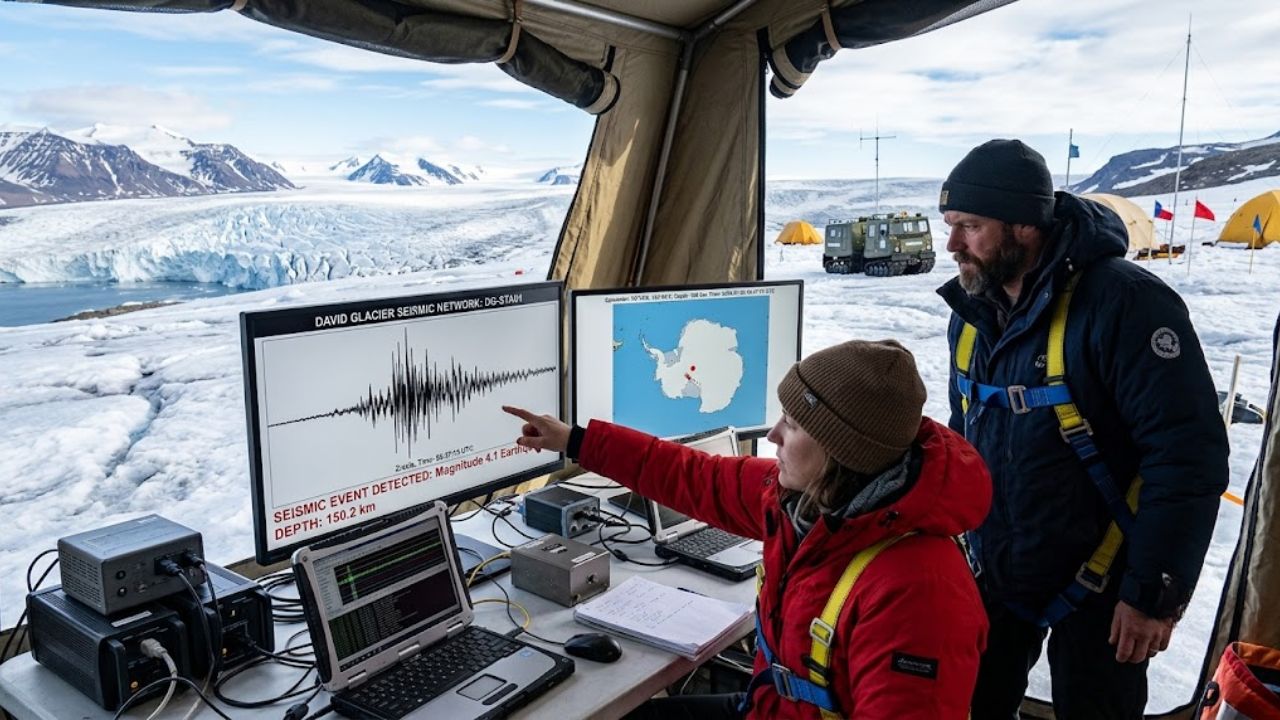
A mystery that challenges the traditional laws of geology has been uncovered deep beneath East Antarctica. An international study published by the journal Science revealed the occurrence of 510 earthquakes at intermediate depths — between 100 and 150 kilometers below the surface — concentrated under the David Glacier.
The events recorded intensities considered low on a global scale, ranging from 1.6 to 3.5 in magnitude. The discovery intrigues the scientific community because the phenomenon occurs in a stable region, where the planet’s physical conditions should prevent rocks from breaking.
The physical factors behind the ruptures in the Earth’s mantle
The explanation for the emergence of this unexpected activity involves a complex combination of pressures inside the planet.
-
Excavation for Solar Park in Germany Uncovers Rare Celtic “Princely Tomb” with Elite Warrior Buried with Gold, Weapons, Etruscan Jug, and Two-Wheeled Chariot in Bad Camberg

-
NOAA Scientists Discover Mysterious, Perfectly Aligned Holes on the Mid-Atlantic Ridge Seafloor, Origin Still Unknown

-
California Startup Develops Giant “Space Sling” to Launch Vehicles at Mach 6, Reducing Fuel Use and Enabling Thousands of Satellite Deployments

-
ChatGPT Alerts FBI to Prevent Planned Murder of 8-Year-Old in Brazil’s Espírito Santo


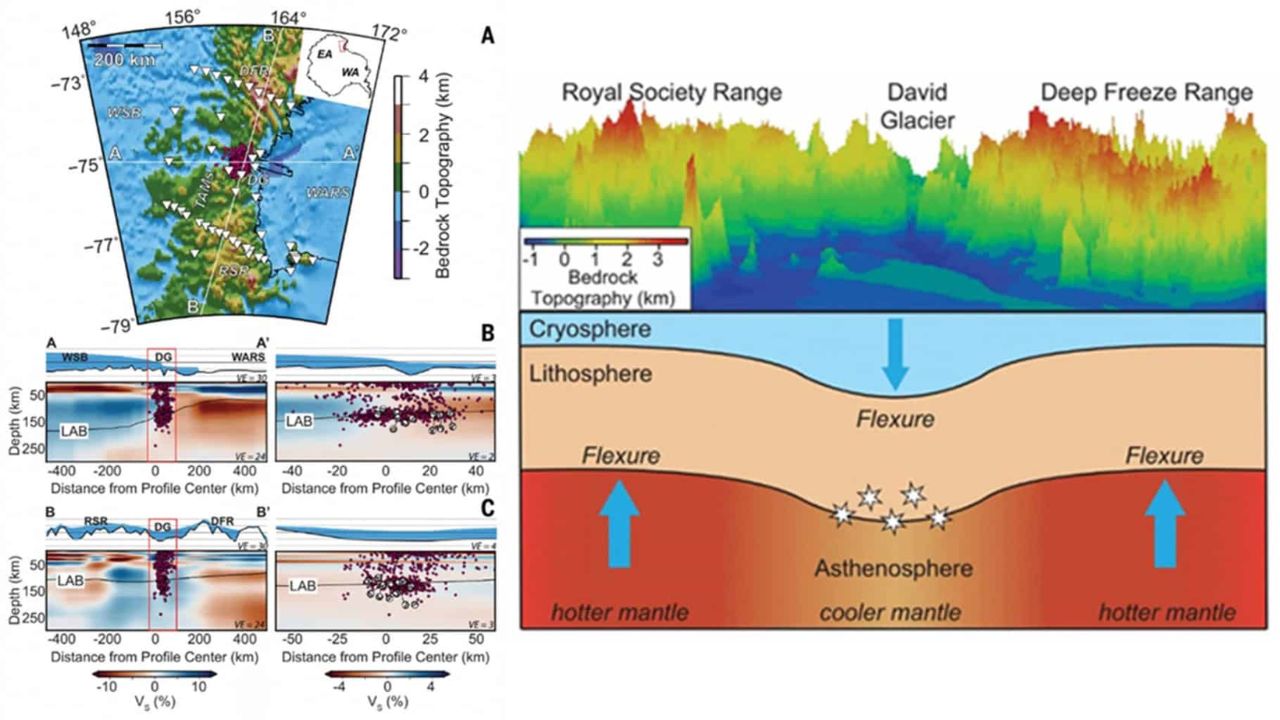
Although the David Glacier is not located at the junction of two tectonic plates, it is near a division that separates two entirely distinct continental structures.
The phenomenon is generated and fueled by the following local geological features:
- Structural shock: The contrast between the East Antarctic plate (which is thicker and cooler) and the West Antarctic plate (which is thinner and warmer).
- Magmatic force: The heated material coming from the deep layers of the Earth’s mantle that rises towards the crust.
- Surface overload: The colossal weight exerted by the immense ice cover that continuously crushes the region.
Scientists believe that the difference in physical properties between these two continental portions creates severe zones of tension accumulation.
This mechanical stress, combined with the weight of the ice and the rise of mantle heat, generates the necessary force to trigger underground fractures.
The scientific enigma of earthquakes
The recording of these earthquakes in ranges reaching up to 150 kilometers deep has brought a major impasse to current theories. In these extreme conditions of underground isolation, the intense heat and crushing pressure should cause the rocks to behave in a plastic and malleable manner.
In theory, the rocky material should slowly mold instead of suffering dry and sudden ruptures. Furthermore, the conclusions challenge the traditional models of plate tectonics.
Most of the world’s earthquakes occur exclusively at the edges and active margins of continents. The events recorded under the David Glacier are classified as intraplate, as they manifest right in the middle of a solid structure.
“Intraplate earthquakes (events that occur within plates, far from active margins) challenge the traditional paradigm of plate tectonics, which indicates that the interior of the plates should suffer little deformation,” detailed the authors of the article.
Computational analysis: how the data was extracted from the ice
The discovery of the earthquakes was only possible because the researchers replaced manual methods with an advanced deep learning system, a branch of artificial intelligence. The computer program was fed with information collected by 49 monitoring stations distributed across East Antarctica.
The technology managed to sweep through the immense volume of noise caused by the wind and the ice masses themselves to isolate the real geological cracks. To determine the exact point of each event, the algorithm analyzed the behavior of two energy waves generated underground.
The cross-referencing compared the P waves (capable of traversing any type of matter) with the S waves (which propagate only through solid rocks). The difference in speed and trajectory of these waves allowed the calculation of the location of the deep fractures.
Pending Questions in the Transantarctic Mountains
Despite explaining the conditions that favor tremors at great depths, the international study did not resolve all geographical doubts. Very similar rock formations and structures exist along the Transantarctic Mountains, but they do not exhibit the same seismic behavior.
In any case, the authors emphasize that the success in using new data processing technologies indicates that these phenomena in stable areas are more common than previously thought, suggesting that many tremors around the world have remained hidden for decades due to the lack of adequate tools.
Source: Olhar Digital