Portuguese
  Spanish


Discovery made in an ancient Neolithic settlement challenges traditional explanations about death and burial, as researchers try to understand why dozens of individuals had their skulls removed before being buried in an extensive ditch in present-day Slovakia.
A surprising archaeological discovery is drawing the attention of the international scientific community. Archaeologists found a ditch filled with headless human skeletons in an ancient Neolithic settlement located in the southwestern region of Slovakia. The information was released on June 2, 2026, by researchers responsible for the study published in the scientific journal Proceedings of the Prehistoric Society.
The find occurred at the archaeological site of Vráble, one of the most important areas of human occupation from the Neolithic period in Central Europe. Dated to approximately 7,000 years ago, the remains reveal an unusual scenario that is leading experts to reconsider fundamental aspects of the funerary practices of the continent’s early agricultural societies.
According to information released by the researchers, the skeletons show precise cut marks on the neck vertebrae, indicating that the skulls were removed with sharp tools. However, the evidence suggests that the decapitations did not occur violently during the individuals’ lives but probably after death, as part of a complex funerary ritual.
-
Why Yellow is the Safety Color for Heavy Machinery: Origins and Benefits Since 1931

-
U.S. Channel Highlights 20 Brazilian Innovations Leading Latin America: From Açaí to Modular Homes and Biogas

-
Dog Goes Viral for Buying Its Own Food and Carrying the Bag Home in Its Mouth

-
Unfinished 150-Year-Old Church in Brazil’s Bahia Stands Without a Roof After Railway Shifted Alagoinhas’ Center



A Neolithic settlement surrounded by mysteries
The archaeological site of Vráble was occupied between 5250 and 4950 BC by communities associated with the so-called Linear Pottery Culture, known internationally by the acronym LBK (Linear Pottery Culture). This group left as a legacy ceramics decorated with parallel lines and spread across various regions of Central Europe during the early agriculture on the continent.
Archaeological investigations began in 2012 and revealed a massive settlement composed of more than 300 houses distributed across three distinct neighborhoods.
One of the most intriguing aspects of the site is that only one of these neighborhoods was protected by a double ditch approximately 1.3 kilometers long. It was precisely in this defensive structure that archaeologists began excavations in 2022 and made the discovery that now intrigues specialists from various countries.
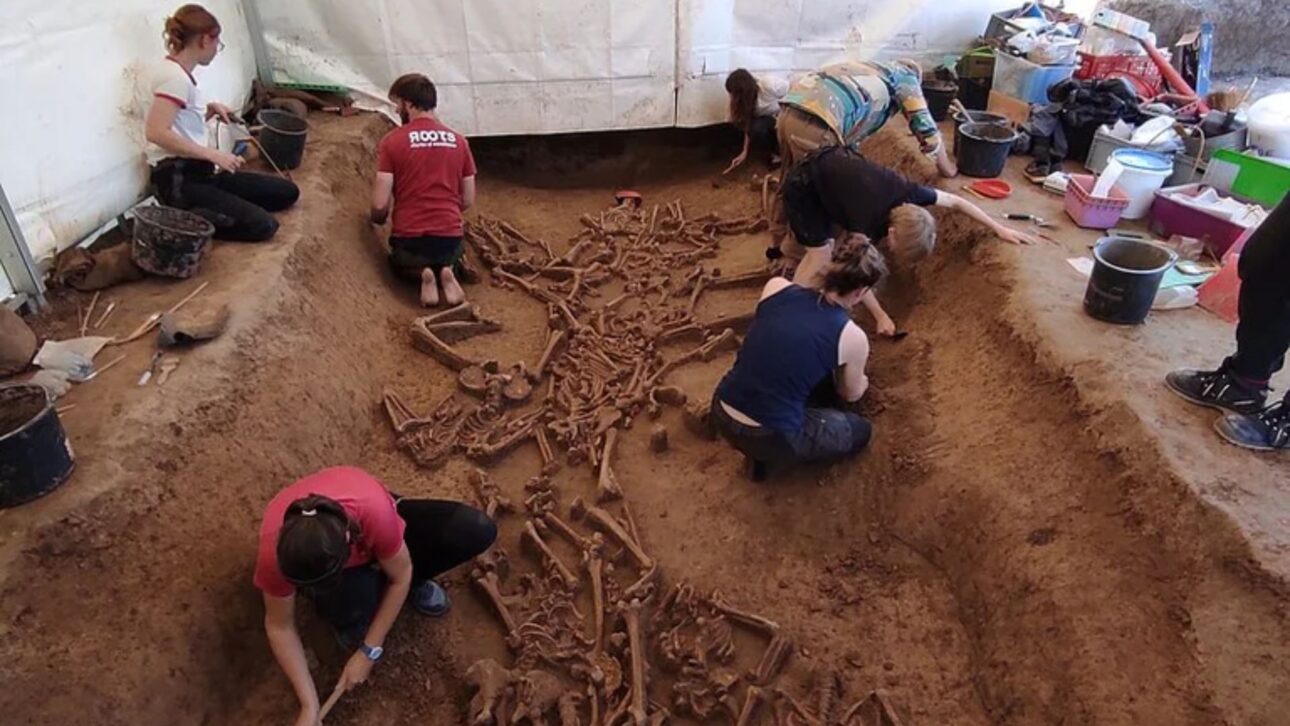
During the work, four pairs of headless skeletons were found buried side by side, along with a large collective grave containing at least 77 decapitated individuals. Curiously, only one skeleton still retained the skull, belonging to a child.
The number of bodies found immediately transformed the site into one of the most important archaeological sites of the European Neolithic.
Evidence indicates ritual and not massacre
At first glance, the presence of dozens of headless skeletons could suggest an episode of extreme violence or a large-scale massacre. However, preliminary analyses point to a very different interpretation.
Biological anthropologist Katharina Fuchs, from the University of Kiel in Germany, explained that the initial results indicate a careful removal of the skulls.
Researchers observed that the marks found on the neck bones were produced by sharp instruments used with precision. Furthermore, the lower jaws were also absent, suggesting that preserving the head as a complete unit held special significance for that community.
Another detail caught the attention of specialists. In many cases, the cervical vertebrae were found leaning against the walls of the ditch, indicating that the bodies were likely deposited at the site only after the removal of the skulls.
According to the study’s authors, the manipulation of the bodies was part of recurring symbolic practices loaded with social and spiritual significance.
The role of ancestor worship in the Neolithic
The discovery at Vráble is not an entirely isolated case in European archaeology. In different regions of the continent, other Neolithic sites have already revealed practices involving human skulls.
In Italy, for example, archaeologists found a set of 15 human skulls dated to about 7,400 years ago that were apparently repeatedly manipulated in rituals linked to ancestors.
In Spain, analyses conducted in a cave revealed evidence of a massacre that occurred approximately 5,600 years ago, accompanied by possible episodes of cannibalism.
However, Vráble presents a unique characteristic. So far, none of the skulls belonging to the individuals buried in the ditch have been located.
This absence makes it difficult to understand what really happened at the site. Researchers do not know if the skulls were stored elsewhere, used in specific ceremonies, or permanently removed from the community.
The strongest hypothesis suggests that the head was seen as a symbol of identity, life, and connection with ancestors, a practice similar to that observed in major Neolithic centers of the Near East.
In places like Çatalhöyük and Jericho, researchers have already identified traditions in which skulls were removed from the dead, coated with plaster to reconstruct faces, painted, and later displayed within communities.
Social tension may also explain the burials
Although the funeral ritual is currently the main explanation, scientists do not completely rule out the possibility of internal conflicts.
The authors of the study note that the three neighborhoods of the settlement showed significant differences. Only one of them had a ditch protection system, and its entrances were oriented away from the other inhabited areas.
This pattern may indicate some type of rivalry, social segregation, or dispute among groups sharing the same settlement.
In this context, the burials in the ditch could have served not only as a funerary practice but also as a symbolic way to mark territory, reinforce collective identity, or consolidate the connection between the inhabitants and their ancestors.
Even so, there is not enough evidence to determine whether the individuals died naturally, in confrontations, or under other circumstances.
The next steps in the research include the complete excavation of the ditch and more in-depth analyses of the human remains, including genetic, anthropological, and archaeological studies.
For the specialists, the results already show that Vráble occupies a unique position in European archaeology.
Archaeologist Martin Furholt, the main author of the study, highlighted that the site offers a rare opportunity to understand how the first agricultural societies interpreted death, the human body, and social bonds.
As new excavations progress, the expectation is that the mysteries surrounding the headless skeletons may finally reveal previously unknown aspects of the life and beliefs of populations that lived more than seven millennia ago in Europe.
Source: According to a report published by the portal Live Science and based on the scientific study published on June 2, 2026, in the journal Proceedings of the Prehistoric Society.