Portuguese
  Spanish


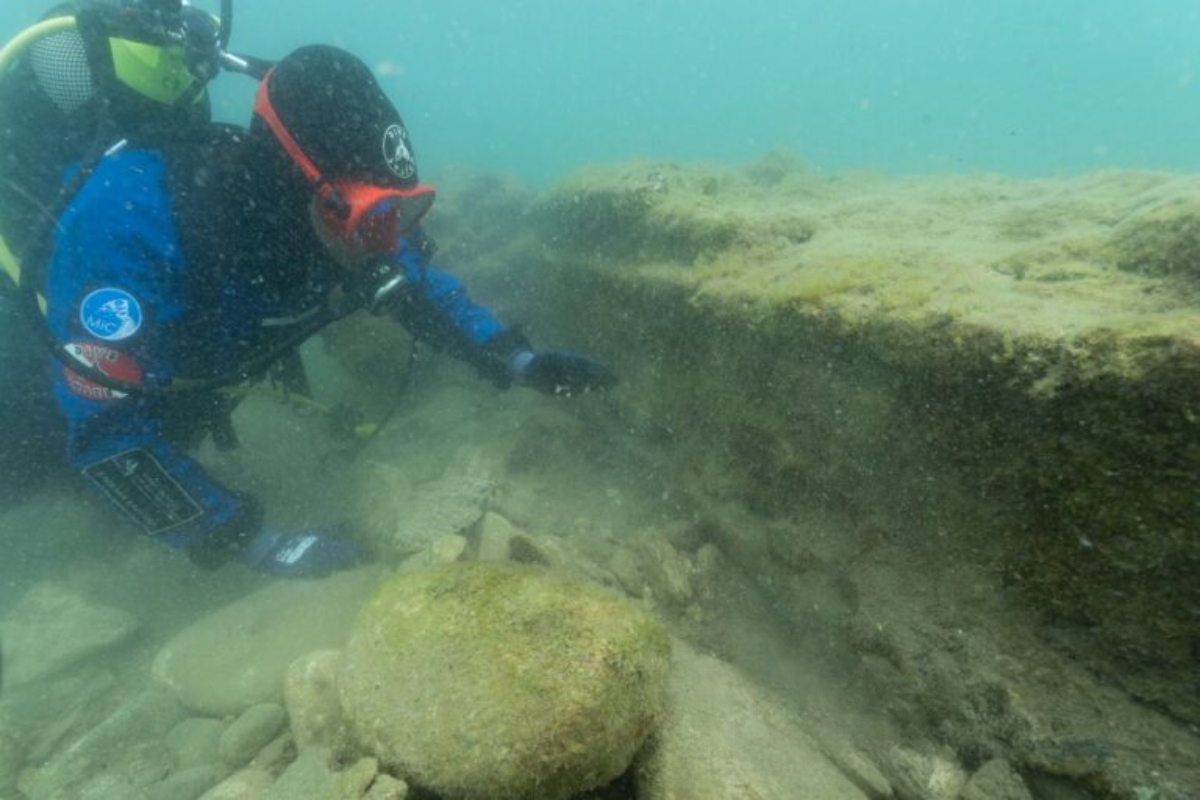


Excavations in Campo di Mare revealed preserved wood, cocciopesto flooring, and rare traces of Roman coastal engineering just a few meters from the sand, transforming the Lazio coastline into a new archaeological focus
The Tyrrhenian Sea has once again exposed one of the most intriguing scenarios of the Italian coast. In Campo di Mare, on the Lazio coastline, archaeologists have identified and restored a large Roman structure now submerged, just a few meters from the sand, in an area very close to Rome.
What emerged from the investigation was neither an isolated ship nor a lost object on the seabed. What is documented is a monumental circular construction of about 50 meters in diameter, linked to an ancient Roman villa, with signs of sophisticated architecture and unusual preservation underwater.
The strength of the find lies precisely in its scale. The scene resembles a lost city, but what the most solid sources support so far is the presence of an elite maritime pavilion, part of a larger complex that has yet to be fully revealed.
-
How to Prevent Brown Recluse Spider Bites: Common Hiding Spots and Free Tips to Reduce Risks

-
Natto: The Unusual Japanese Superfood Gaining Popularity on Social Media and Driving Record Exports
-
Brazilian Mayor Goes Undercover as Homeless for 24 Hours to Assess Public Services

-
15-Year-Old Entrepreneur Malu Lira Publishes 20 Children’s Books on Financial Education, Earns $500,000, and Expands Her Project to the Amazon Rainforest




Campo di Mare exposed a circular structure just a few meters from the sand
The submerged structure is located off the coast of Cerveteri and has drawn attention for being very close to the sandy beach. This detail helps explain why the site has become a focus of Italian underwater archaeology and why the area may still hide other sections of the ancient complex.
The most recent work included underwater excavation, site surveying, and restoration of wooden parts, a rare finding for ancient coastal structures. The current interpretation points to a construction directly linked to the water, designed to showcase power, comfort, and Roman presence in a valued stretch of the coastline.

Brick walls, clay bench, and preserved wood change the interpretation of the site
The most impressive part of the complex lies in the engineering. Archaeologists documented a double belt of brick walls, separated by about 3 meters, with foundations laid on a clay bench that helped preserve wooden elements and parts of the original structure.
This level of preservation increases the historical value of the site. Instead of scattered ruins almost erased by the sea, what appeared was a robust construction, with recognizable design and technical details that reinforce the idea of a space intended for ostentation and noble use in the Roman period.
Noble flooring and sophisticated finishing reinforce the image of Roman luxury
Visible evidence on the seabed helps to measure the construction pattern. There are sections covered with cocciopesto, parts of the floor in opus spicatum, and central fragments of opus sectile, materials associated with refined finishes and prestigious environments.
With this set, the interpretation gains strength. The sea did not cover just any structure. It preserved what appears to have been an elegant, representative space linked to the Roman aristocracy, in a strategic coastal area of the ancient route of the Via Aurelia.
Recent expeditions put Campo di Mare on the international radar

According to Archaeology Magazine, an international magazine specializing in archaeology and ancient heritage, the discovery of Campo di Mare began to attract attention outside of Italy when underwater excavations revealed a monumental structure of about 50 meters associated with an ancient Roman villa.
The significance of the find gained even more strength when details about the circular structure emerged, now completely submerged and located just a few meters from the coast, in a spot that continues to be under pressure from marine erosion.
A column found earlier indicated that there was something much larger under the sea
The area had already attracted attention since 2021, when divers located a cipollino column with a Ionic capital nearby. The find helped pave the way for the reading of a much larger set hidden under the water and beneath the sand strip.
Today, the very official documentation treats Campo di Mare as an area for underwater excavation, relief, and restoration of wooden parts, a sign that the investigation is still ongoing and that the sea may have returned only a part of what truly existed in that stretch of the Roman coastline.
The impact of the discovery goes beyond the powerful image of ruins underwater. It expands the map of Roman occupation on the Lazio coast and reinforces how the coast near Rome still holds traces capable of changing the understanding of architecture, power, and circulation in the ancient world.