Portuguese
  Spanish


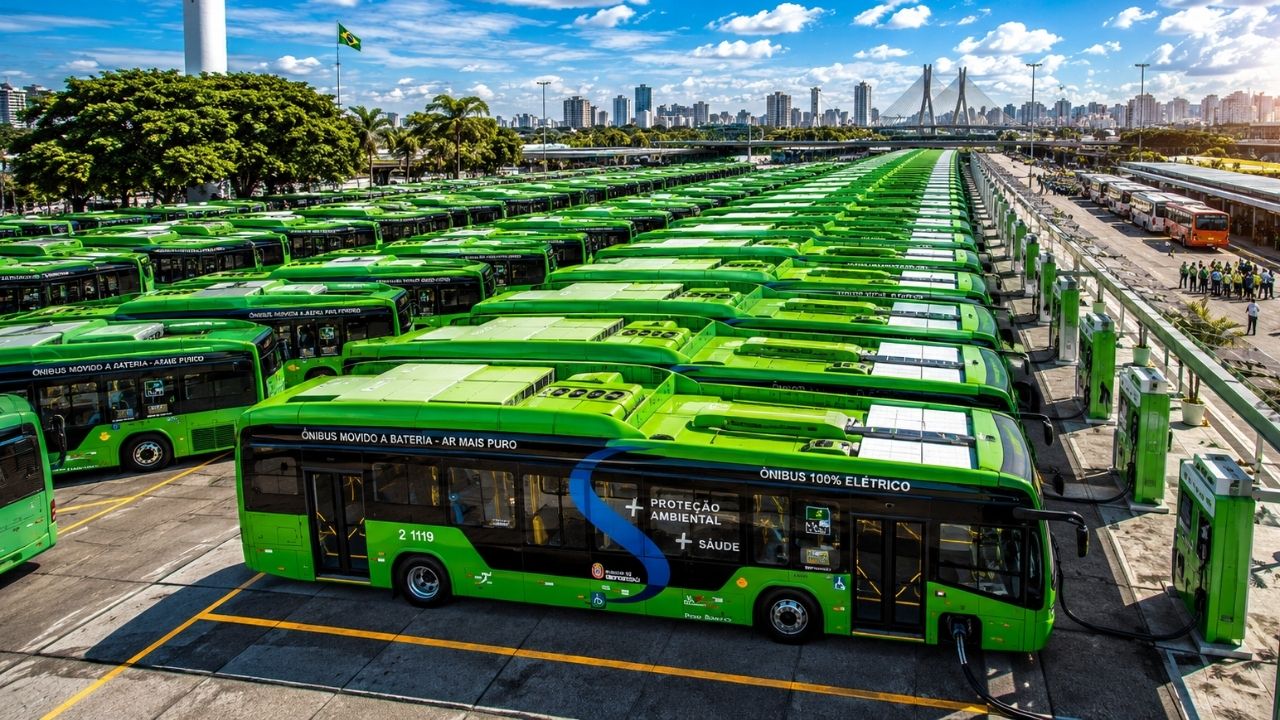


According to Exame, electric buses are advancing in Brazil, but São Paulo still dominates the electric fleet, while public transport in other cities struggles with infrastructure, financing, and a price of up to R$ 3 million to switch diesel for clean models and gain scale outside the São Paulo axis in the country.
The electric buses are experiencing a contradiction in Brazil in 2026: registrations advanced 170% in 2025, but São Paulo still concentrates the electric fleet, while public transport in other cities depends on infrastructure and financing. According to a report by Exame published on June 5, 2026, the country had 1,471 electric buses by February, compared to 130,000 diesel urban buses in circulation.
The problem is not just in the technology. Manufacturers, operators, and public managers cited by Exame point out that the advancement of electric buses depends on a difficult equation: vehicles that can cost up to R$ 3 million, prepared garages, available energy, accessible financing, and contracts capable of sustaining the transition in public transport.
São Paulo concentrates the majority of the country’s electric fleet
São Paulo appears as the main center of public transport electrification in Brazil. The São Paulo capital has more than a thousand electric buses in operation, the result of a municipal policy initiated in 2019, when the city hall began to prevent the entry of new diesel vehicles in the fleet renewal.
-
AI Security System in Brazil Aims to Cut False Alarms by Differentiating Pets from Intruders, Enhancing 24/7 Monitoring for Homes and Businesses

-
Archaeologists Discover 1,500-Year-Old Byzantine Mosaic with Greek Biblical Inscription in Israel, Uncover Ruins of 10 Buildings Near Kiryat Gat
-
Ohio Carpenter Finds 308-Gram Meteorite the Size of a Baseball After Dreaming of Its Location

-
Chinese Student Builds Humanoid Robot for $2,100 at Age 20, Now Leads Robotics Startup in China



The concentration, however, exposes the size of the national challenge. According to data from the Brazilian Electric Vehicle Association, cited by Exame, 81% of electric bus registrations between January 2022 and April 2025 occurred in São Paulo. In the same period, only 21 Brazilian municipalities had such vehicles in circulation, showing how the electric fleet is still far from most public transport.
170% growth has not yet turned into national expansion
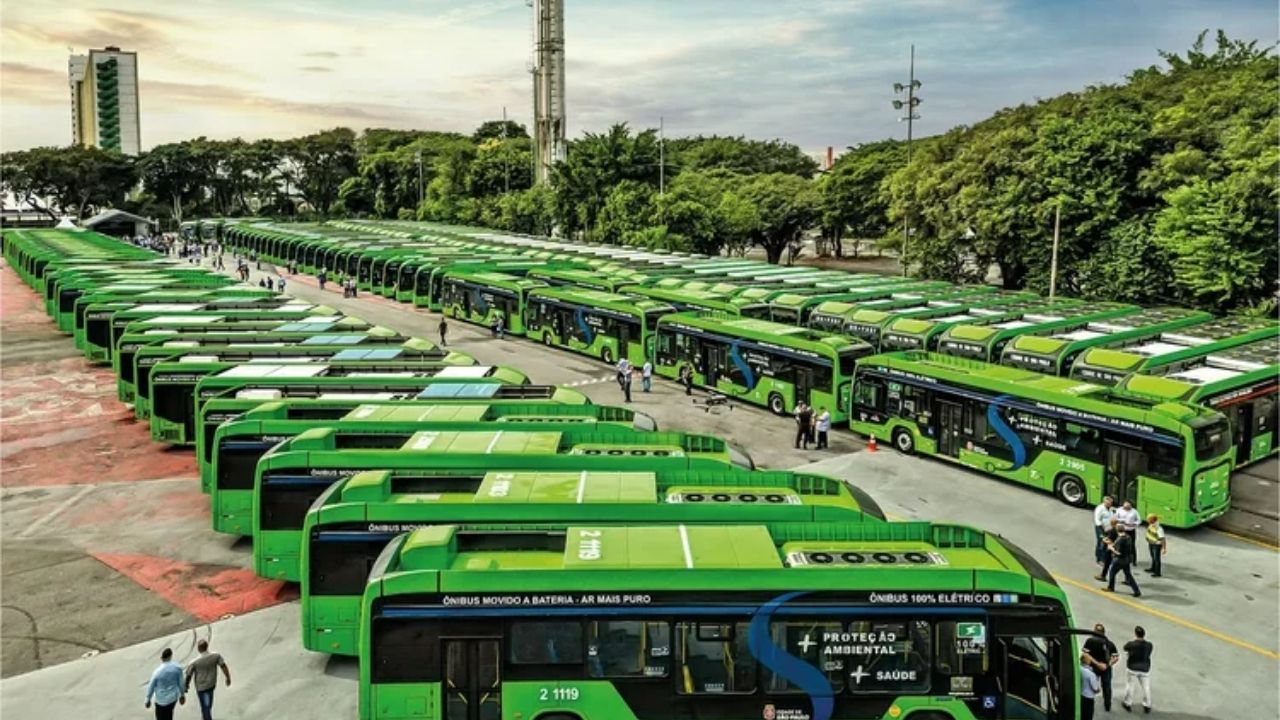
The 170% increase in registrations in 2025 places Brazil in a prominent position in Latin America, with the possibility of surpassing Chile and Mexico, according to projections mentioned by Exame. Even so, the progress is not yet evenly distributed across the national territory.
The Southeast region concentrated 89% of registrations, while the North and Northeast combined were below 2%. This contrast shows that electric buses are growing in statistics, but the electric fleet has not yet consistently reached most Brazilian cities.
Outside São Paulo, progress depends on isolated cases
Some cities outside the São Paulo axis have started to stand out, but still as exceptions. Aracaju, the capital of Sergipe, was pointed out by Exame as the first northeastern capital to have its own fleet of electric buses, with 15 vehicles in operation supplied by TEVX.
Manaus received 14 units from Eletra in 2023. Goiânia also entered the electrification map, with projects involving Volvo and Marcopolo. These examples show that the technology can move out of São Paulo, but scaling in public transport still depends on local planning, financing, and charging infrastructure.
Price of up to R$ 3 million hinders municipal decisions
One of the main obstacles is the initial price. According to Exame, an electric bus costs between R$ 2.5 million and R$ 3 million, while an equivalent diesel model ranges from R$ 700,000 to R$ 900,000. In practice, the electric vehicle can cost three to five times more.
This cost hinders many municipalities even before a complete analysis. However, manufacturers argue that the calculation should consider the total cost of ownership. The electric bus is more expensive to purchase, but tends to spend less on energy and maintenance over its lifetime.
Total cost may change the calculation against diesel


TEVX, a manufacturer of transport solutions, claims that fuel savings can reach 85% or 90% when energy is purchased on the free renewable market. Maintenance can also cost between 65% and 70% less, according to data cited by Exame.
Milena Romano, CEO of Eletra, told the report that clients with more than 30 electric vehicles do not return to diesel after realizing financial efficiency and quality gains. Eletra, the largest national manufacturer in the sector, has over 60% market share, uses 93% national components, and has a production capacity of 2,400 buses per year.
Infrastructure is the bottleneck that appears after purchase
Even when there is money to buy electric buses, the city needs to prepare the operation. Unlike a diesel vehicle, which refuels at a pump, an electric fleet requires substations, high-voltage cables, transformers, chargers, and adapted garages.
João Paulo Ledur, Director of Strategy, Digital, and Innovation at Marcopolo, warned Exame that charging a fleet of 100 or 200 buses in the same location requires significant investment and planning. Therefore, the infrastructure does not depend solely on the vehicle: it changes the entire structure behind public transport.
Enel claims to have delivered energy to garages in São Paulo
Enel Brasil, the energy distributor responsible for São Paulo, informed Exame that it met the planned and requested electrical infrastructure demand by operators in the city. From 2024 to February 2026, the company claimed to have delivered 72 MW of energy to 28 bus garages.
According to Enel, this volume would be enough to supply at least 1,600 buses. The company also reported that, in the garages connected by the distributor, the maximum utilization of the installed power did not exceed 57% in the last 12 months and was 42% in February 2026.
Public financing has become a decisive piece for expansion
The cost of capital is another obstacle for electric buses. High interest rates can make the purchase unfeasible, even when future operational savings seem favorable. Therefore, public financing emerges as a central piece in the electrification of public transport.
In São Paulo, according to Exame, the municipality uses BNDES resources at subsidized rates, pays part of the bus value to the manufacturer, and transfers the vehicle to the private operator within the concession contract. Milena Romano explained that, in this model, the municipality pays 75% of the value and the operator covers 25%, disbursing something close to the cost of a diesel bus.
New PAC foresees electric buses, but the sector sees a limit
In the New PAC, Growth Acceleration Program, projects for 2,296 electric buses were registered, with resources via BNDES, through the Climate Fund, and Caixa Econômica Federal. According to Exame, the projects cover 49 cities and 7 states.
Even so, industry representatives assess that the volume is still not enough for a large-scale transition. Carlos Eduardo Souza, CEO of TEVX and member of the Brazilian Electric Vehicle Association, stated that there are still gaps to finance private operators with competitive resources.
Models used in Chile and Colombia come into focus
An alternative mentioned by Exame is the model where investors finance the complete package: vehicle, infrastructure, and energy. Then, they receive over 12 to 15 years, according to the concession period and the guarantees provided by the public administration.
This type of structure already appears in markets like Chile and Colombia, with the participation of international funds. In Brazil, institutions such as the World Bank, Inter-American Development Bank, and the German bank KfW have already shown interest in similar projects, according to the report.
Official projection points to 48.5 thousand electrified buses
The 2035 Ten-Year Energy Expansion Plan, from the Ministry of Mines and Energy, projects 48.5 thousand electrified buses in Brazil in less than ten years. Of this total, 43.5 thousand would be purely electric, according to the data cited by Exame.
The projection shows that electrification has entered the national energy planning. The challenge is to turn the goal into an electric fleet on the streets, especially outside São Paulo, where many cities still lack scale, technical team, financing, or infrastructure to accelerate the change.
The debate now is not whether the technology works
Ricardo Alouche, Vice President of Sales and Marketing at Volkswagen Trucks and Buses, told Exame that the decision in the commercial sector is not ideological, but economic and operational. According to him, operators evaluate energy consumption, maintenance, battery, availability, and route productivity.
Walter Barbosa, Vice President of Sales at Mercedes-Benz do Brasil, also pointed out that vehicle technology is already mature. For him, the country now depends on infrastructure and financing for electromobility to gain real scale in public transport.
The advancement of electric buses in Brazil shows that the change has already begun, but it is still far from being national. São Paulo leads the numbers, manufacturers advocate for long-term gains, and cities outside the São Paulo axis try to advance, but the price, the electrical grid, and financing still define the pace of this transition.
Do you think Brazil should speed up the purchase of electric buses with more public money, or does the country need to first resolve infrastructure, garages, and financing before expanding the fleet? Leave your opinion in the comments.