






 Portuguese
  Spanish


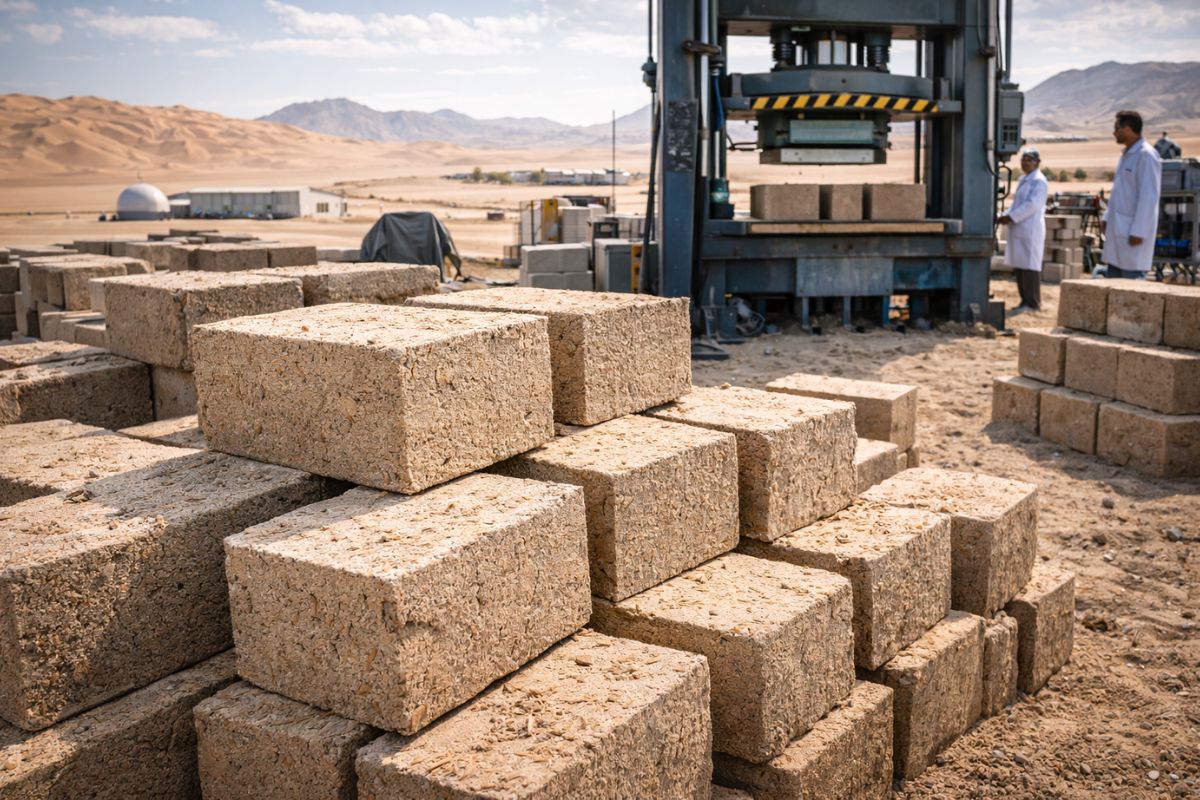


Desert Sand Enters The Construction Radar When Researchers In Norway And Japan Use Wood Waste And Pressure To Produce Cement-Free Paving
Desert sand has always been in excess on the planet, but for a long time, it was treated as useless for conventional concrete. Now, researchers in Norway and Japan show that the turnaround may lie in the right material, not the right sand: desert sand combined with organic waste and pressing turns into cement-free paving blocks.
This shift gains weight because concrete is the most used construction material in the world, second only to water, and cement production is associated with about 8% of global CO₂ emissions. At the same time, the availability of suitable sand is decreasing. Sandcrete appears as a pragmatic response to two bottlenecks at once: sand and carbon.
Why Desert Sand Was Considered “Useless” For Concrete
It is not enough to just have sand. For concrete to work in the traditional model, the grains need to be of specific size and shape.
-
Canada Sinks Six Giant Balloons in Lake Ontario to Test Underwater Battery That Stores Compressed Air 60 Meters Deep

-
Astronauts Returning from Space Develop Early Cataracts Due to Eye Lens Radiation, Highlighting Risks for Future Mars Missions

-
Brastemp Unveils New Dishwasher with Smart Sensor, 14 Place Settings, Acquaspray Jet, 70°C Rinse, Water Efficiency, and Intelligent Drying
-
Antarctic Sea Creature Yields Promising Compound Against Melanoma, Captivating U.S. Researchers



Desert sand tends to be too fine and too rounded by the wind, making it unsuitable for conventional concrete.
This is the paradox: desert sand is abundant to the point of being excessive, but, for years, it has been seen as a geological waste without value for construction. The inevitable question arises: what if the problem was not the sand, but the type of concrete?
The Global Sand Crisis And The Environmental Cost Of Concrete
The scarcity of suitable sand puts pressure on ecosystems where the “compatible” material is found. As a result, rivers are excavated, deltas are dredged, and mountains are crushed to obtain aggregates.
The outcome is well known: accelerated erosion, loss of biodiversity, social conflicts, and increasing pressure on fragile ecosystems.
Adding to this, the scale of cement is staggering: more than 4 billion tons are produced annually, with a climate cost associated with CO₂.
What Is Sandcrete And Why Desert Sand Enters The Game
Sandcrete is described as an ecological concrete that reuses desert sand and organic waste, especially wood dust.
Instead of trying to “force” desert sand to mimic a classic aggregate, the material is designed considering its limitations.
The proposal breaks the dogmas of traditional construction: biomaterials and pressure, without classic cement. The logic is simple in idea and demanding in process control.
How Sandcrete Is Produced Without Traditional Cement

The secret lies in combining ultra-fine desert sand with plant-based additives, mainly wood dust, and applying pressure and heat. It is not a process of pouring and waiting to dry like in conventional concrete.
Here, the material is compacted, almost like an industrial process closer to engineered wood panels or ceramics.
In the lab, researchers tested temperature, pressure, pressing time, ratios, and types of sand. Without complex chemical treatments, the material achieves sufficient strength for practical uses, at least in non-structural applications.
What Is It Used For First: Paving Blocks And Sidewalks
The initial planned applications are clear and realistic: outdoor paving, sidewalks, pedestrian areas, and paving.
These are spaces that require mechanical strength, durability, and stability, but not the extreme level of demand of building structures.
Comparative tests indicate that this botanical concrete can compete with conventional materials in density and strength, as long as the process is carefully controlled.
Desert sand, in this scenario, stops being “wrong sand” and becomes input for the right product for the right use.
Local Production: The Detail That Decides If The Idea Is Sustainable
The environmental potential increases when desert sand is processed locally. If part of the demand for aggregates is met close to desert areas, the need to extract river sand or crush rocks on a large scale tends to decrease.
The team emphasizes a decisive point: the environmental benefit only exists if the material is used where it is found. Transporting sand thousands of kilometers would be inconsistent with climate logic. Here, proximity is key and avoids creating new logistical problems and emissions.
What Still Needs To Be Proven Outside The Laboratory
The advancement is still in the laboratory phase, which does not detract from its value. On the contrary: it allows adjusting parameters before thinking about industrial scale.
There is still work to be done, including tests of resistance to cold cycles, prolonged moisture, wear, and aging in real conditions.
Sandcrete does not aim to replace traditional concrete tomorrow, but paves the way to reduce dependence, diversify options, and adapt construction to the resources of the territory.
When Desert Sand Stops Being An Obstacle And Becomes A Resource
In many arid regions, sand is seen as an obstacle to infrastructure and everyday life. Transforming it into raw material for local construction changes the perception: from problem to resource.
In the long run, the combination of local materials, biological additives, and simple industrial processes can change how sustainable construction is thought of.
Sometimes, progress is looking at what has always been there in a different way, even desert sand.
Do you think that desert sand has real potential to become the standard for sidewalks and paving, or is it still too early to trust this type of material?


Why are you forcing people to take a survey by a right wing Chinese cult?