Portuguese
  Spanish


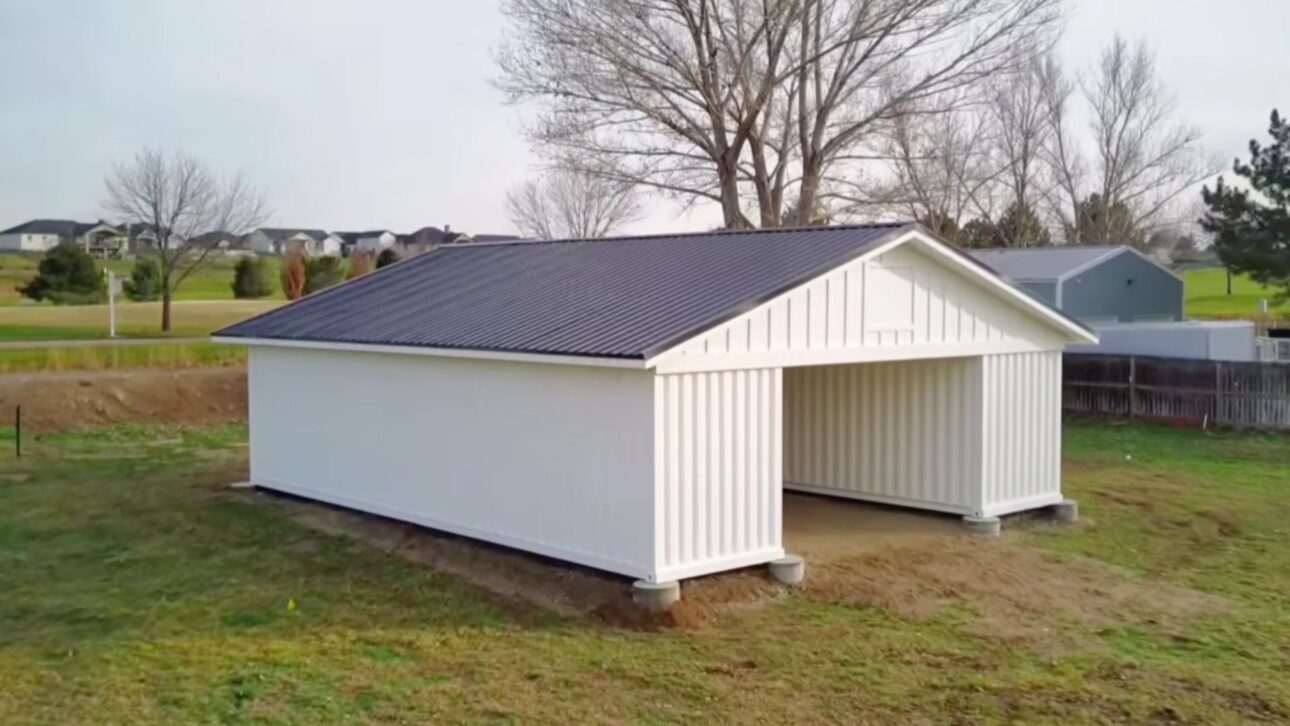
The DIY project used two 40-foot high cube shipping containers on a floating foundation, with a metal roof in the middle. The cost does not include the family’s labor, who did everything themselves, and the containers themselves accounted for more than half of the total cost.
Faced with budgets exceeding 100 thousand dollars for a conventional barn, a family decided to build their own using two shipping containers and a roof in the middle. The result was a robust construction that cost about 21 thousand dollars, roughly 110 thousand reais at the current exchange rate, less than a quarter of what was being asked for the traditional construction. The step-by-step process was documented from start to finish by the Solo Jim Outdoors channel, with open costs for each stage.
The number is impressive, but it needs context to avoid being misleading. All the work was done by the family themselves, without hiring labor, which significantly reduces the final cost. Additionally, the containers alone accounted for more than half of the value, the foundation was of the floating type, not permanent, and the author himself admits that a pole barn could be cheaper.
Why the family opted for shipping containers
As the budgets for a conventional construction exceeded 100 thousand dollars, about 517 thousand reais at the current exchange rate, the family chose to do everything on their own.
-
Brazil’s Minas Gerais Government Signs Agreement for Ring Road to Divert Heavy Trucks Away from Urban Center

-
The Great Wall of China was built with a surprising kitchen secret: sticky rice mixed with lime created a mortar so durable it has withstood centuries, earthquakes, and human destruction.

-
Tired of Seeing Homelessness, New Westminster in Canada to Open Region’s First Tiny Home Village: 30 Container Homes with Central Kitchen, Meals, and Facilities
-
Brazil’s Santa Catarina Port Drives 770 Tons of Steel Piles into the Sea, Reaches Midpoint of $100 Million Project to Dock Two Ships Simultaneously by October




The choice fell on two 40-foot high cube shipping containers, equivalent to about 12 meters in length, with a roofing system between them.
The arrangement of the containers defines the shape of the barn.
Each container is about 2.4 meters wide, and the two were positioned approximately 4.9 meters apart, resulting in a total area of about 10 by 12 meters.
Being of the high cube type, they are almost 30 centimeters taller than standard containers, and the family purchased one-trip units, without dents and in good condition.
As per the rule, the shipping containers were never placed directly on the ground, maintaining a 15-centimeter gap for air circulation.
Foundation and the Arrival of the Containers
Everything started with the base, taking care to keep the ground level and square.
To ensure right angles, the family used the 345 method, stretched to 9, 12, and 15, with stakes, string, and spray paint.
After removing the organic layer, adding road base, and compacting the soil, the pillar holes were opened, about 61 centimeters in diameter.
By choice, the stakes were floating, not going below the frost line, to keep the structure modular and non-permanent.
In cardboard tubes suitable for concreting, called sonotubes, with rebar inside, the couple mixed and poured concrete all day long.
This stage of foundation and earthwork cost 1,194 dollars.
With the base ready, the containers arrived, and here lies an important warning.
The author notes that container scams are common and recommends never paying before seeing the unit, and avoiding purchases outside the region.
The family found a seller about 30 minutes from home, who delivered the containers on a dump trailer.
Due to a slight slope of the land, a neighbor helped position them with a front loader, which avoided crane rental.
Small level adjustments were made with steel shims and a hydraulic jack. Just the shipping containers cost 11,436 dollars, the largest portion of the project.
Painting, Trusses, and Metal Roof
Before covering, the containers were prepared and painted.
The family removed stickers, washed everything with a high-pressure washer, and installed the truss supports, spaced every 2.4 meters, to paint them together.
A metallic paint specifically for shipping containers was used, in white, purchased from a large materials chain, which significantly changed the appearance.
The paint, primer, and supplies for the entire project totaled 562 dollars.
The roof started with trusses ordered from a local manufacturer, designed to support snow.
They were wooden trusses in the 2×6 format, with a slope of 4 to 12, spaced about 2.4 meters apart and braced by slats fixed in metal supports.
The trusses were assembled on the ground and hoisted onto the containers, then fitted and leveled with the help of the couple’s children.
The gables were closed with plywood, and the eaves, made with 2×6 wood, extend about 18 inches.
The set of trusses, wood, finishes, and hardware cost 5,109 dollars.
On top of the trusses came the metal roof, assembled in a single day of work.
A local supplier prepared a complete kit from a simple drawing of the barn, with drip edge, panels, screws, and finishes.
The first panel was squared, with an excess of about 1.5 inches at the base to drain water, and the screws went in without needing pre-drilling.
To finish, the family hid the container marks with wooden finishes, created cutouts so the container doors could still open, and even installed a compass.
The roofing package cost 2,897 dollars.
How much it really cost and what to consider before copying


Adding up all the phases, the barn structure cost 21,198 dollars, close to 110,000 reais.
The amount is less than a quarter of the over 100,000 dollars required for a conventional build, and the shipping containers accounted for 11,436 dollars, more than half of the total.
The remaining stages were divided between foundation, painting, roofing, and the trusses and wood part, the latter at 5,109 dollars.
It is worth noting that prices vary according to the region and the cost of materials, as the author himself emphasizes.
Before getting excited about repeating the idea, however, some points need to be clear.
The author warns that he is not a professional and that the content does not replace technical guidance, urging everyone to do their own research.
The disclosed amount also does not include labor, as the family built everything themselves, which would significantly increase the project cost if hiring was necessary.
Add to this the floating foundation, which is modular and non-permanent, and the note that a pole barn could cost less.
Since it is a barn for hay and cattle, and not a residence, comfort and housing requirements are not part of this calculation.
The barn with shipping containers is a good example of how planning and self-work can reduce the cost of a build.
For those who need a sturdy barn and are willing to get hands-on, the savings compared to conventional construction are real and significant.
Still, the case shows that the secret to the low price was both in the choice of containers and in the fact that the family did everything themselves, something not everyone can or wants to do.
And you, would you live in or store your things in a construction made with shipping containers? Do you think it’s worth replacing traditional construction with two containers and a roof in the middle, even with the foundation and purchasing care involved? Share your opinion in the comments, respecting different opinions, and share the article with those considering building.