Portuguese
  Spanish


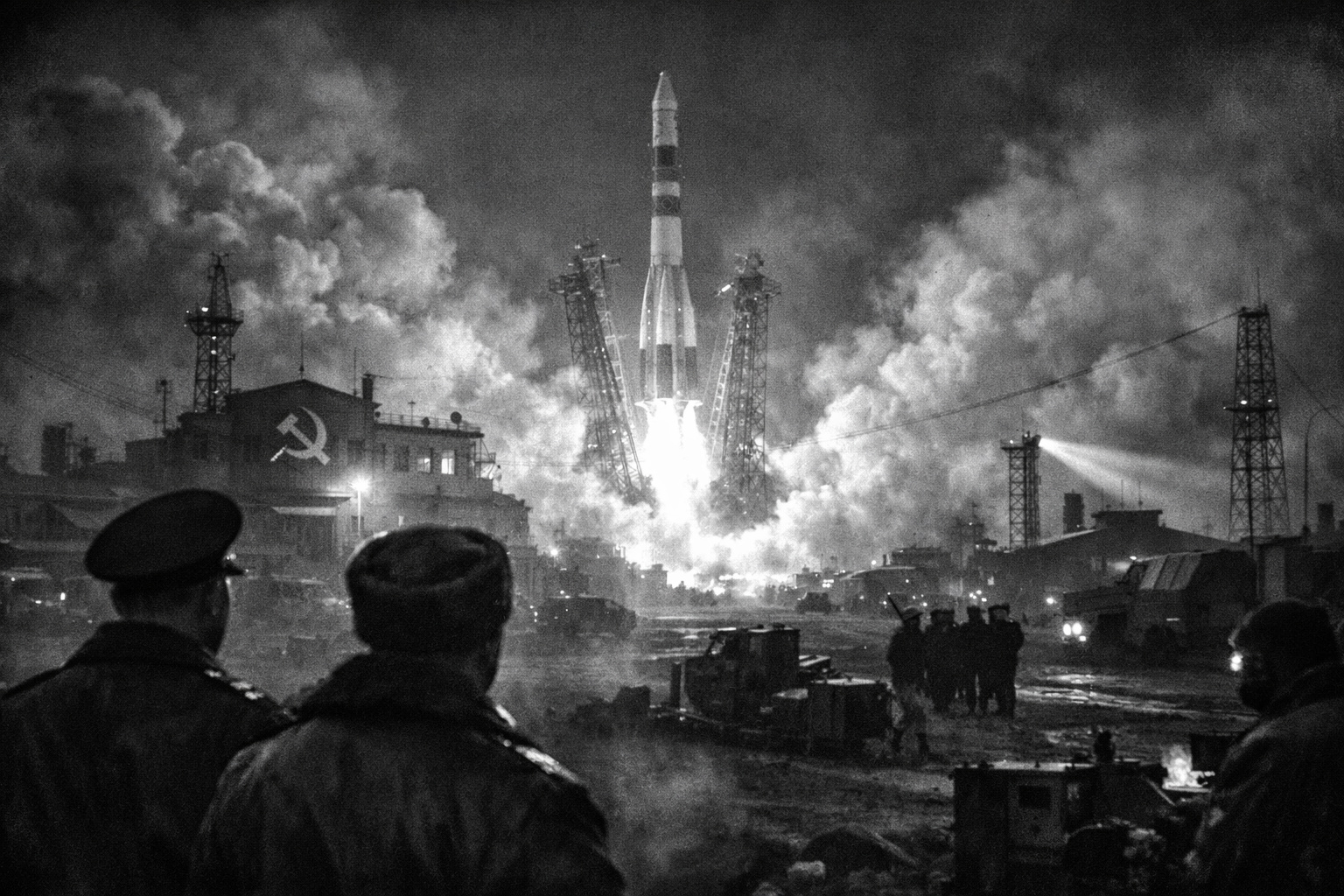

Between celebrated achievements and buried secrets, the space race reveals little-known episodes that raise disturbing questions about what really happened behind the scenes of the Soviet Union
The history of space exploration has always been marked by impressive feats and achievements that changed the course of humanity. However, behind the grand announcements and official celebrations, there are accounts that raise profound questions. After all, what if the first human sent into space never returned? This unsettling doubt gains strength when we analyze the behind-the-scenes of the space race during the Cold War, a period filled with disputes, secrets, and carefully controlled narratives.
Recently, less than a month ago, the world watched four astronauts travel to the Moon, orbit the natural satellite, and return safely to Earth. The Artemis II mission represented yet another historic milestone. However, looking back, especially to the year 1961, when the Soviet Yuri Gagarin was officially recognized as the first human to go into space, questions arise that challenge the traditional version of history.
The information was disclosed by “Brasil Paralelo”, which presented an analysis based on historical accounts, declassified documents, and theories debated over the last few decades, bringing to light a narrative that mixes proven facts with unresolved mysteries.
-
Artist’s 15-Meter Lighthouse in the Mojave Desert, 160 km from the Sea, Intrigues Visitors with 19 km Range After Years of Bureaucracy

-
Bluetti AC70 Solar-Powered Station: Powers Fridge and Wi-Fi During Blackouts, Delivers 1,000W, 3,000 Charge Cycles, Priced at $900

-
Enormous Black Hole Phoenix A* Challenges Scientific Understanding with Mass of 100 Billion Suns, Surpassing Famous TON 618 in One of the Largest Known Galaxy Clusters
-
Say Goodbye to Storing Wine in a Regular Fridge: Midea’s Climate-Controlled Cellar Holds 34 Bottles, Maintains 5-18°C, and Uses Only Half a kWh Daily


Accidents, failures, and tragedies that marked the early years of the space race
To understand the context, it is essential to remember that the Soviet space program faced numerous challenges and serious accidents. In 1960, for example, a rocket exploded on the launch pad, resulting in the death of at least 78 people. This episode, although documented, remained for a long time out of public knowledge.
Furthermore, shortly before Gagarin’s historic mission, a cosmonaut died during training after a fire broke out inside a capsule. As if that weren’t enough, in 1967, another fatal accident shocked the behind-the-scenes of the program: during reentry into the atmosphere, the capsule’s parachute failed to open, resulting in the crew member’s death.
These events, although confirmed, were reported in a limited manner. Therefore, speculation grows: were these really the only tragedies?
The Soviet mission that may have been erased from history
In this scenario of uncertainties, one account stands out even today. In 1960, science fiction writer Robert Heinlein visited the Soviet Union. During his stay, he heard from cadets of the Red Army that a manned launch had recently occurred — and that it had failed.
According to this information, the mission involved the Korabl-Sputnik 1 capsule, which reportedly experienced failures in the guidance system, preventing a return to Earth. Officially, however, the launch was classified as unmanned by Soviet authorities.
Despite this, Heinlein’s testimony has never been completely dismissed, fueling theories about possible secret missions that were not publicly acknowledged.
Voices in space: mysterious recordings captured in Italy
Another element that intensifies the mystery involves two Italian amateur radio operators, Achille and Giovanni Judica-Cordiglia, from the city of Turin. They claimed to have captured radio transmissions from Soviet missions that allegedly failed.
In November 1960, the brothers reported having recorded a Morse code message that they interpreted as a distress call from a spacecraft moving away from Earth. Over the years, they claimed to have made nine similar recordings.
One of the most striking would be that of a woman speaking in Russian, describing flames and questioning mission control about the possibility of the spacecraft exploding. If this recording were true, it would indicate that the first woman in space might not have survived.
However, officially, Valentina Tereshkova only made her flight in 1963, being recognized as the first woman to travel to space.
Skepticism, science, and absence of concrete evidence
Despite the intriguing theories, experts point out various inconsistencies. The Korabl-Sputnik 1 capsule, for example, did not have a heat shield for reentry, suggesting that there was never an intention to bring a crew back. Furthermore, the Soviet lunar probes of the time did not have the capability to carry humans.
The recordings by the Italian brothers are also widely considered false by experts, who highlight technical flaws and the absence of independent validation. Additionally, declassified Soviet documents do not present any record of missing cosmonauts in secret missions.
Yuri Gagarin himself, in his biography, mentioned that many rumors could be explained by accidents in low orbit, unrelated to alleged hidden missions.
Still, even in the face of official explanations, the mystery continues to spark curiosity and debate. After all, in a period marked by extreme secrecy and ideological rivalry, to what extent did all information come to light?
The legacy of the space race and the questions that remain
Finally, the space race was not just a technological competition, but also a battle of narratives. While the United States and the Soviet Union sought to demonstrate superiority, many events may have been concealed or reinterpreted.
In this way, even with declassified documents and advances in historical research, some questions remain without definitive answers. And perhaps it is precisely this mystery that keeps the fascination for this period alive.