






 Portuguese
  Spanish


BMW Registers Patent For Internal Fan That Adjusts Motorcycle Aerodynamics In Real Time To Improve Grip In Corners And Braking
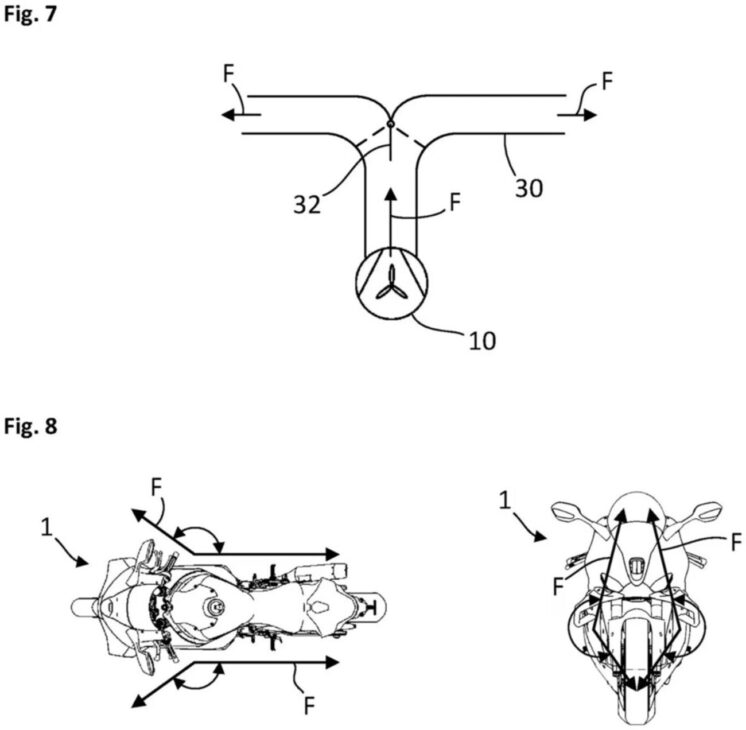
BMW surprised the automotive sector by registering a new patent that proposes the use of an internal fan to improve the grip of motorcycles. It involves an active aerodynamics system that channels pressurized air through ducts and nozzles strategically positioned on the motorcycle’s body.
The most important thing is that the project aims to alter the dynamic behavior of the machine even at low speeds.
Unlike the traditional wings of MotoGP or the fixed fins of superbikes, which rely on wind generated by speed, BMW’s idea is to control aerodynamics actively, using artificially driven air.
-
2027 Toyota Corolla Cross Unveiled: New Design, Enhanced Fuel Efficiency, Reduced Maintenance Costs, Advanced Technology, Connected Services, and Up to 10-Year Warranty

-
Fiat Cronos Precision 2018: Affordable Sedan with Spacious Trunk and Reliable Maintenance
-
Volkswagen to Cut Production by 1 Million Cars by 2030, Reducing Jobs and Platforms, Focusing on More Profitable Models

-
Toyota Launches First 100% Electric Car in Brazil: bZ4X with 343 HP, All-Wheel Drive, 361 km Range, Priced at $419,990 BRL, Limited to 99 Units




This air can be redirected according to the need of the moment: backward during acceleration; forward during braking; upward to increase downforce; and even sideways, generating more pressure in corners.
A Compact And Versatile System
The system features an internal fan connected to a network of valves and ducts. This network allows for a precise distribution of airflow to improve the motorcycle’s performance in different situations.
The proposal is similar to traction control but based on real-time aerodynamics manipulation.
Although it may seem new, the idea has appeared on other occasions in the automotive world. A classic example is the Brabham BT46B from Formula 1, created by Gordon Murray in the 1970s.
The car used a large fan to create ground effect, winning its first race with Niki Lauda.
The system was withdrawn by the team’s own initiative to avoid an innovation war among manufacturers.
References From The Past And Promise For The Future
Another famous case is the Chaparral 2J, which also used auxiliary fans. Decades later, Murray himself revisited the concept in the development of the supercar T.50.
In 2018, Bosch attempted a similar approach using pressurized gas cartridges. However, the idea did not progress due to cost and complexity.
Now, BMW’s proposal seems more compact and, in theory, applicable to production motorcycles.
There is still no launch forecast, but the patent reveals that the manufacturer is open to new ways of dealing with grip.
Instead of solely relying on electronics or tires, the company bets on a solution that blows air as if the motorcycle were a drone.
With information from Xataka.








