Portuguese
  Spanish


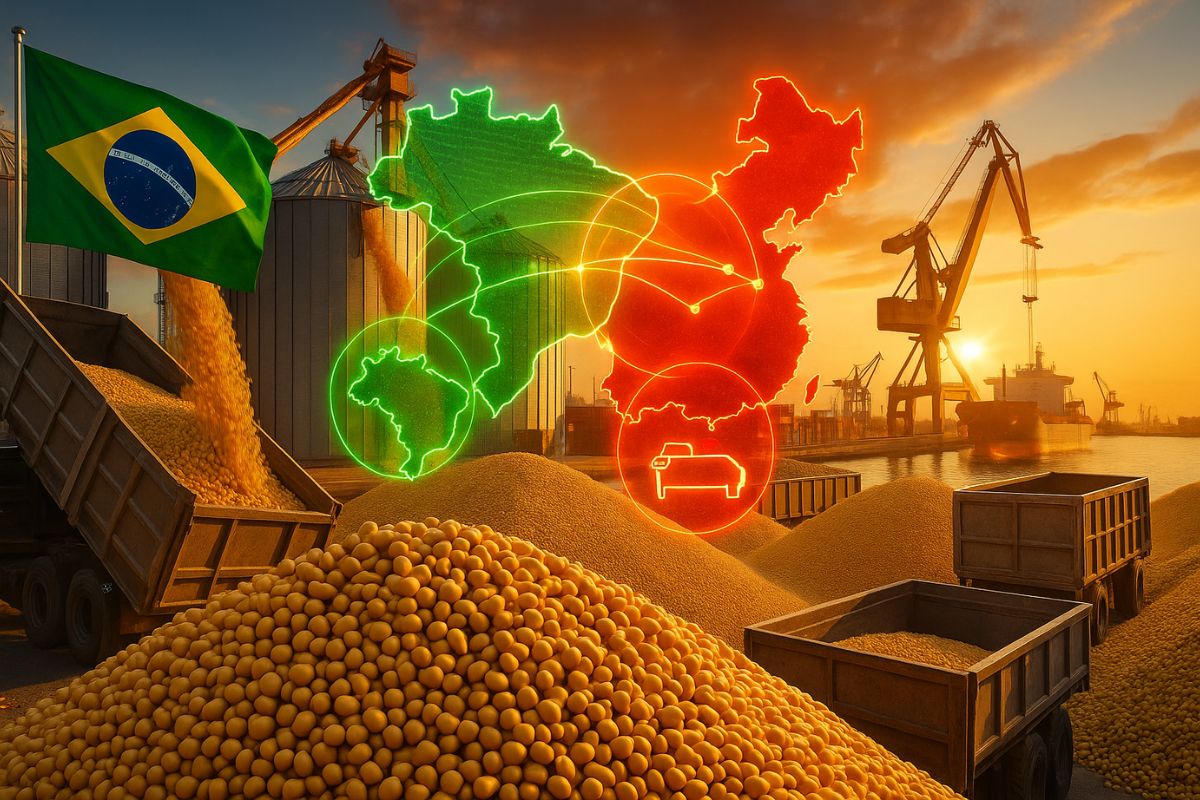


The Historical Leadership in Soybeans in 2025 Places Brazil at the Center of Global Food Trade, but Logistical Bottlenecks Threaten the Continuity of This Progress.
The historical leadership in soybeans in 2025 did not happen by chance. The tariff war between the United States and China opened up space for Brazil to occupy an unprecedented position in the global market. Direct offspring of this trade dispute, Brazilian producers began to supply China with record volumes of grains, consolidating a strategic role in global food security.
According to international trade consultant Welber Barral, this change is not limited to a spike in sales. It represents a structural change in the route of international trade, capable of redefining Brazil’s weight in global agricultural negotiations and influencing the long-term trade balance.
How Much China Bought and the Impact on the U.S.
In 2025, data presented on the Fest Money program showed that China has already secured 7.4 million tons of soybeans, most of which were purchased from Brazil and neighboring countries.
-
Brazilian Startup Turns Coffee Grounds into Plant-Based Leather, Cutting Water Use by Over 50 Times for High-Impact Sustainable Fashion

-
Eco Invest Auction Aims to Unlock $10 Billion in Investments, Focusing on Green Fertilizers, Critical Minerals, Batteries, and AI for Clean Industry in Brazil

-
Half of Brazilians Prefer Lower Taxes with Private Health and Education, While 44% Opt for Higher Taxes for State-Provided Services, Datafolha Survey Reveals

-
Brazil’s Most Expensive Toll Rises to R$ 40.60 on Route from São Paulo to the Coast, Nearly Matching Bus Fare to Santos



Meanwhile, the United States closed no shipments from the new harvest, a direct contrast to previous years.
This billion-dollar redirection weakens American revenue and strengthens Brazil’s trade surplus.
More than just numbers, soy has become a geopolitical instrument of contention, with a direct impact on the coffers of Beijing and Washington.
Who Else Benefits Besides Soy
Barral emphasized that the advantage is not limited to the grain.
The tariff war has also boosted Brazilian exports of corn, beef, pork, chicken, and even sorghum.
Today, around 50% of the meat imported by China already comes from Brazil, a statistic that reinforces the strategic role of Brazilian agribusiness in the Chinese diet.
This cascading effect amplifies Brazil’s relevance as a supplier of proteins, solidifying the country as a reliable alternative in light of population growth and Asian demand for food.
Where Brazil Can Expand Beyond China
The dispute is not limited to the China–U.S. axis.
Southeast Asian countries, such as Indonesia, Vietnam, Malaysia, and the Philippines, are emerging as increasingly relevant destinations.
They are markets with expanding middle incomes, experiencing strong demographic and economic growth, requiring grains and proteins to sustain internal consumption.
In this context, Brazil is competing directly with the United States, which are trying to regain ground through bilateral agreements and tariff cuts.
For Barral, this is the moment to expand economic diplomacy and open new routes for product distribution.
The Internal Bottlenecks That Threaten Leadership
Despite the achievement, Brazil faces a chronic logistical dilemma.
The transportation of soybeans and corn to ports remains slow and costly, reducing part of the competitiveness gained from the tariff war.
Poor roads, congested ports, and high storage costs pressure producers and could compromise medium-term advantages.
Barral warns that, even with these difficulties, Brazil has managed to maintain a position of strength.
However, without structural investments in infrastructure, the risk is to turn a momentary victory into a lost opportunity.
The Role of Brazilian Diplomacy
Presidential diplomacy also comes into play.
President Luiz Inácio Lula da Silva is preparing for his participation in a meeting of the ASEAN (Association of Southeast Asian Nations).
The goal is to diversify agribusiness destinations, reducing dependence on China and exploring markets like Vietnam and Malaysia.
This geopolitical maneuver reinforces the perception that the historical leadership in soybeans in 2025 may be the beginning of a global turnaround for Brazil, but it will depend on political articulation to be consolidated.
Is It Worth It for Brazil?
The immediate positive impact is clear: increased trade surplus, strengthening of agribusiness, and greater international prominence.
However, dependence on a single buyer brings risks.
If China signs preferential agreements with the United States, part of this advantage could disappear quickly, as has happened in other sectors.
The challenge for Brazil is to balance short-term gains with long-term strategic planning, investing in logistics, expanding diplomacy, and diversifying export destinations.
The historical leadership in soybeans in 2025 represents a milestone for Brazil, but also exposes internal fragilities that need to be overcome.
Do you believe this leadership will be sustainable or that dependence on China could become a problem in the future? Have you noticed the effects of this advance in your region or sector? Leave your opinion in the comments — we want to hear from those experiencing this transformation firsthand.