Called the Jaguari-Atibainha interconnection, Sabesp’s project uses a 6.4 km tunnel carved in rock and six 5,000 HP pumps to carry water from the Paraíba do Sul River to the Cantareira System in São Paulo. In June 2026, ANA authorized the transfer of up to 268.28 hm³.
One of the largest water engineering projects in Brazil has returned to the spotlight to aid São Paulo. The Jaguari-Atibainha interconnection, managed by Sabesp, uses a tunnel of 6.4 kilometers opened in rock and powerful pumps to transfer water between basins and reinforce the Cantareira. The case was detailed by the engineering publication Cimento Itambé.
What reignited the topic was a recent decision by the public authority. In June 2026, the National Water and Basic Sanitation Agency, ANA, authorized increasing the volume of water that can be transferred to the Cantareira, reaching up to 268.28 cubic hectometers. The measure is a response to the drought that has again put pressure on the system.
Behind this transfer is an engineering feat. To carry the water from one reservoir to another, the project needs to overcome a mountain, pushing the liquid uphill with gigantic pumps. Next, understand how the Jaguari-Atibainha interconnection works and why it is so strategic for São Paulo.
-
Engineering Students Build Off-Grid Tiny Home with Sustainable Features and Offer Free DIY Guide

-
Historic Brazilian Championship Stadium Demolished for New Supermarket and Shopping Center Development

-
Workers excavate one of the world’s longest railway tunnels beneath the Alps between France and Italy, stretching nearly 60 km, 600 meters deep, with an investment of 11 billion euros.
-
Japanese Company Constructs 100m² 3D-Printed House Using Earth Instead of Concrete, Generating Its Own Energy and Reducing Costs and Emissions



What is the Jaguari-Atibainha interconnection
The project was created to connect two different hydrographic basins. The Jaguari-Atibainha interconnection links the Jaguari reservoir, located in the Paraíba do Sul River basin, to the Atibainha reservoir, which is part of the Cantareira. In practice, it creates a water bridge between two systems that previously did not communicate.
The connection is operated by Sabesp, the São Paulo sanitation company. The project was completed in 2018, as a direct response to the severe water crisis of 2014 and 2015, when the Cantareira nearly dried up and Greater São Paulo faced the specter of water shortages. The idea was to create an extra source of security.
The project is considered the largest inter-basin connection work in the country. By allowing the transfer of water from where there is more to where there is less, the Jaguari-Atibainha interconnection increases the resilience of supply during droughts. It is a kind of water insurance for millions of people.
The scope of the project is impressive. According to the project’s information, the interconnection helps ensure water for about 39 million people in the metropolitan regions of São Paulo, Campinas, in the Paraíba Valley, and even in Rio de Janeiro. It’s a number that gives a sense of what’s at stake.
The project cost hundreds of millions of reais and mobilized a massive engineering effort. Built in just a few years, under the pressure of the crisis, it became a symbol of how São Paulo tried to shield itself against new droughts. For Sabesp, it is now a central piece of the metropolitan area’s water supply system.
A 6.4 km tunnel carved into the rock
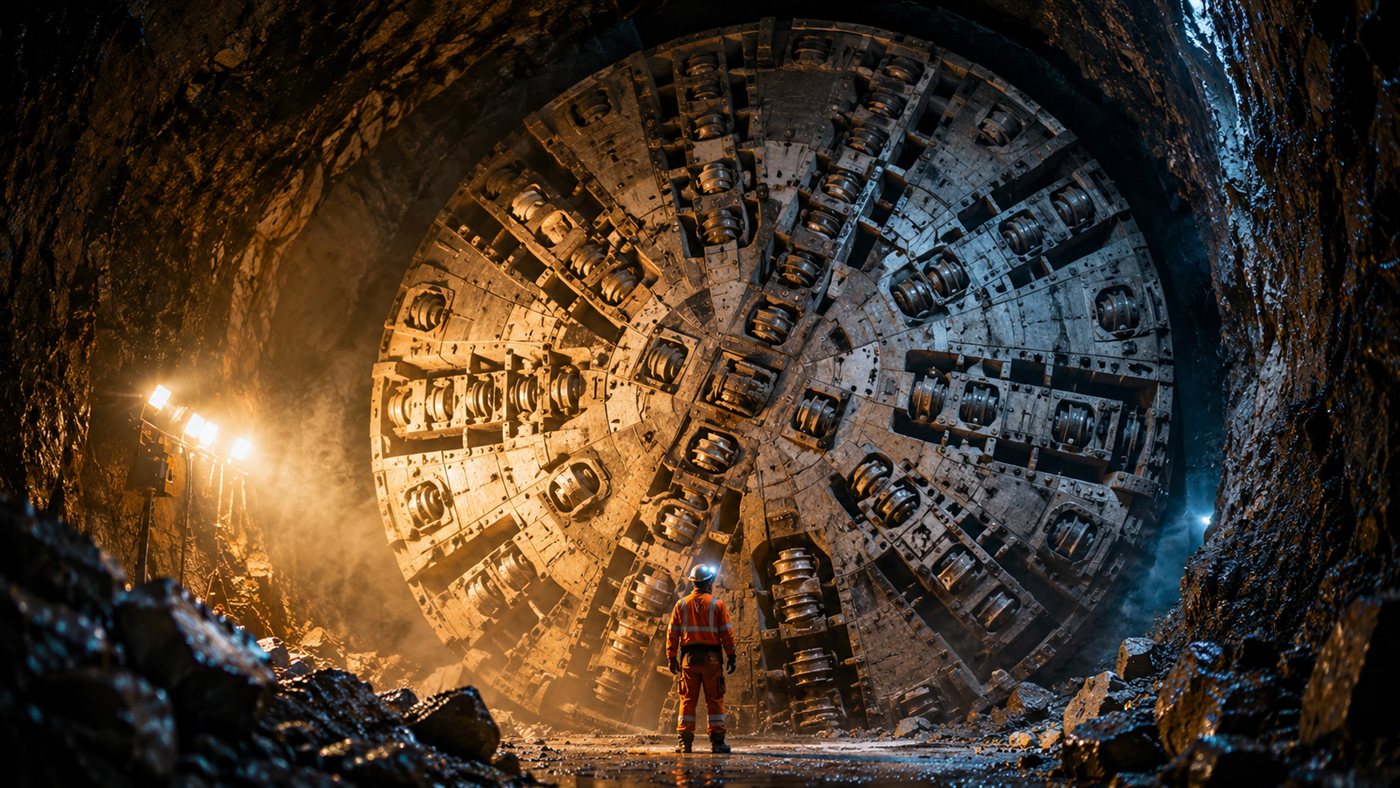
The heart of the project is a massive underground tunnel. To overcome the terrain between the reservoirs, the engineers opened a tunnel 6.4 kilometers long directly into the rock, through which the water is conducted. It’s a passage carved into the mountain, out of sight of those who only see the reservoirs on the surface.
The dimensions of the tunnel help to understand the size of the undertaking. The gallery is about 5 meters high and 4 meters wide, which gives a section of approximately 20 square meters. It’s enough space to transport a large volume of water at once, like an underground avenue.
Opening a tunnel of this size in the rock is no simple task. It involves drilling, excavation, and reinforcing the structure over kilometers, with heavy machinery and a lot of engineering control. Each meter advanced requires care to ensure the safety and durability of the passage.
But the tunnel is just one part of the project. Besides it, the interconnection includes about 13.2 kilometers of pipelines, conduits that carry the water, as well as a pumping station responsible for capturing and pumping the raw water, and a power substation to feed the entire system. It’s a complex set of pieces working together.
Underground projects like this are among the most complex in engineering. Digging a tunnel in the rock requires studies of geology, ventilation, drainage, and wall reinforcement, all to prevent collapses and infiltrations. In the case of the Jaguari-Atibainha interconnection, the challenge was even greater by connecting the tunnel to pumping stations.
6 pumps of 5,000 HP to push water uphill
The biggest technical challenge of the project is going against nature. Normally, water flows down by gravity, but here it needs to climb a mountain to pass from one reservoir to another. For this, the Jaguari-Atibainha interconnection relies on a set of extremely powerful pumps.
There are six pumps of 5,000 HP each. These gigantic pieces of equipment have the function of pushing the water uphill, overcoming the terrain that separates the reservoirs. Without them, the transfer simply wouldn’t happen, as the water doesn’t rise on its own.
The elevation that needs to be overcome is impressive. The pumps have to surpass about 200 meters of water column, meaning the equivalent force to lift the water to that height. It’s like pumping an entire river to the top of a building of dozens of floors, continuously.
This whole effort has an energy cost. Pushing so much water upwards requires a lot of electricity, which explains the need for a substation dedicated solely to the project. In return, the system gains something precious: the ability to move water in the direction of those who need it most.
Keeping this pumping running comes at a high price. Since the pumps consume a lot of energy, transferring water through the interconnection is much more expensive than capturing from a nearby source by gravity. Therefore, Sabesp uses the system mainly in critical moments, and not all the time.
8,500 and 12,200 liters per second: a two-way street
A little-known detail is that the interconnection works in both directions. The project was designed as a basin transposition with the possibility of reversal, meaning the water can flow both ways, depending on the need of each moment.
The flow rates, however, are different in each direction. In the direction that reinforces the Cantareira, from the Jaguari reservoir to the Atibainha, the interconnection can transfer up to 8,500 liters of water per second. This flow is what interests São Paulo in times of drought.
In the reverse direction, the capacity is even greater. From the Atibainha to the Jaguari, the system can reverse up to 12,200 liters per second, returning water to the Paraíba do Sul basin when necessary. This flexibility is what makes the project so ingenious.
Therefore, a common correction is warranted. The number of 12.2 thousand liters per second, often cited, refers to the reversal direction, not the flow that supplies the Cantareira. To save the São Paulo system, what counts is the flow of up to 8,500 liters per second in the Jaguari-Atibainha direction.
This flexibility has long-term logic. In rainier years, São Paulo can return water to the Paraíba do Sul; in dry years, it receives reinforcement through the Jaguari-Atibainha interconnection. The system thus functions as a kind of water current account between the two basins, adjusted according to the season and need.
The authorization of ANA and the 268.28 hm³
The most recent hook of the story came from Brasília. In June 2026, ANA, together with state management bodies, approved a temporary supplementary capture to reinforce the supply of the Cantareira. This decision is what released more water for Greater São Paulo.
The authorization numbers are specific. The maximum annual volume that can be transferred from the Jaguari plant to Atibainha increased from 162 cubic hectometers to up to 268.28 cubic hectometers, an increase of 106.28 cubic hectometers. The maximum authorized intake flow is 8.5 cubic meters per second.
The release, however, has rules and a deadline. According to ANA, the authorization is valid until the end of 2026 and is temporary, linked to drought management. The reinforcement is automatically suspended if the Cantareira returns to operating above 60% of its useful volume, that is, when the situation improves.
This caution shows the balance sought by regulators. The idea is to use the extra water only while there is real need, avoiding harm to other regions. Thus, Sabesp gains breathing room to get through the dry period without excessively depleting neighboring sources.
To give an idea of the volume, it’s worth translating the unit. One cubic hectometer is equivalent to 1 billion liters of water, so the 268.28 hm³ authorized represent hundreds of billions of liters over the year. It’s a significant reinforcement to help sustain the Cantareira during the drought.
Why Cantareira Needed Reinforcement
To understand the urgency, it’s necessary to remember the recent past. The Cantareira System is one of the main water sources supplying Greater São Paulo, and it became globally known during the crisis of 2014 and 2015, when its reservoirs came close to collapse. The trauma of that time still lingers.
It was precisely this crisis that motivated the construction of the Jaguari-Atibainha interconnection. After seeing the largest metropolis in the country on the brink of rationing, the government invested in projects that would bring water from other basins, creating alternatives to avoid repeating the desperation of years past.
In 2026, the scenario once again raised the alarm. With the drought, the Cantareira began operating in an alert zone, with a reduction in the water withdrawal limit by Sabesp. This situation justified the request for more transfers through the Jaguari-Atibainha interconnection.
The reinforcement then acts as a safety valve. Bringing water from the Paraíba do Sul helps maintain the levels of the Cantareira during the dry season, buying time until the rains return. It’s a way to prevent the metropolis from reaching a critical situation again.
The pressure on the Cantareira also comes from the size of the demand. Greater São Paulo has more than 20 million inhabitants, and any failure in supply affects a huge contingent. Ensuring water for so many people requires a robust system full of alternatives, like the interconnection operated by Sabesp.
“Surpassed São Francisco in Technology”?
The project is often compared to another giant in the country. According to the publication Cimento Itambé, the Jaguari-Atibainha interconnection would have surpassed even the São Francisco River transposition in terms of technology employed. It is a framing from the source, not an absolute consensus.
The comparison makes sense for a technical reason. The São Francisco transposition uses, for the most part, channels that take advantage of gravity to carry the water. Meanwhile, the São Paulo interconnection needs to pump the water uphill, through a tunnel in the rock, which requires different and very powerful engineering.
Each project, however, has its own grandeur. The São Francisco is gigantic in extension and social reach in the Northeast, while the Jaguari-Atibainha stands out for the complexity of overcoming the terrain with pumps and tunnel. Comparing the two helps to appreciate the challenges of each project.
The important thing is what these projects represent. Both the São Francisco transposition and the Sabesp interconnection show how Brazil resorts to large-scale engineering to redistribute water and face scarcity. They are significant responses to a problem that tends to grow with climate change.
Where the water comes from: the Paraíba do Sul River and the agreement with Rio
The water that aids São Paulo originates from a disputed basin. The Paraíba do Sul River, from where the transfer starts, also supplies cities in the interior of São Paulo and, mainly, the state of Rio de Janeiro. Therefore, altering this volume involves negotiation between states.
The agreement reached seeks to protect all sides. According to the ANA, the authorization maintains guarantees for the supply to Rio de Janeiro, preserving the minimum flow at the Santa Cecília dam and the pumping to the Guandu River, which is vital for the capital of Rio. No one can be left without water.
This care avoids conflicts between neighbors. Transferring water from one basin to another is always delicate, because what is left for one may be lacking for another. Therefore, the Jaguari-Atibainha interconnection operates with limits and monitoring, so as not to turn São Paulo’s solution into Rio’s problem.
In the end, the project benefits a huge population on both sides. By balancing needs, the transfer helps provide water security to tens of millions of people in São Paulo, Campinas, the Paraíba Valley, and Rio de Janeiro. It is a collective effort for an increasingly valuable resource.
Basin transpositions, however, divide opinions among experts. While on one hand, they save metropolises from a lack of water, on the other, they may encourage waste and delay solutions like reducing network losses and reusing water. The Jaguari-Atibainha interconnection is an important remedy but does not replace the fight against waste.
And you, did you know that São Paulo pumps water uphill to avoid drying out?


The Jaguari-Atibainha interconnection shows the magnitude of the effort to ensure water for the country’s largest metropolis. With a 6.4-kilometer tunnel in the rock and six 5,000 HP pumps overcoming a 200-meter elevation difference, Sabesp pushes the water uphill to reinforce the Cantareira, now with approval from ANA to transfer up to 268.28 cubic hectometers.
And you, did you imagine it was necessary to pump entire rivers up the mountain to supply São Paulo? Share your thoughts in the comments about this engineering feat and whether you believe projects like this are the way for Brazil to face future water crises.