Portuguese
  Spanish


Brazilian real estate agent based in Florida explains the construction system used in the United States and shows why the absence of a concrete slab is directly linked to hurricane resistance, construction cost, and even domestic accidents
According to a video published on June 28, 2026, on the Ricardo Molina USA channel on YouTube, Brazilian real estate agent Ricardo Molina, based in Orlando, Florida, explains one of the details that most catches the attention of Brazilians when visiting or buying a house in the United States: the absence of a concrete slab. Unlike the predominant construction standard in Brazil, most American houses are built on a system called a raft foundation, and the reason for this choice goes far beyond aesthetics.
According to Molina, understanding this difference requires first knowing how the foundation of these residences works. In this sense, the raft foundation functions like an inverted slab: a layer of concrete 20 to 30 centimeters thick, applied directly over compacted sand, which serves as the base for the entire construction. From there, the rest of the process follows a logic quite different from what Brazilians are used to seeing in residential construction.
The foundation that replaces the slab: how the raft system works
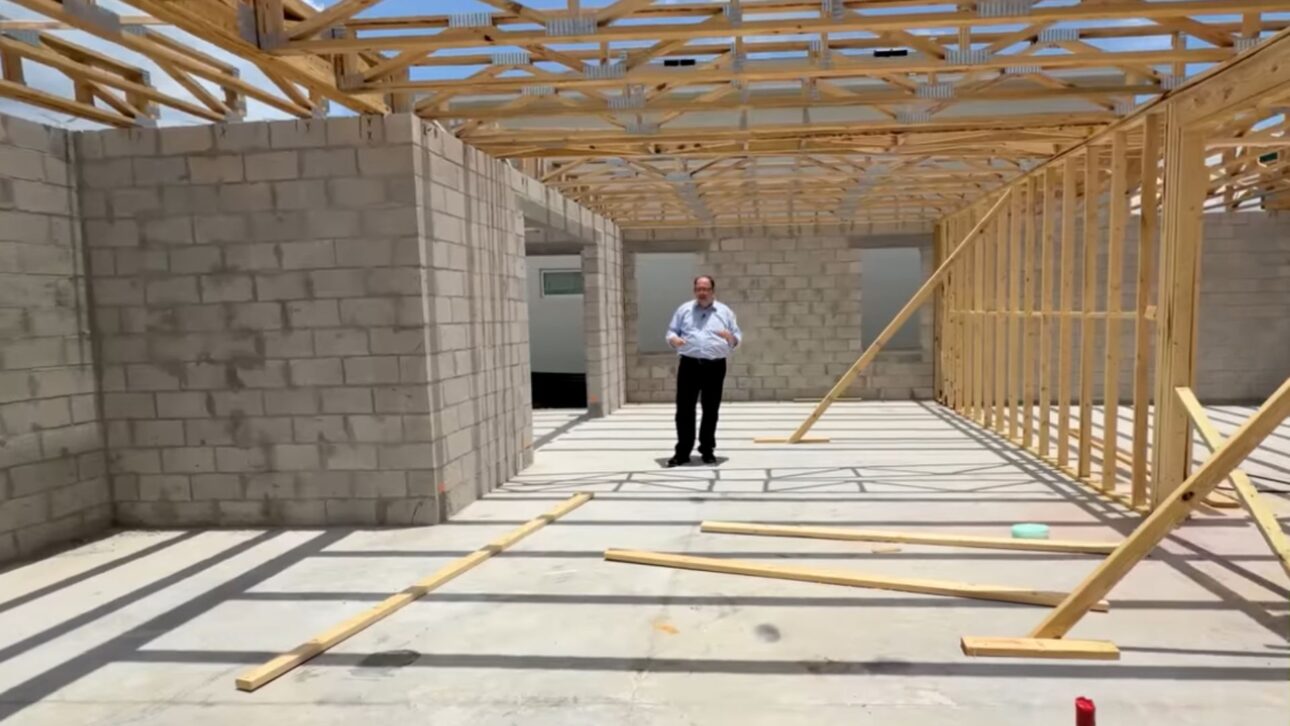
On the raft foundation, the first floor of the house is usually built entirely in structural block. In this system, small concrete columns are positioned every 2.5 meters, approximately, ensuring the support of the walls. Additionally, all beams that span larger gaps — such as a garage door, for example — arrive pre-molded at the construction site, with specific dimensions to support the weight of the structure. A beam used over a garage, according to Molina, is usually about 30 centimeters wide by 20 centimeters high, significantly wider than what is normally seen in equivalent Brazilian constructions.
-
China’s Largest Floating LNG Plant, NGUYA, Sets Sail for Congo: 2.4 Million Tons Annually for Italy’s Eni

-
Innovative Project Demonstrates How to Build a Modular, Eco-Friendly Cabin Using Recycled Timber Logs

-
Transform Your Bathroom with Paint, Mirrors, LED Lighting, and Accessories for a Quick, Cost-Effective Makeover
-
Couple Converts 1925 Detroit Bank into Home, Earns $40,000 Annually on Airbnb

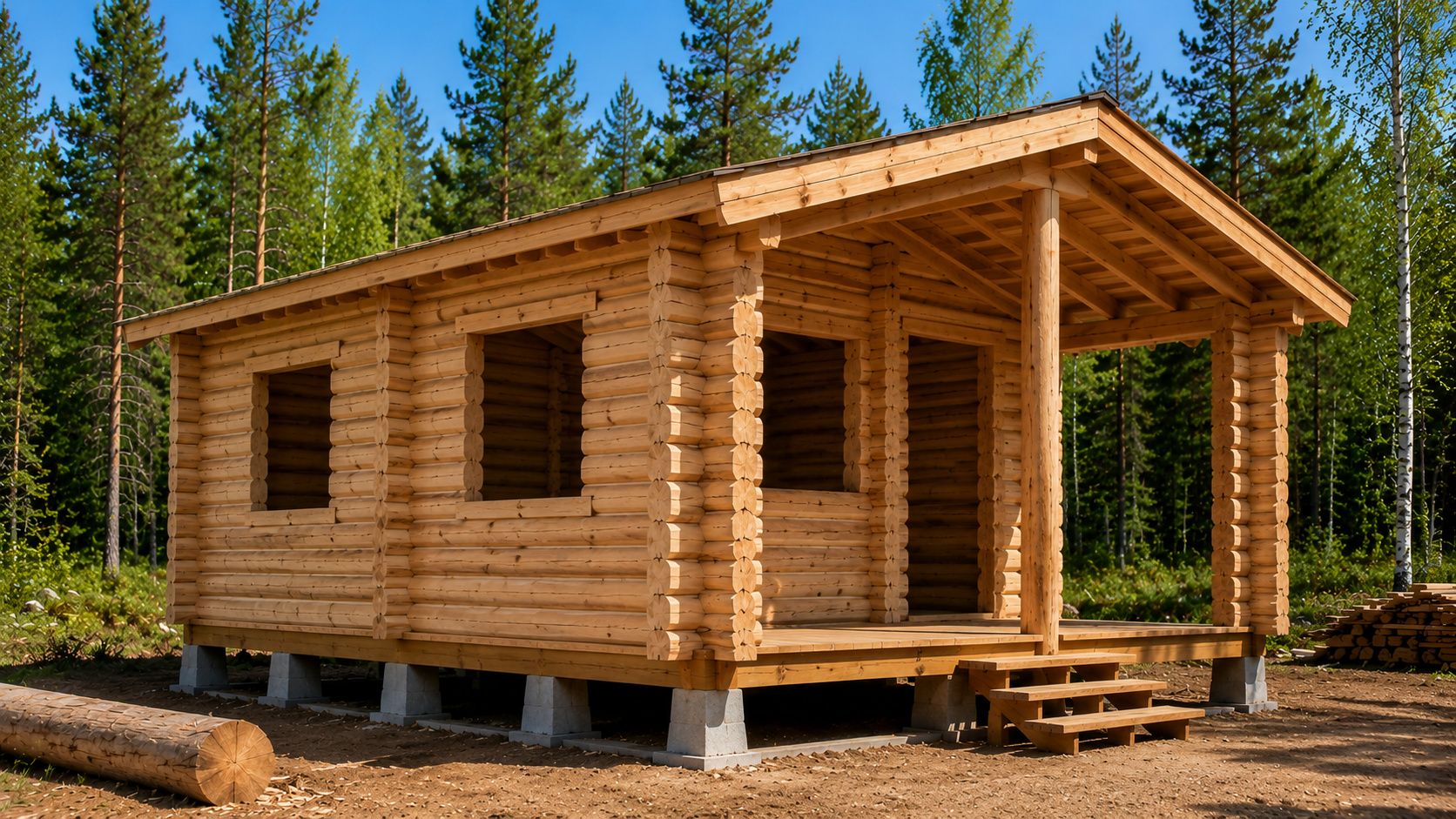


Another technical detail draws attention: the last row of blocks, at the top of the wall, is of the channel type, internally filled with concrete. It is precisely in this concrete beam that galvanized steel ties are embedded — pieces responsible for extremely resistantly joining the masonry part with the wooden structure that will be built on top. Although this combination of wood and concrete may seem unreliable to those accustomed to the Brazilian standard, it is precisely this embedding that allows American houses to withstand strong winds well.
From this point, the construction moves on to what usually raises more questions in Brazil: the famous wood frame, a system in which the upper part of the house is erected with wood spaced every 16 inches, interlocked with each other and then closed with drywall panels. It is also at this stage that the house’s layout begins to become visible — internal walls defined, water piping already installed and pressurized, ready to receive the final finishes.
Wood frame, trusses, and the absence of a slab: why this is safe — and where the risk lies
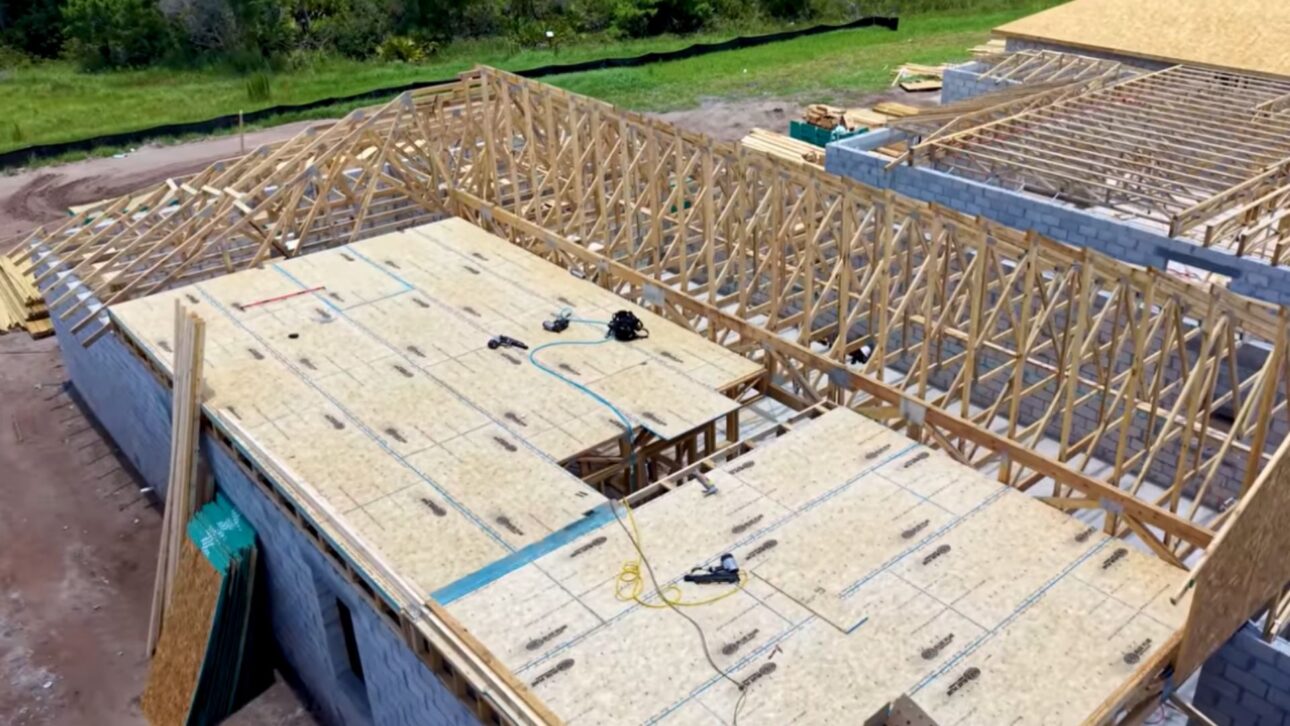
But the central point of Molina’s explanation lies in what replaces the slab on the house’s ceiling: wooden trusses, calculated and supplied by companies specialized in structural wood. These pieces already arrive at the site custom-made, ready to be fitted, which explains the speed of assembly — a truck delivers the numbered beams, and each one is positioned in its specific place, allowing an entire roof to be installed in a single day.
When the house is single-story, the underside of the roof receives only a layer of drywall, followed by styrofoam or another insulating material, whose function is to contain the heat coming from the cover. Here, however, is a structural detail that has serious consequences: this drywall ceiling was not designed to support the weight of a person walking on it — only to support the layer of thermal insulation.
It was precisely this detail that, according to Molina, explains the accident that killed presenter Gugu Liberato in November 2019, inside his own home in Florida. Upon climbing into the space above the ceiling, Gugu might have interpreted the structure as a concrete slab, similar to what is normally seen in Brazil. By stepping on the drywall span — which does not have the resistance for this type of load — he fell headfirst, in a fatal accident. The case, remembered by Molina as a practical example, reinforces the importance of knowing the real limitations of this material before moving through areas that, at first glance, seem safe.
It is also worth noting that this vulnerability is not a rule in all constructions. When the house is a two-story — that is, it has more than one floor — an additional layer of plywood is installed over the drywall, precisely to support the weight of people walking on the upper floor. Another technical point mentioned by Molina involves the space created between the ceiling and the roof, known as the “attic” in the United States — equivalent to the attic in Brazil. All the air conditioning ducts and the house’s electrical wiring pass through there, in addition to functioning as an extra layer of thermal insulation against the intense heat of Florida. Not by chance, thermal comfort is a constant concern in American constructions: practically all have central air conditioning, and the better the insulation of the house, the longer the equipment’s lifespan and the lower the energy consumption.


Is it worth asking for a concrete slab anyway? Cost, hurricanes, and earthquakes
Given so many technical details, the most common question arises among Brazilians considering buying or building a house in the United States: is it possible to ask for a concrete slab, the way it is built in Brazil? According to Molina, yes — but the request comes at a price. Besides the concrete itself, pointed out as the most expensive material of the entire construction, the greatest financial impact comes from the foundation. Since the slab system was designed to support the weight of a wooden structure, any significant load increase — such as that of a concrete slab — requires additional reinforcements, like footings and drills, specifically calculated by an engineer.
On the other hand, Molina draws attention to an important point: the most common motivation among Brazilians for wanting a slab is the fear of hurricanes — and, according to him, this concern may not make much sense in the American context. Wood frame constructions follow building codes calculated to withstand category 5 hurricanes, the highest level on the scale. According to the broker, it is unlikely that a hurricane can tear off the upper part of a new house built to this standard and cause damage to those below. Images of houses destroyed by hurricanes, common on the Florida coast, usually show old constructions, built before the requirement for category 5 resistance — and, in most cases, the greater damage does not come from the wind, but from the water.
Still, however, there is a scenario where the concrete slab actually represents a greater risk: that of earthquakes. Although Florida does not have this type of occurrence, states like California, located on the Pacific tectonic plate, frequently face this risk. In these cases, according to Molina, a concrete slab can collapse during a tremor and cause serious injuries to those underneath, precisely because of the weight of the material. A wooden structure, being more flexible, tends to sway and adjust to the seismic movement, rarely collapsing on the residents.
Molina’s conclusion is straightforward: those who want a concrete slab simply out of personal preference and are willing to pay more for it can request it without any issues. However, those who intend to make this request solely for hurricane protection might be solving, with Brazilian logic, a problem that, in the American context, doesn’t even exist.
Specialized in helping Brazilians understand the workings of the American real estate market, Molina has been a real estate agent since 2004 and has lived in the United States for years, after swapping, as he recounts on his own channel, a world sailing trip for a new life in Florida — now dedicated to demystifying, for the Brazilian audience, the differences between building and living in the two countries.
Given the many structural differences between the two countries, it raises a reflection: does the fear of hurricanes really justify giving up a cheaper, more flexible, and technically prepared construction system for this type of natural disaster — or is this just another case of trying to solve, with the Brazilian yardstick, a problem that the United States has already solved in its own way?