Portuguese
  Spanish


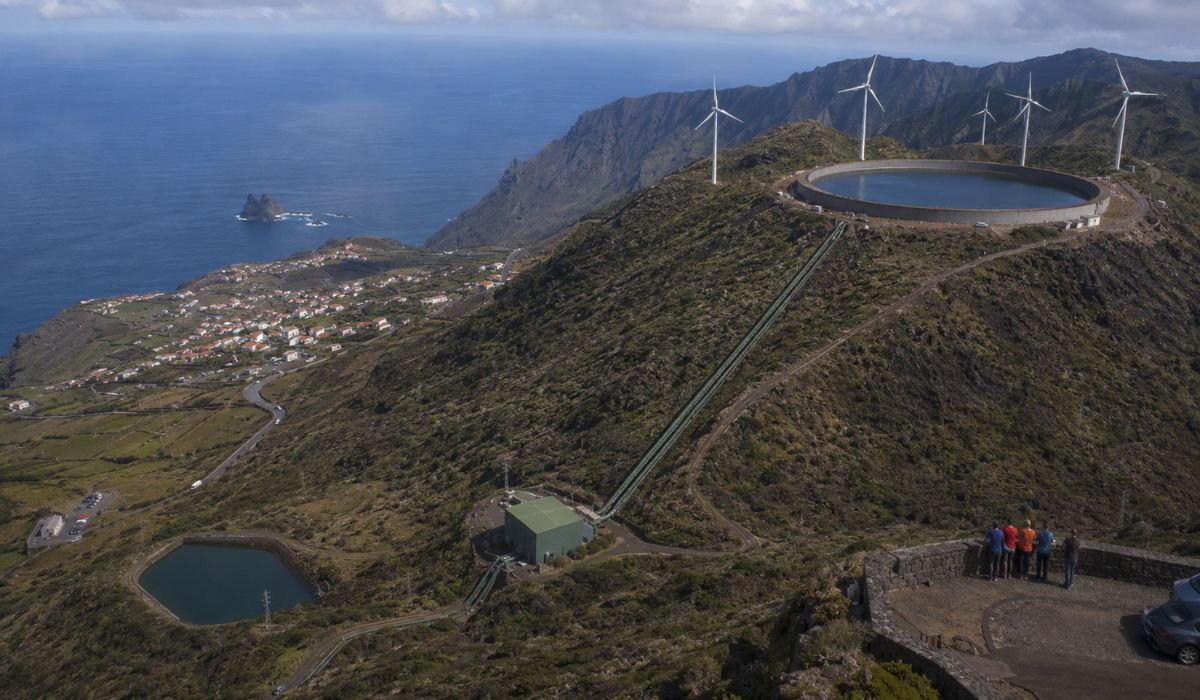

In the Atlantic, a small island combines wind, water, and volcanic terrain to reduce dependence on fossil fuels and test an energy model observed by researchers from different countries.
The Spanish island of El Hierro, in the Canary Islands archipelago, has accumulated 10,000 hours of 100% renewable electricity supply since the Gorona del Viento project, which combines wind and water to reduce diesel dependence in an isolated territory in the Atlantic, became operational.
The milestone was reported by The Guardian and has once again placed the island in the debate on clean energy models in areas without direct connection to large power grids.
Located at the westernmost point of the Canary Islands, near the northwest coast of Africa, El Hierro has strong volcanic activity, rugged terrain, and constant winds.
-
Brazilian Craftsman Builds Small Hydropower Plants Generating Over 1,000 kWh Monthly, Paying for Themselves in Just Over a Year

-
Unknown Molecule Possibly Detected on Pluto and Titan by James Webb Telescope

-
Global Population Estimates May Be More Inaccurate Than Thought: Study Finds Rural Areas Underestimated in 35 Countries, Sparking Debate Over Earth’s 8.2 Billion Inhabitants
-
From Space, a “Great Solar Wall” Spans 400 km of China’s Kubuqi Desert, Transforming the “Sea of Death” with Giant Panels to Combat Sandstorms and Revitalize the Land



According to UNESCO, the island has one of the highest concentrations of volcanoes in the archipelago, with more than 500 open craters and hundreds more covered by more recent lava flows.
The small size, geographical isolation, and need to import fuel help explain why El Hierro has become a focus for researchers, governments, and companies interested in solutions for islands and remote regions.
Renewable energy in El Hierro
The center of the project is the Gorona del Viento wind-hydro power plant, located in the municipality of Valverde.
The system comprises five wind turbines, a pumping station, a hydroelectric plant, water reservoirs, and a control structure that alternates generation and storage according to wind conditions and demand.
When there is sufficient wind, the wind turbines produce electricity to supply the island.
The excess energy is used to pump water from a lower reservoir to another located at a higher elevation.
In periods of lower wind production, this water is released and passes through hydraulic turbines, generating electricity for the local grid.
According to the Institute for Energy Diversification and Saving of Spain, the plant has a 11.5 MW wind farm, a 11.32 MW hydroelectric plant, a 6 MW pumping system, and an upper reservoir with a capacity of 380,000 cubic meters.
María Candelaria Sánchez Galán, head of operations at Gorona del Viento, explained in an interview with The Guardian that the stored water functions like a battery.
The statement summarizes the principle of the system: using the surplus wind energy to create a reserve capable of generating electricity when the wind is not sufficient.
Diesel use is still part of the electric grid
Despite the advances, El Hierro still does not operate permanently without fossil fuels.
Official data from Gorona del Viento shows that in 2025, the plant ensured 1,049 hours of 100% renewable coverage, avoided the emission of 21,551 tons of greenhouse gases, and saved 5,591 tons of diesel.
Red Eléctrica, the operator of the Spanish electric system, reported that the hydro-wind plant accounted for 43.6% of the island’s annual generation in 2025.
In the same year, renewable participation exceeded 80% on 69 days, according to the company.
This data updates the previous reference that El Hierro met about half of the annual electricity demand with renewable sources.
The difference between reaching 100% at certain periods and maintaining this rate throughout the year is central to understanding the case.
The experience shows that renewable self-sufficiency can occur for long periods, but also depends on wind, consumption, storage, and network control operating in a coordinated manner.
In 2019, El Hierro had already recorded a prolonged period of exclusively renewable supply.
According to the Cabildo of El Hierro, between July 13 and August 7 of that year, the island spent 596 consecutive hours with electricity produced by the combination of wind and hydraulic generation.
Why El Hierro attracts researchers
The quest for self-sufficiency on the island did not start only with electricity.
A severe drought in 1948 marked the local memory and led residents to rely on external aid to secure water.
Since then, water and energy security have been integrated into public policies and infrastructure projects in the territory.
Today, the electricity produced by Gorona del Viento also helps power the desalination plants that supply the population.
The relationship between water and energy appears in two stages: water serves as a form of electrical storage and, at the same time, requires electricity to be produced on an island with limited natural resources.
Galán told The Guardian that scientists from different countries visit El Hierro to study how the model can be applied in other territories.
“We are a constantly evolving laboratory,” she said.
The phrase was used by the head of operations to describe the technical monitoring that the project has received since its implementation.
The application of the model, however, depends on local conditions.
El Hierro has a small population, lower electricity demand than large urban centers, frequent winds, terrain suitable for water pumping, and environmental conservation policies.
These factors help explain the performance of the plant and make direct comparisons with larger cities or islands with different geography difficult.
Volcanoes, biodiversity, and protected areas
The energy transition of El Hierro takes place in a territory recognized by international conservation bodies.
The island was declared a Biosphere Reserve by UNESCO in 2000 and received the status of a global geopark in 2015, a classification aimed at preserving areas with geological relevance.
The volcanic landscape is one of the central features of the island.
In less than 300 square kilometers, El Hierro gathers craters, cones, lava fields, cliffs, and agricultural areas adapted to an irregular terrain.
The territory also includes protected zones, marine reserves, and endemic species, which brings the energy policy closer to topics such as land use, agriculture, and biodiversity conservation.
In the Valle del Golfo, organic farming appears as another axis of the local strategy.
Mariela Pérez, responsible for an experimental farm of the island council mentioned in the original report, related the presence of butterflies to the environmental quality of the area.
“Butterflies are the indicator of air quality. Here everything is organic farming, and that’s why they come,” she stated.
Agricultural production coexists with the recovery of traditional vineyards.
The winemaker Carmelo Padrón, who inherited land from his family, works on the revival of local varieties in areas that had been abandoned.
According to him, some of these grapes became rare in Europe after phylloxera, a pest that affected European viticulture in the 19th century.
Tagoro Volcano and marine research
The southern coast of El Hierro, known as Mar de Las Calmas, is also part of the island’s conservation and research projects.
The region is used by artisanal fishermen, divers, and scientists, especially because of the underwater volcanic formations and the presence of marine life.
In 2011, a submarine eruption south of the locality of La Restinga gave rise to the Tagoro volcano.
Initially, the phenomenon impacted marine fauna and flora.
Over the years, researchers began to observe the recovery of species and study the area as a natural environment for scientific monitoring.
The proximity of Tagoro to the coast made the volcano more accessible for research.
Eugenio Fraile, a researcher at the Spanish Institute of Oceanography cited in the original report, states that the existence of a hydrothermal source less than 2 kilometers from the coast can be investigated as a potential geothermal resource for El Hierro.
Fraile’s assessment indicates potential for energy use, but the proposal still depends on studies, technical feasibility, and confirmation before any application.
Therefore, geothermal energy appears as a possibility under analysis, not as a solution already incorporated into the island’s electrical system.
What the energy model indicates
El Hierro has not completely eliminated diesel nor solved all the challenges of an isolated electrical grid.
Even so, official data indicates that the island has managed to sustain supply with renewable sources for thousands of hours since the implementation of Gorona del Viento.
The case also indicates that the energy transition in isolated areas depends on more than one generation source.
In the model adopted by the island, wind, water, storage, grid control, and consumption management work in an integrated way to reduce the activation of diesel engines.
The hydro-wind power plant is the most well-known structure of the project, but the local experience also involves desalination, agriculture, artisanal fishing, environmental protection, and territorial planning.
In El Hierro, these areas appear connected because the availability of energy, water, and natural resources directly interferes with the daily life of the population.