Portuguese
  Spanish



Anatel releases bands used by mobile telephony for direct connection between satellites and regular cell phones, but Starlink will not be able to operate alone in Brazil
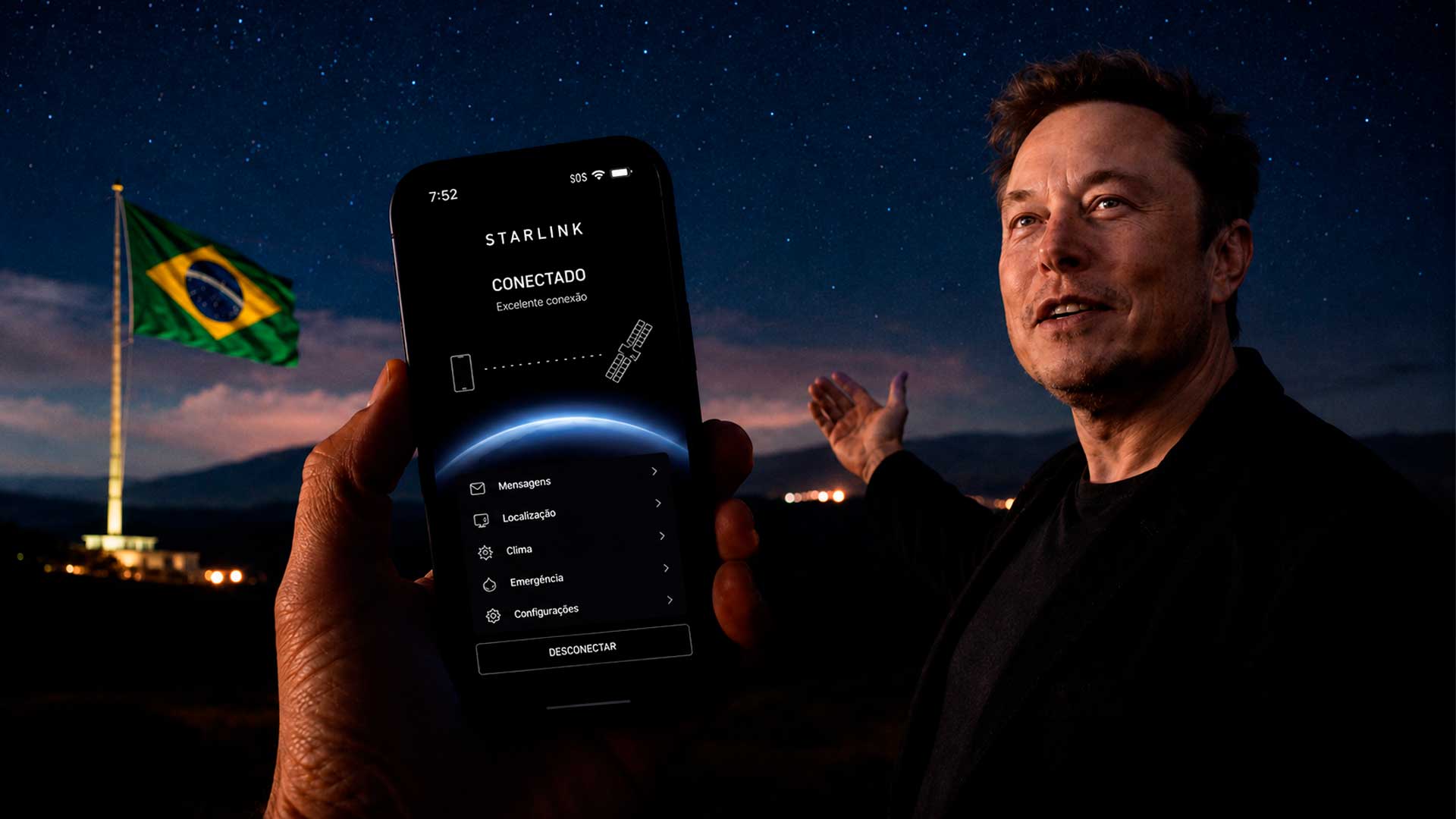
Anatel approved the allocation of radio frequency bands for Direct-to-Device services, a technology that allows regular cell phones to connect directly to satellites without an external antenna. The decision paves the way for services like Starlink Direct to Cell to arrive in Brazil.
The central point is the operating model. The satellite connection should function as an extra layer of the mobile network, always in partnership with operators already authorized to use the bands in the country.
In practice, the feature should start with messages, location, and basic services in areas without signal. Calls and heavier mobile data still depend on technical evolution, Anatel’s final rules, and commercial agreements.
-
Brazilian Recycling Company Overcomes $200,000 Debt to Process 360 Tons of Plastic Monthly and Produce 27,000 Items Daily

-
The More You Love Someone, the Sleepier You Feel Around Them: Science Explains Why the Body Relaxes and Feels Safe with a Loved One

-
Kenyan Company Recycles Over 10 Million Flip-Flops from Indian Ocean Beaches into Elephant and Giraffe Sculptures Sold for Up to $1,200
-
Kenyan Brothers Recycle Old Newspapers Into 100,000 Pencils Daily, Aiming to Donate to 1 Million Children in Underprivileged Schools




Anatel’s decision places satellite cell phones within the frequencies already used by Claro, TIM, and Vivo
The Board of Directors of the National Telecommunications Agency approved, on Thursday, July 2, 2026, the update of the Frequency Allocation, Destination, and Distribution Plan in Brazil. The measure included direct communication between satellites and regular cell phones, known in the sector as Direct-to-Device, or D2D.
The new allocation allows the secondary use of traditional mobile telephony bands, such as 700 MHz, 850 MHz, 900 MHz, 1,800 MHz, 1,900/2,100 MHz, and 2,500 MHz. According to Mobile Time, the operation cannot occur in isolation and must be done with the terrestrial provider that holds the primary use of that spectrum.
This detail changes the significance of the news. Starlink may have the most advanced technology to start the service, but it has not gained authorization to connect Brazilian cell phones directly to its network on its own. It will need to make agreements with mobile operators already licensed in Brazil.
The model is similar to what happens in the United States, where Starlink operates alongside T-Mobile. The satellite comes into play when the cell phone loses the terrestrial tower signal, mainly on roads, rural areas, forest regions, mining zones, farms, vessels near the coast, and points with low coverage.
The regular cell phone becomes the center of the dispute because it does not require an antenna, special chip, or new device


The promise of D2D is simple for the user. Instead of buying a Starlink antenna, installing equipment at home, or carrying a satellite communicator, the compatible cellphone connects directly to a low-orbit satellite when it doesn’t find terrestrial coverage.
Anatel itself had already monitored tests in Maranhão in 2025, conducted by Claro and Lynk. According to the agency, the technology allows direct communication with regular cellphones and can expand coverage in remote locations or in emergency situations when terrestrial towers are damaged.
The operation, however, does not transform the cellphone into a complete Starlink internet on the first day. The initial phase tends to prioritize text messages, location, and essential communications. This limitation is technical because the signal needs to travel hundreds of kilometers between the device and the satellite, using much less power than a dedicated antenna.
Even so, the impact can be significant in a country with long highways, extensive rural areas, and coverage gaps outside urban centers. For those working in farming, transportation, energy, mining, fishing, adventure tourism, or civil defense, a message sent in an area without a tower can solve an emergency.
The caveat of the authorization is in the next 90 days and in the technical rules that are still missing
Anatel’s approval does not mean immediate commercial launch. The Superintendence of Grants and Provisioning Resources will have up to 90 days to draft the technical specifications of the service and submit the text to the Board of Directors.
These rules will define usage limits of the sub-bands, interference parameters, operating conditions, and ways of coexistence between satellites and terrestrial networks. The subject is sensitive because the released frequencies are already used by mobile operators in millions of active accesses in the country.
According to Teletime, the assignment was approved on a secondary basis. This means that satellite operation cannot impair the primary use of the bands by mobile phone companies.
This point protects the traditional network but also limits the actions of satellite companies. If there is a risk of interference or degradation of the operators’ service, Anatel may impose adjustments, restrictions, or additional conditions before the commercial offer.
Starlink takes the lead, but AST SpaceMobile, Lynk, and other companies are also looking at Brazil
Although Starlink is the most well-known name, Anatel’s decision was not written for just one company. The rule opens space for different satellite operators that develop direct connection with cell phones, as long as they operate in partnership with mobile operators.
The advantage of Starlink lies in its scale. Elon Musk’s company has already placed satellites prepared for Direct to Cell in orbit and started commercial operation in some markets. In a document released by Starlink itself, the Direct to Cell service was already commercially available in the United States and New Zealand for satellite messaging on 4G LTE cell phones.
In the United States, T-Mobile reports that the service via Starlink allows sending messages, sharing location, and calling for emergency help in remote areas where towers do not reach. The operator presents the feature as an extension of traditional coverage, not as a substitute for the common mobile network.
This is the most likely scenario for Brazil. The user should not manually choose “satellite” to navigate as they do with Wi-Fi. The connection should come into play in specific situations, when the cell phone is outside the coverage area of the partner operator and there is sufficient line of sight to the sky.
Free at first, paid later or embedded in the plan
The initial trend is for the service to arrive without extra charge for some customers, especially during the commercial validation phase. This model helps operators test demand, educate the user, and measure in which situations the satellite connection will actually be used.
After that, the charge may follow different paths. The feature may become a benefit of premium plans, an additional package for remote areas, a pay-per-use service, or a tool included in corporate plans for companies with field teams.
The price will also depend on the capacity offered. Messages and location require less network than voice calls, sending photos, using real-time maps, or mobile data in common applications. The closer to a 4G or 5G experience, the higher the operational cost tends to be.
An academic study published in 2025 on measurements of Starlink’s Direct-to-Cell in the United States pointed out that the service was still concentrated in areas poorly served by the terrestrial network and estimated limited performance for mobile data in the early phases, with evolution dependent on spectrum, authorized power, and number of satellites.
What changes for those living outside major cities
For urban consumers, the novelty may seem distant. In capitals and metropolitan regions, the terrestrial mobile network will still be faster, more stable, and cheaper for daily use.
The difference appears where the cell phone usually has no service. Roads without coverage, planting areas, reserves, isolated communities, parks, rivers, mountain regions, and coastal stretches may benefit first.
There is also a critical use in natural disasters. Floods, fires, landslides, and storms can bring down towers or cut power to radio base stations. In these situations, direct communication with satellites can keep basic messages functioning even when part of the local infrastructure fails.
The approval from Anatel, therefore, does not put unlimited Starlink internet in the hands of Brazilians overnight. It opens the regulatory door for a service that may start small, with messages and emergencies, but change the way the country handles mobile coverage in areas neglected by towers.
Would you use internet or satellite messages on your phone if the service arrived without extra charges at the beginning? Leave your comment and tell us if this technology would make a difference in your city, on the road, or at work outside the signal area.