Portuguese
  Spanish



Company Develops Jetless Flying Car That Can Reach A Range Of 320 Km Flying Silently. Moreover, The Model Promises To Avoid Traffic In Large Cities.
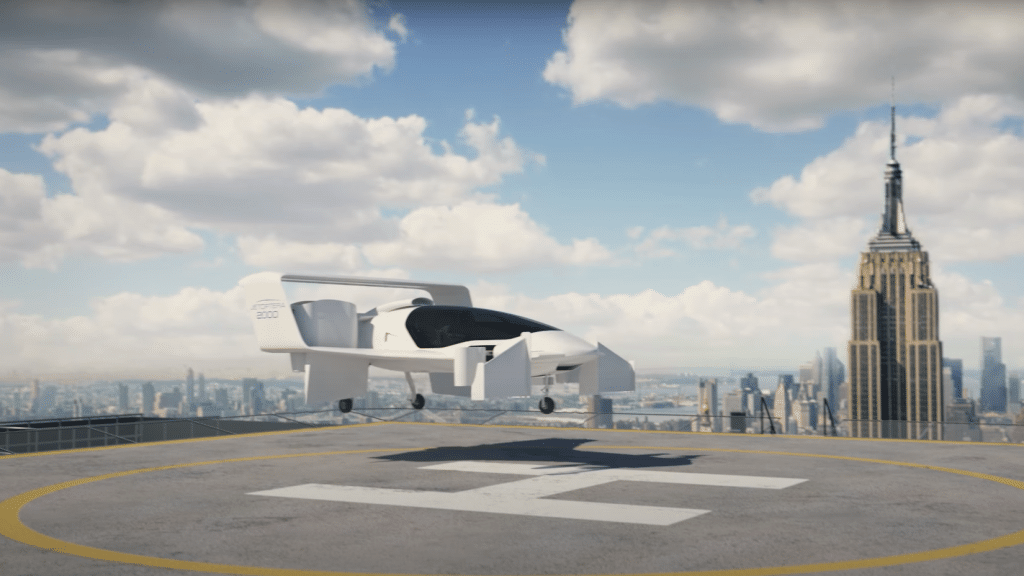
The era of flying cars inspired by The Jetsons is still a long way from hitting the market. However, the American Jetoptera is working to allow us to enjoy the beginning of a revolution with the arrival of the flying car era. The startup working in the aviation sector is developing its own creation, the J-2000, a curious jetless flying car that flies completely silently.
Silent Flying Car Offers A Range Of 320 Km
According to the company, the model is focused on high performance, capable of reaching an impressive 320 km/h, making it ideal for use as an air taxi in large cities, providing a range of 320 km. Able to float in the air, the jetless flying car, J-2000, also promises to be quieter than many aircraft.
The model takes advantage of the same physical principle as blade-less fans. From an engineering perspective, all air is technically a fluid. By using tubes and small motors, some of this compressed air forces larger volumes of air to flow over the wings on the fuselage, generating lift. The company calls this technology fluidic propulsion.
-
End of an era in Brazil: beloved sedan by Brazilians is discontinued despite having a 2.0 engine with 151 hp, CVT transmission, 466-liter trunk, and up to 650 km of range.

-
New Law Proposal in Brazil Could Heavily Penalize Drivers: Dangerous Overtaking May Become a Serious Offense with Fines Increased Tenfold and a 12-Month License Suspension; Update on 2026 Progress

-
Electric Revolution: Watts W125 Motorcycle Offers 160 km Range, 90 km/h Speed, and Affordable Price Starting at $3,000
-
General Motors Replaces Over a Thousand Workers with 50 Cobots at Electric Vehicle Plant, UAW Union Criticizes Move Amid Industry’s Automation Push




For now, the current versions of the silent flying car use gas generators to power the aircraft’s propulsion. The company claims that the goal is to wait for battery technology to mature to convert the VTOL to electric. According to the responsible company, the concept of a jetless flying car could reduce fuel consumption by 50% compared to a small turbojet. Moreover, the weight of the aircraft is much lighter, and its operation generates lower costs as it is a less complex vehicle.
How The Jetless Flying Car Works
In other parts of the model’s system, there are other rotating blades that require the passage of fluids to take a small flow of compressed air and use it to suck in a volume of ambient air at high speed.
The air is forced backward over a surface shaped like a wing around a ring, where negative pressure is developed that supports the vehicle. Additionally, the pressure differential is extremely neutral in areas of equal negative pressure around the ring, thereby generating a “tornado” of low pressure in the center of it. The pressure system is 30% lighter and also much less complex when compared to turboprops and turbofans.
The company states that, being lightweight, the model is much easier to tilt, allowing for VTOL lift and float operations, as well as fast forward cruise flight. Furthermore, unlike any other type of propulsion system for flying electric cars on the market, a circular shape is not required.
Flying Vehicles Gain Attention
In addition to flying cars, companies are also looking to develop flying motorcycles, and Japan has come close to achieving this impossible dream. The project belongs to the Japanese company Aerwins and is named X-Turismo, the first hybrid flying motorcycle ever produced at scale. Now, with its presentation at the Detroit Auto Show last year, the model can already be purchased in the U.S.
The motorcycle had its wheels replaced with propellers to be able to fly, making this one of the features that set the model apart from a common vehicle, considering that its body is very similar to that of a giant sports model.
The X-Turismo weighs 300 kg, and the company’s recommendation is that the rider weighs a maximum of 100 kg. The model features a hybrid system that combines a Kawasaki combustion engine, a battery, and an electric propeller.