






 Portuguese
  Spanish





Container House for R$ 46 Thousand Seems Like a Guaranteed Savings, But Extra Costs and Technical Requirements Can Raise the Final Price Well Beyond the Advertised Amount.
The Promise Seems Too Good to Be True: A complete house, with all the finishes, for R$ 46 thousand. While a traditional masonry construction can cost over R$ 180 thousand for 100 square meters, some Brazilian companies claim to deliver houses made of shipping containers for a fraction of that price and ready in a matter of weeks, not months. But is this savings real? Or are there hidden costs that turn that initial R$ 46 thousand into much higher amounts?
The Answer Is Not Simple. Data from 2026 shows that yes, it is possible to build a container house for significantly lower amounts than traditional masonry. However, the Brazilian market is full of pitfalls, mandatory “extra” costs, and technical details that can make your budget explode — especially if you don’t know what to ask before signing the contract.
The R$ 46 Thousand House Exists (But There’s a Huge Catch)
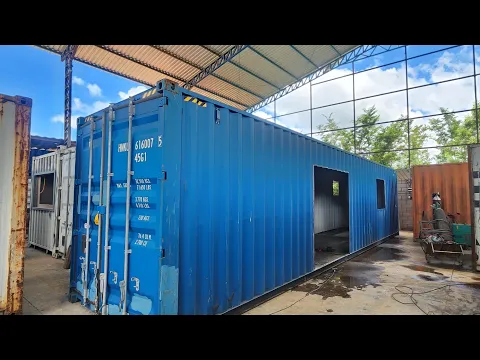

According to Carlos Gariani, sales director of Container Express, one of the largest companies in the sector in Brazil, a 20-foot (6-meter long) container complete with all finishes really costs R$ 46 thousand. The 40-foot model (12 meters) goes for R$ 84 thousand.
-
U.S. City Builds Tiny Home Village on Water Company Land to House 136 Homeless People: Inside the Social Housing Units

-
Woman Turns Shipping Container into Home, Embraces Rural Life to Cut Monthly Expenses to Just Over $330
-
France Revamps 530 Social Housing Units with Large Balconies and Glass Facades Without Demolishing Existing Buildings

-
Facing high rent, couple transforms parents’ garage into a fully functional apartment, creating a complete home at a fraction of the market cost.




These amounts include:
- The revitalized container
- Cuts and welds for doors and windows
- Thermal and acoustic insulation
- Interior finishes (flooring, tiles, sanitary ware)
- Basic electrical and plumbing installations
Seems like the perfect deal, right? But there’s a crucial detail that most companies don’t mention upfront: this price does not include the foundation.
And the foundation is not optional. It’s mandatory.
For a basic container house, the foundation with concrete footings costs between R$ 2,000 and R$ 3,000. In areas with unstable soil or larger projects, this amount can reach R$ 20,000. This means that the R$ 46 thousand house practically starts at R$ 48,000, and that’s if you’re lucky with the soil.
But the foundation is just the first pitfall.
The Hidden Costs of the Container House That No One Warns About
Transport: From R$ 1,200 to R$ 4,000
Containers do not move on their own. The transport to your land costs on average R$ 3 to R$ 4 per kilometer traveled, excluding tolls.
If the company is 300 km away, you’ll pay about R$ 1,200 just to bring the container. If the distance is 1,000 km, the cost rises to R$ 4,000.
Many companies include transport in the package, but others charge separately. Always ask.
Thermal Insulation: Between R$ 2,000 and R$ 10,000
Here lies the biggest problem with container houses: steel conducts heat (and cold) extremely well.
Without proper insulation, a container becomes an oven in the summer and a refrigerator in winter. And we’re not talking about mild discomfort; we’re talking about real uninhabitability.
Conventional containers (the “dry” model) need additional insulation:
- Gypsum boards: ~R$ 2,000 per container
- PET wool, fiberglass, or rock wool: R$ 40 to R$ 200 per square meter
Refrigerated containers (the “reefer” model) come with insulation from the factory but cost between R$ 6,000 and R$ 13,000 more than dry models.
Even with basic insulation included in the package, you’ll probably need to invest in cross-ventilation, solar protection (brises, eaves, pergolas), and a good air conditioning system. Otherwise, your family will depend on air conditioning running 24 hours a day.
Land and Preparation: From R$ 5,000 to R$ 30,000+
If you don’t have the land yet, this is the biggest invisible cost of all. Urban land in inland cities can start at R$ 50,000, while in larger centers, prices easily exceed R$ 200,000.
But even if you already have the land, it needs to be prepared:
- Grading and clearing: R$ 1,200 to R$ 8,000
- Water, sewage, and electricity connections: R$ 5,000 to R$ 30,000+ (especially in rural areas)
Projects and Documentation: R$ 15,000 to R$ 31,000
Many people think container houses “don’t need a permit.” False.
Container houses are civil constructions like any other and must follow the same rules and laws that regulate traditional buildings. You will need:
- Architectural project: R$ 10,000 to R$ 20,000
- Structural project: R$ 2,000 to R$ 5,000
- Electrical project: R$ 1,500 to R$ 3,000
- Plumbing project: R$ 1,500 to R$ 3,000
- Permits and approvals from the city hall: prices vary by municipality
Skipping this step is illegal and dangerous. Without proper structural calculations, cuts for windows and doors can compromise the integrity of the structure. Without an electrical project, you run the risk of short circuits and fires. Without approval, you cannot sell the property legally.
Professional Electrical and Plumbing Installations: R$ 5,000 to R$ 18,000
Even if the basic package includes “electrical and plumbing installations,” this usually means just the essentials: a few outlets, switches, and water points.
For a functional house of 60 to 100 square meters, the actual costs are:
- Complete electrical installation: R$ 3,000 to R$ 10,000
- Complete plumbing installation: R$ 2,000 to R$ 8,000
Savings here is not an option. Poor installations in metal structures can cause electrical shocks, leaks, and accelerated corrosion of the steel.
So, How Much Does a Container House REALLY Cost in Brazil in 2026?

Let’s do the math with three real scenarios:
Scenario 1: Minimal House (20 Feet, ~14m² Usable)
- Complete container (Container Express): R$ 46,000
- Basic foundation: R$ 2,500
- Transport (300 km): R$ 1,200
- REAL TOTAL: R$ 49,700
Ideal for: office, studio, guest house, ADU. Not recommended for family living.
Scenario 2: Basic Livable House (60m², 2 Containers 40 Feet)
- 2 complete containers: R$ 168,000 (2 × R$ 84,000)
- Foundation: R$ 5,000
- Transport: R$ 1,500
- Projects and documentation: R$ 20,000
- Additional insulation: R$ 5,000
- Utility connections: R$ 10,000
- TOTAL: R$ 209,500
Comparison: masonry house 60m² = R$ 108,000 to R$ 156,000 (R$ 1,800-2,600/m²) Result: 60m² Container is MORE EXPENSIVE than masonry.
Scenario 3: Medium House (100m², Custom Project)
- Cost per m²: R$ 1,500 to R$ 3,000
- TOTAL: R$ 150,000 to R$ 300,000
Comparison: masonry house 100m² = R$ 180,000 to R$ 260,000 Result: Container is competitive only in the lower range.
The Truth That No One Talks About: Container Is Not (Always) Cheaper
The myth that container houses are “50% cheaper” than masonry needs to die.
Data from 2026 shows that:
- Simple Projects: 20% to 25% savings compared to masonry
- Sophisticated Projects: cost equal to or higher than traditional construction
- Medium Projects: marginal or no difference
According to the National System of Construction Cost Research (SINAPI), the average construction cost in masonry in Brazil in 2026 is R$ 1,810.25 per square meter. Container houses range from R$ 1,500 to R$ 4,000 per square meter — meaning the overlap is significant.
So why build with containers?
The Real Advantages (That Aren’t Price)
Speed of Construction
While a masonry house takes 6 to 12 months to be ready, a container house can be assembled in weeks.
For those who need urgent housing, are building a second residence, or want to start a business quickly, this is the decisive differential.
Sustainability
Shipping containers are recycled rather than discarded. The construction generates less debris than traditional builds and uses less water, cement, and other resources.
Modularity
It is possible to start with one container and add more modules in the future as the family grows or needs change.
Structural Resistance
Containers are designed to support stacking of up to 9 full units on ships at sea. When well adapted, they are extremely resilient structures.
Modern Design
The industrial and minimalist look of container houses appeals to those seeking contemporary and unique aesthetics.
The Disadvantages That No One Mentions
Constant Maintenance
Metal rusts. You will need to repaint the exterior annually to prevent corrosion. This costs between R$ 1,500 and R$ 4,000 per year.
Low Ceiling Height
Standard containers have a height of 2.4 meters. Discounting insulation, flooring, and ceiling, you end up with about 2.2 meters, below the ideal of 2.6 to 2.8 meters for thermal comfort.
Limited Width
With an internal width of 2.3 meters, the space is tight. Designs need to be well planned to avoid feeling claustrophobic.
Difficulty Reselling
The Brazilian real estate market still holds prejudice against alternative constructions. When it comes time to sell, you may have difficulty finding buyers or need to accept discounts.
Unknown History (Used Containers)
Used containers may have transported toxic products, lead paint, or chemicals. Always demand technical reports and professional inspections before buying.
The Brazilian Market Is Growing (But With Caution)
According to consulting firm Mordor Intelligence, the Brazilian market for prefabricated buildings (which includes container houses) is expected to grow from US$ 3.25 billion in 2024 to US$ 4.26 billion by 2029 — a growth rate of 5.54% per year.
This shows that there is real and growing demand. But it also shows that the sector is still small compared to traditional construction.
Serious companies like Container Express, Ativa Locação, and other specialists are professionalizing the market, offering guarantees, complete projects, and technical support. But the sector still suffers from improvisation, lack of clear regulation, and many suppliers who promise the world but fail to deliver quality.
How Not to Fall into Traps in Building Your House
Request a COMPLETE and DETAILED Budget
Demand that the budget includes:
- Container + transport + foundation + projects + documentation + installations + finishes
Beware of budgets that only show the price of the container.
Visit Completed Works
Check out projects delivered by the company. Talk to past clients. Ask about any problems that arose.
Hire an Independent Engineer
Before signing a contract, pay for a consultation for a civil engineer to evaluate:
- Quality of the structural design
- Adequacy of thermal insulation for your region’s climate
- Feasibility of the proposed installations
Check the Origin of the Container
If it’s used, demand:
- Usage history (what was transported)
- Structural inspection report
- Decontamination certificate (if necessary)
New containers cost more, but eliminate health risks.
Set Aside 20% of the Budget for Contingencies
Problems always arise: worse-than-expected soil, project changes, rising material costs, necessary adjustments.
Having a reserve prevents you from having to stop the work midway due to lack of funds.
Is Container House Worth It?
Yes, a container house for R$ 46 thousand exists. But it is a 14 square meter structure that will still need a foundation, prepared land, legal documentation, and probably some adjustments to be comfortable.
For small, simple, and quick projects — an office in the backyard, a guest house, a studio to rent — a container can be excellent: real savings of 20-25%, construction in weeks, modern look.
For larger and more sophisticated projects, the savings disappear. You will pay as much or more than an equivalent masonry house.
The main advantage of a container house is not the price. It’s the speed. If you need urgent housing, are building a second residence, or want a differentiated project, a container makes sense.
But if you have time and are just looking for savings, do the math carefully. In most cases, the cost difference between container and masonry is smaller than construction companies want you to believe.
And remember: those initial R$ 46 thousand are just the beginning of the story. The final bill depends on dozens of variables you need to know before signing any contract.







