






 Portuguese
  Spanish
  3 min of reading
  0 comments


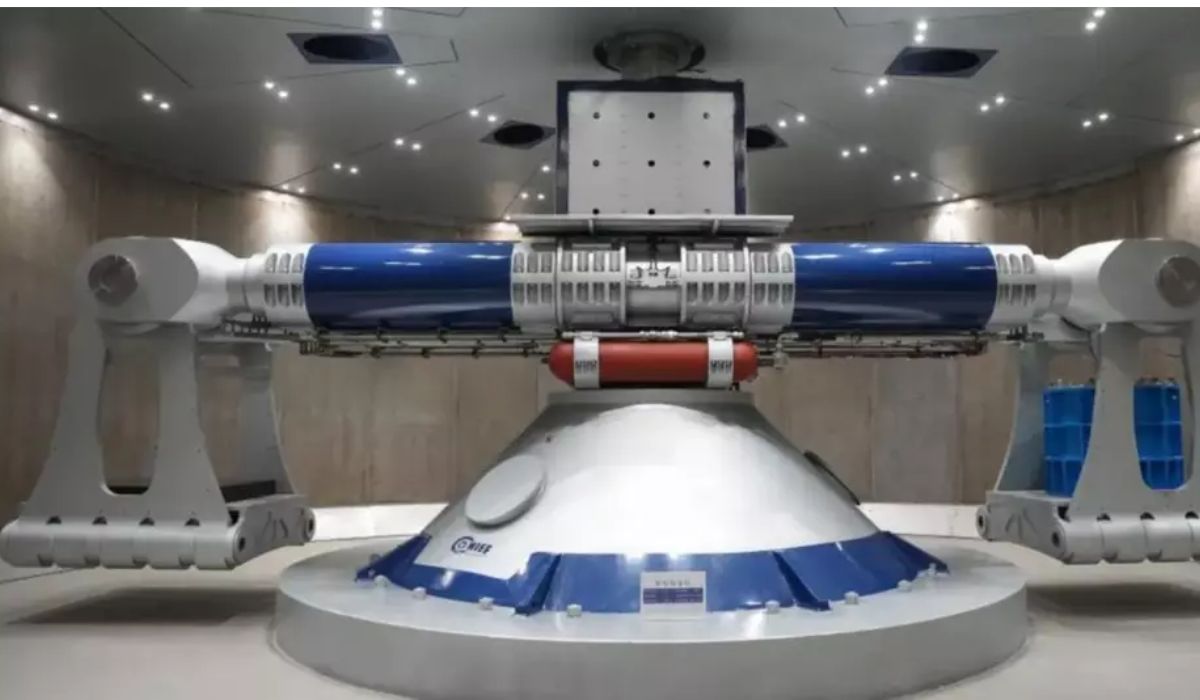
Installed in the basement of a Chinese university, a hypergravity centrifuge expands testing capacity in engineering, geotechnics, and materials by enabling accelerated observation of extreme physical phenomena in controlled environments and large scales.
The Zhejiang University, in eastern China, has activated a hypergravity centrifuge installed 15 meters underground, designed to reproduce extreme forces in the lab and accelerate tests that would take decades or centuries in the real world.
Named CHIEF1900, the equipment is part of a complex funded with 2 billion yuan, equivalent to about US$ 285 million, and, according to information released by the project’s leaders, surpasses similar structures previously operated by the United States Army.
According to the technical description provided by the developers, the reference to “1,900 times gravity” is used to express the scale of the system.
-
A doctor from Minas Gerais warns that sleeping with the fan pointed at the body all night is not as harmless as you think; it dries out the respiratory tract, causes mucus buildup, spreads dust mites, and can even irritate the cornea of the eyes.

-
Ecuadorian volcano at 6,268 meters is more than 2,000 meters closer to space than Everest, which is 8,848 meters, because the Earth is wider at the equator.
-
Public school students in the hinterlands of Maranhão create a bioinsecticide with neem and castor to protect corn crops, transform rural waste into biogas and biofertilizer, and bring sustainable technology to producers at ExpoSertão.

-
Ötzi, the 5,300-year-old mummy found in the Alps, reveals a still active microbiome, and the Iceman’s yeast points to an energy-saving fermentation.


The record associated with the equipment, however, is linked to the capacity of 1,900 g·ton, a unit that combines gravitational acceleration and mass applied in experiments.
Structure of CHIEF1900 and Underground Installation
The CHIEF1900 is part of the Centrifugal Hypergravity and Interdisciplinary Experiment Facility (CHIEF), a facility designed to operate below ground level.
The underground location, as explained by the engineers involved, aims to reduce external vibrations and ensure greater stability during high-speed tests.
The centrifuge was constructed by a Chinese industrial consortium and delivered to the Zhejiang University campus in December 2025 for installation, according to information released in institutional statements and international reports about the project.

Hypergravity Applied to Engineering and Science
According to researchers in the field, hypergravity centrifuges allow the simulation, on a smaller scale, of stresses and deformations equivalent to those observed in real structures.
The principle is to apply high centrifugal acceleration to reproduce, in smaller models, physical conditions that would normally manifest at large dimensions and over long periods.
In civil engineering, one of the examples cited by the lab personnel involves dams.
By subjecting a model of a few meters to a field of 100g, tests can reproduce stress levels comparable to much larger structures, while respecting the physical relationships of the system being analyzed.
The same methodology, according to researchers, makes it possible to observe in just a few hours phenomena such as soil instabilities, cumulative load effects and vibration, and the dispersion of contaminants, processes that in the natural environment would occur over extended periods.
Technical Challenges in Extreme Gravity Operations
Operating with high loads under hypergravity conditions presents technical challenges related to heating, pressure, and the integrity of mechanical components.
To address these factors, the project engineers describe the use of vacuum-based systems, as well as specific cooling and ventilation solutions, aimed at reducing air resistance and controlling temperature during operation.
In addition to applications in geotechnics and infrastructure, those responsible for the installation point out uses in materials studies and in experiments with biological systems subjected to gravitational fields outside of Earth’s standard.
The structure is also presented by the project managers as open to external researchers, including international teams, with the proposal to serve as a shared infrastructure for large-scale experiments in physics and engineering.



-

-

-

-

-

-

34 people reacted to this.