Portuguese
  Spanish


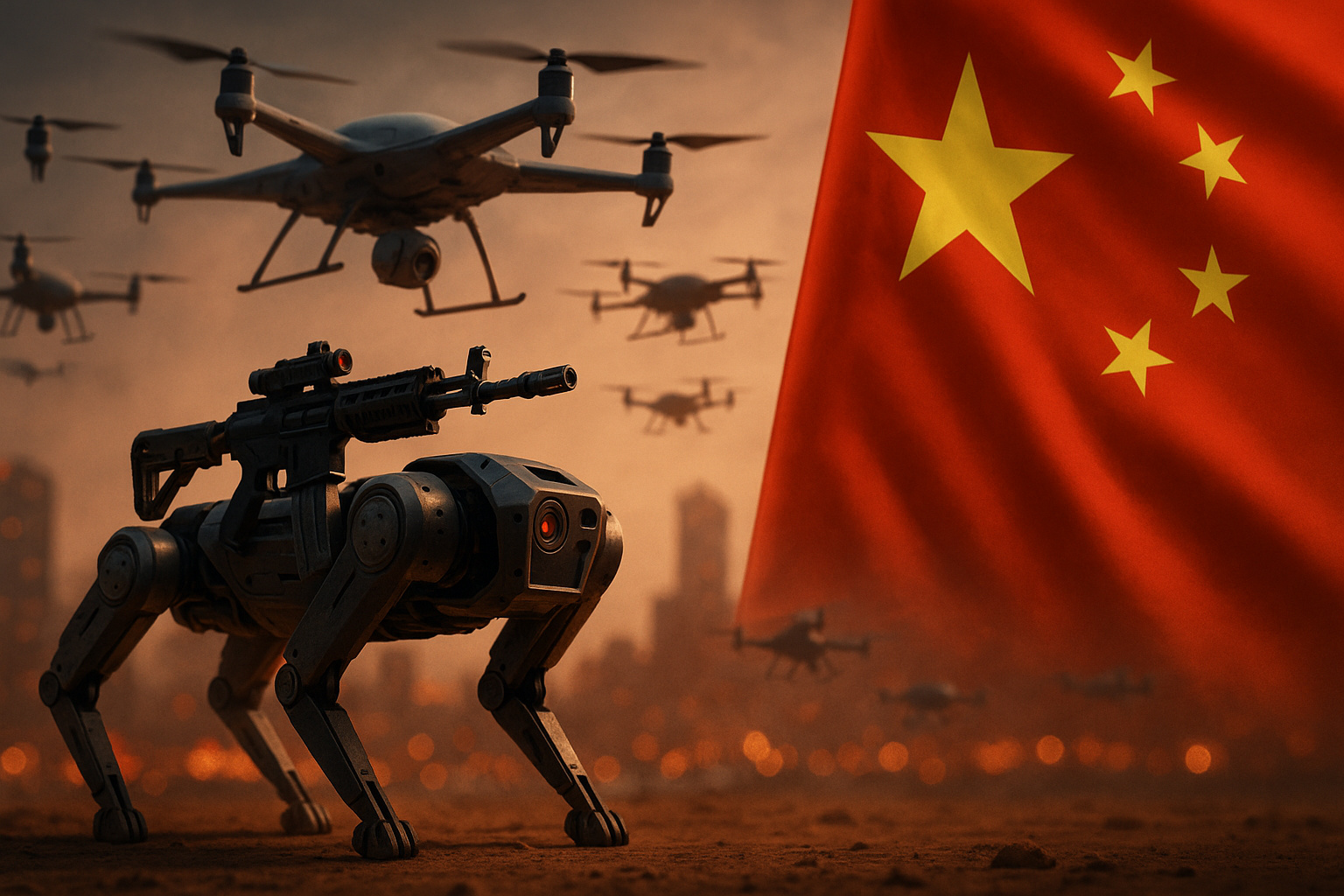

China Uses AI in Robotic Dogs and Drone Swarms to Attack U.S. Advantage in Military Technology Worldwide — Understand How and Why.
In the latest phase of the global technological race, China has launched an ambitious AI and warfare technology program where armed robotic dogs and drone swarms lead the advance.
The project, coordinated by the Chinese army since November 2024, mobilizes the Asian giant to reduce the technological gap with the U.S. in the military world.
In Beijing, military and defense-related companies are integrating artificial intelligence (AI) systems for target recognition and autonomous operations, in an attempt to gain an advantage while Washington observes.
-
In a Degraded Atlantic Forest Area, a São Gonçalo Resident Transforms Land into a Living Eco-Museum, Now a Model for Environmental Education

-
World’s First Lithium-Sulfur Battery Factory Launches, Promising to Double Range Without Relying on China

-
AI Data Centers Now Feature Built-In Nuclear Power Plants and Have Ordered Non-Existent Reactors
-
In India, thousands earn about $2.50 an hour cooking and cleaning with a phone strapped to their heads, as every move is recorded to train humanoid robots for jobs they might one day replace.



The reason is clear: dominating warfare technology in the world now means strategic power in the future.
Why China Accelerates AI and Warfare Technology
China understands that, in today’s world, technology — especially AI — is crucial for military power. Therefore, it seeks to surpass the U.S. in this arms race.
The intense investment aims precisely to modernize its armed forces and recover lost ground. Meanwhile, the U.S. observes and adapts its strategies.
How Chinese Robotic Dogs and Drone Swarms Work
In November 2024, the People’s Liberation Army of China opened an unprecedented bidding process to develop AI-equipped robotic dogs, designed to operate in groups and accurately identify threats, as well as neutralize explosion risks in conflict areas.
Images released by official Chinese government channels show that the manufacturer Unitree has already conducted tactical exercises with armed robotic dogs, demonstrating the country’s advancement in using warfare technology based on artificial intelligence.
At the same time, over twenty records of military bids and patents indicate that Chinese AI is also being integrated into autonomous drones.
These systems are capable of recognizing and tracking targets, operating in swarm with minimal human intervention — a strategy that strengthens the Chinese army’s response capability amid the technological competition with the U.S. and enhances China‘s prominence in the military landscape of the world.
Practical Applications: From Satellites to National Chips
Patents and studies indicate that China is already using AI in military planning. Landship Information Technology claims that its systems combine satellites, radars, and aircraft to quickly locate targets using Huawei chips.
The Xi’an Technological University revealed that DeepSeek analyzed 10,000 scenarios in 48 seconds — something that would take 48 hours for humans. The advancement demonstrates the power of Chinese technology and reinforces the competition between China and the U.S. for leadership in military AI in the world.
Algorithmic Sovereignty: The Focus of Beijing’s Strategy
China, in turn, seeks to reduce dependence on Western technology. Therefore, the focus now is on strengthening internal use of AI and ensuring digital autonomy.
In this context, the strategy appears in the preference for the DeepSeek AI model, already present in several military bids. Furthermore, the country accelerates the use of national chips, replacing imported components to reduce vulnerabilities.
This movement, called “algorithmic sovereignty”, aims to give China total control over its technological infrastructure. In this way, the government avoids external limitations and strengthens its position on the global stage.
Challenges and Limits of Chinese Military Technology
Even with the advancements, China still faces challenges. The operation of the systems remains classified. There are doubts about the contracts for robotic dogs and the actual use of Western chips.
Chinese military officials assure that human control will be maintained, avoiding the AI from operating weapons autonomously in a possible confrontation with the U.S..
Impact on the U.S., China, and the World
For the U.S., China’s advancement in AI and warfare technology represents a direct challenge to its military superiority. Therefore, Washington plans to deploy thousands of drones by the end of 2025, to balance out the Chinese advantage.
Meanwhile, in the world, this technological dispute highlights that future wars will increasingly depend on algorithms, satellites, and automation — and not just on tanks and soldiers.
Thus, the race between China and the U.S. for leadership in military AI goes far beyond a regional rivalry. In practice, it represents a historical milestone for geopolitics, global security, and the very concept of technology in the contemporary world.