






 Portuguese
  Spanish




Test With Geotextile Blankets Reduced Local Melting, But Cost and Scale Limit Application While Global Warming Continues to Pressure Ice
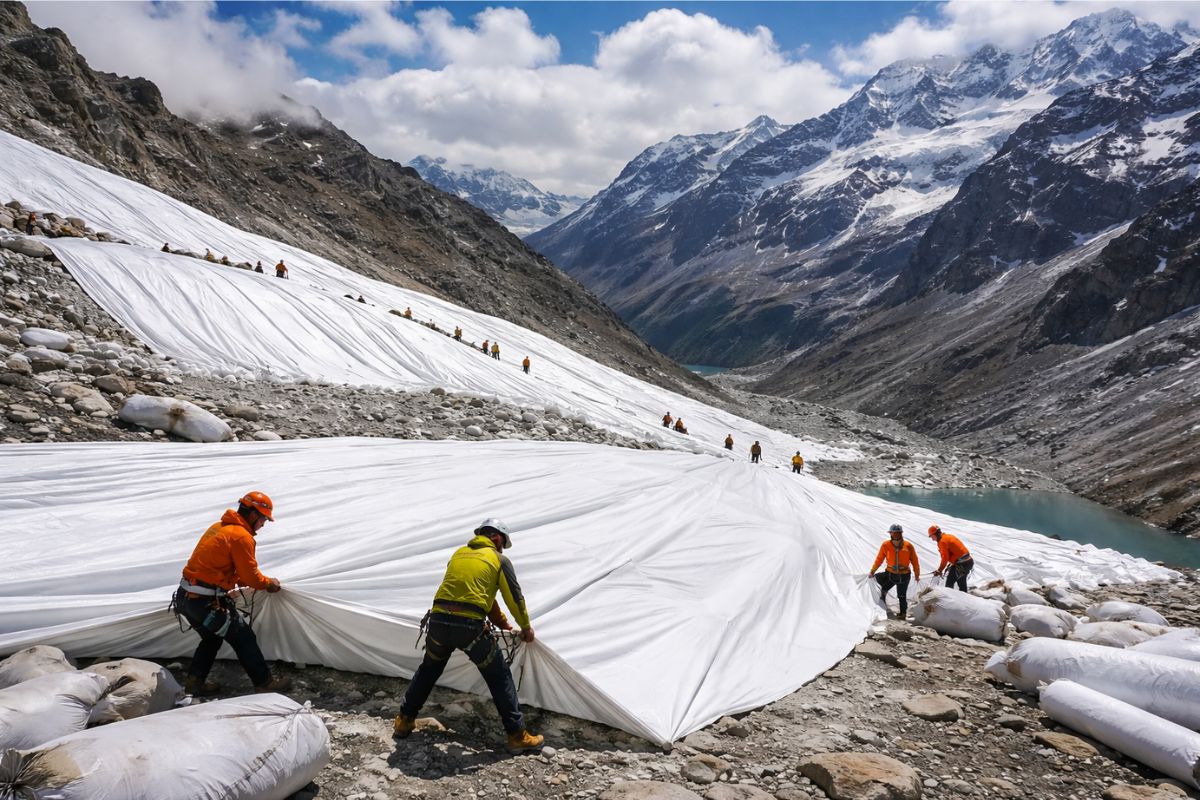
China has started testing an attention-grabbing idea: covering sections of glaciers with white geotextile blankets, as if they were thermal sheets, to reduce melting during the hottest period.
The result is clearly visible in small areas, with increases in ice thickness and decreases in the melting rate. At the same time, the technique raises a crucial point: it works locally but does not address the problem at its source.
Dagu Glacier in Sichuan Was Covered With 500 Square Meters of White Blanket
In 2019, a team from the Chinese Academy of Sciences covered about 500 square meters of the Dagu glacier in Sichuan province during the hottest months.
-
Brazilian Startup Converts Tucumã Seeds into Bioplastic for Bicycle Pedals, Cups, and Construction Materials

-
NASA Captures Rare Encounter of South Korean “Surfboard” Spacecraft Crossing Lunar Orbit at Over 11,000 km/h

-
Germany Opens World’s Largest Smart Power Semiconductor Factory with €5 Billion Investment, Creating 1,000 Jobs and Doubling Capacity for AI and Energy Needs

-
Kazakhstan’s Torysh Valley Holds Thousands of Giant Stone Spheres, Intriguing Scientists with Ancient Oceanic “Cannonballs”

The proposal was simple: place white blankets over snow and ice to try to buy time in the face of rising temperatures.
After about two and a half months, the material was removed, and the protected area had ice up to 1 meter thicker than the nearby uncovered sections.
What the Blanket Does to the Ice: More Albedo and Less Heat Turning Into Melt

The blankets are white geotextiles designed to reduce the warming of the ice through two main pathways: blocking part of the heat and reflecting solar radiation.
This increases the albedo, which is the capacity to reflect light. With more reflection, less energy turns into heat on the surface of the glacier.
In practice, the desired effect is to slow down the melting in the covered area, especially at the peak of summer.
Melting Decreased by 34% From August 2020 to October 2021
The test at Dagu indicated a reduction in the melting rate of about 34% between August 2020 and October 2021.
In other locations and similar studies, local reductions in summer reached 59% to 70%.
Even with these numbers, the gain is limited to what is covered. Outside the blanket, the ice remains exposed to heat and radiation.
Why It’s Not Possible to Cover Everything: There Would Be Over 250,000 km² of Glaciers on the Planet

The very logic of the method limits its expansion. Covering large areas would require heavy logistics, constant teams, and material replacement.
Estimates suggest that massively protecting the over 250,000 km² of glaciers on the planet would be too expensive, even if local melting decreases by 50% to 60%.
Furthermore, the blankets need to be placed and removed each season, suffer from wear and tear, and can become waste if not managed properly.
China Has Already Lost 26% of Its Glacial Area Since 1960 and Has Seen 7,000 Glaciers Disappear
The country has already lost about 26% of its glacial area since 1960, and about 7,000 small glaciers have completely disappeared during this time.
In regions like the Qilian Mountains and the Tibetan Plateau, the retreat of ice is putting pressure on freshwater reserves, affecting millions of people.
The melting also increases risks of landslides, sudden floods, and collapses of natural dams made of ice and debris.
The Blanket Can Save Tourist Spots and Critical Areas, But It Doesn’t Address Emissions
The blankets can help protect critical areas, such as tourist spots, vulnerable sections, and strategic water supply locations, when immediate and localized action is needed.
This type of technology appears alongside other attempts, such as artificial snow and initiatives aimed at the cryosphere, within frameworks like the International Year of Glacier Preservation, 2025 and the Decade of Action for Cryospheric Sciences, 2025 to 2034.
The central debate remains open: the technique buys time but does not replace the cutting of greenhouse gases that continue to warm the planet.





😃😃Me gusta la idea 👍👍 cualquier avance o intento para frenar el calentamiento global es algo muy importante en el mundo entero👌👌
Todos los países deberían hacer lo mismo en vez de tirar el dinero en bombas nucleares
En el Perú se han perdido muchos glaciares
Que tonto, y ****ánto calentamiento y emisiones se CO2,, genera la fabricación de las membranas y su transporte e instalación? Pero el remedio que la enfermedad.
Bem se para o bem da Natureza e Humanidade acredito que vale apena tentar essa manta nos 250.000km