Portuguese
  Spanish


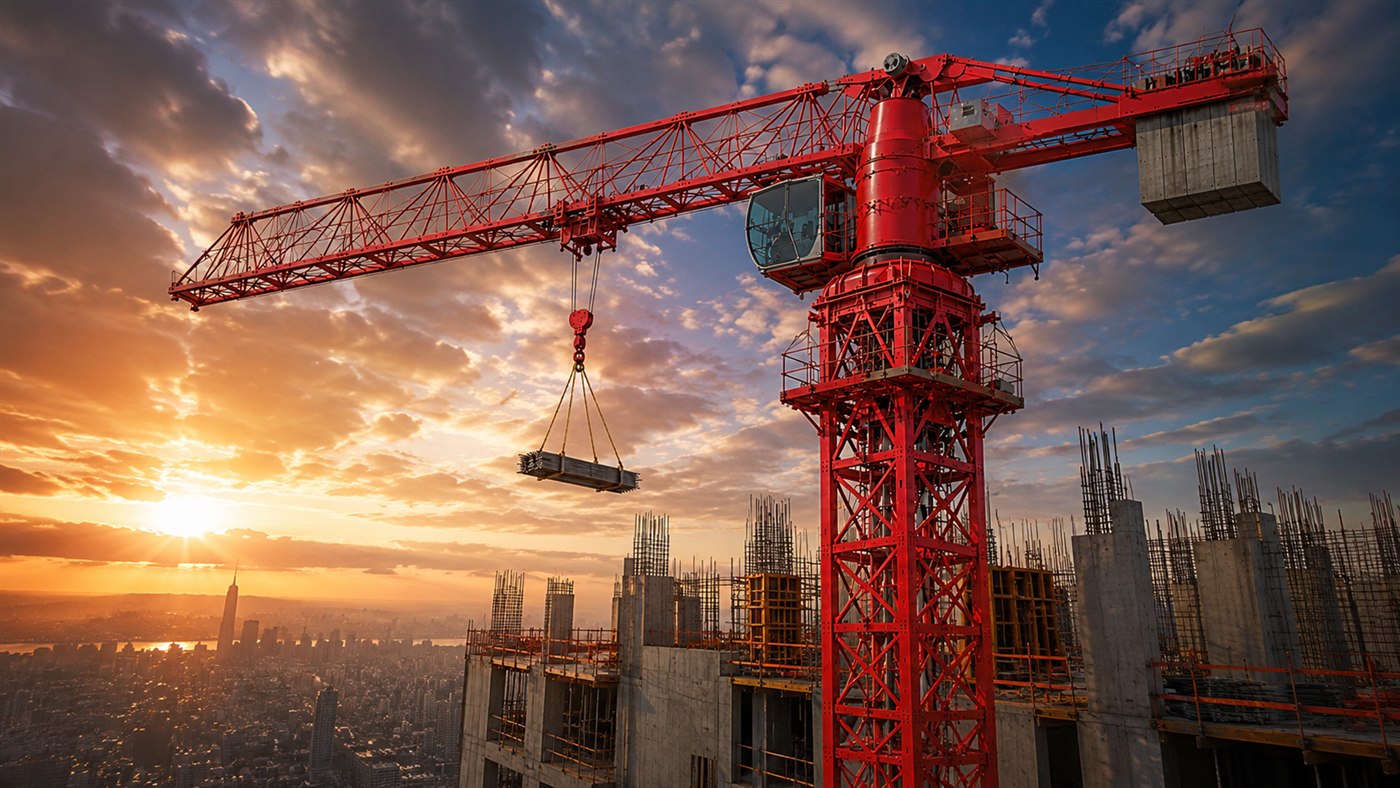

The INOVA DOCS documentary explains the paradox that stalled vertical construction for centuries, the 400-ton foundation, the climbing milestone that makes the tower crane grow with the building, and why a 3-millimeter deviation in a bolt can compromise everything
How does a 200-ton steel machine reach the top of a skyscraper if no larger crane exists to place it there? According to the INOVA DOCS channel, in a documentary published in July 2026, the answer is one of the most ingenious tricks of modern construction: the crane is not lifted by another piece of equipment, it builds itself and grows along with the building, floor by floor.
The paradox behind this is ancient. To build at height, you need equipment that reaches that height, but to position this equipment in the right place, you would need an even larger one, a dilemma that limited vertical construction for centuries until engineering responded with a smarter, not larger, tower crane, as INOVA DOCS explains. And it is this invisible machine that is behind every skyscraper erected in the world today.
The paradox that stalled vertical construction for centuries
The scale of the problem appears in the industry’s numbers. According to INOVA DOCS, in 2024, 168 buildings over 200 meters tall were completed in cities like Dubai, Shanghai, New York, and Riyadh, all with the same technical challenge of placing a crane up there.
-
China Constructs Four 20 km Tunnels in World’s Deepest Canyon for Mega Power Plant to Outperform Three Gorges and Power All of Britain

-
China’s Engineered Bamboo: The “Material of the Future” Stronger Than Steel and a Sustainable Wood Alternative

-
Egypt’s “New Nile”: 170 km Artificial River Aims to Turn Desert into Farmland, but Water Supply Concerns Loom
-
Unable to secure a mortgage as a self-employed single mother, she designed her own floating home from a 20-meter boat and now lives “off-grid” with her two children and solar panels on an English canal.


This market moves gigantic figures. The global market for this equipment is valued at 24 billion dollars in 2026 and is expected to reach 38 billion by 2036, and none of the 168 skyscrapers completed in 2024 would have been possible without this equipment, as INOVA DOCS points out. The solution was not to invent a larger crane, but a system that climbs on its own as the construction progresses.
The 400-ton foundation and 18 hours of concrete
Everything begins underground. According to INOVA DOCS, before any metal piece, the tower crane requires a massive reinforced concrete foundation block, weighing over 400 tons, which cannot be interrupted to avoid cold joints, in an operation that lasts up to 18 continuous hours and costs over 300 thousand dollars just for the base.
From the foundation rises the spine of the equipment. The mast is made up of hollow steel sections up to 6 meters and 10 tons each, stacked and fixed with high-tension bolts, and at the top, the jib, the horizontal arm, reaches 80 meters, balanced by dozens of tons of concrete and steel counterweights, as INOVA DOCS details. The complete set weighs 200 tons and lifts up to 20 tons per operation.
The climbing frame: the exoskeleton that lifts 150 tons
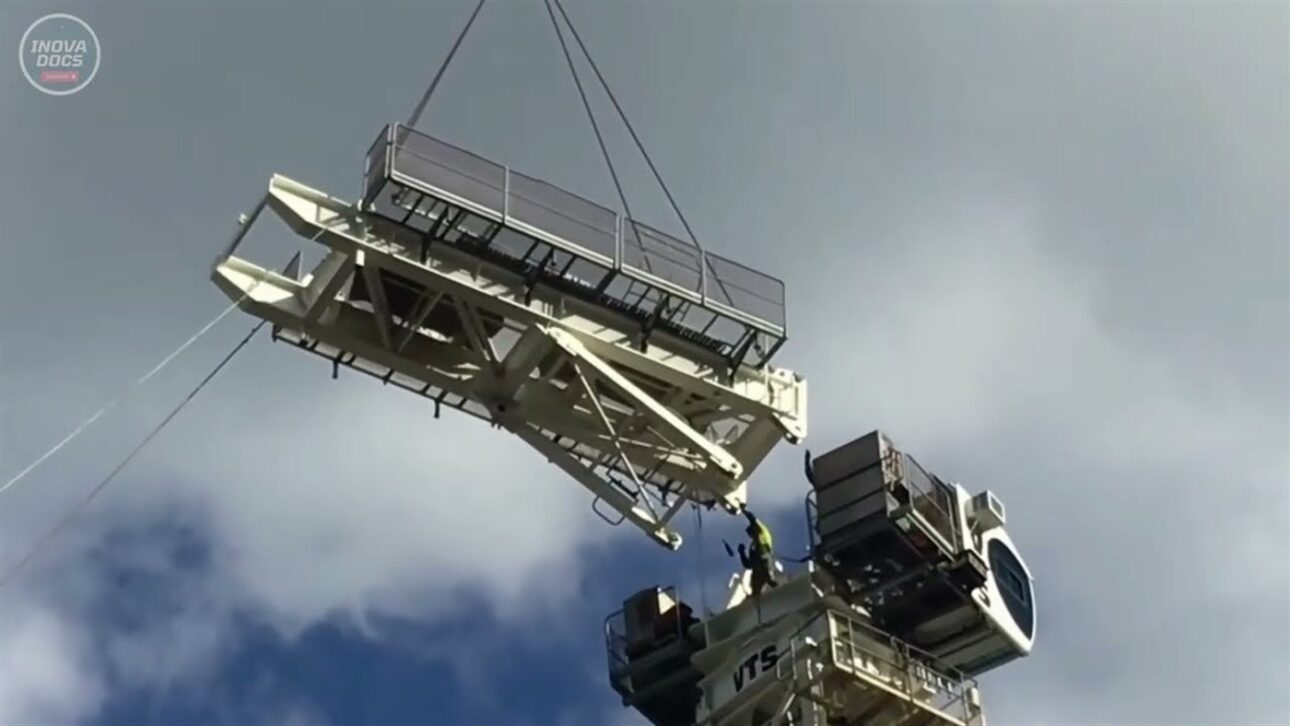
The secret of the crane that grows by itself has a name. According to INOVA DOCS, right below the cabin there is a structure called the climbing frame, a metallic exoskeleton that surrounds the mast and supports the entire upper part of the crane, with hydraulic jacks capable of lifting more than 150 tons at once, including the cabin, the jib, and the counterweights.
The climbing cycle is a choreography of precision. The system lifts a new mast section from the ground, the hydraulic jacks raise the top part and open a 3-meter gap, the new module is fitted, secured with calibrated torque, and the climbing frame retracts, all in less than 1 hour, repeated for each completed floor, as INOVA DOCS shows. This is how the machine self-constructs, gaining height at the same pace as the building.
Less than 1 hour per floor and the 3-millimeter bolt

The margin of error in this process is practically zero. According to INOVA DOCS, each lifting operation requires an approved technical plan, with verification of soil capacity, load configuration, and weather conditions, leaving no room for improvisation, because a deviation of just 3 millimeters in a single bolt can compromise the alignment of the entire structure.
Precision applies to every stacked component. As the crane is assembled section by section with high-tension bolts, a small alignment error at the base multiplies at the top, which is why the tightening torque and verification of each maneuver are as critical as the brute force of the hydraulic jacks, as INOVA DOCS emphasizes. Every centimeter gained in height is checked before the next module rises.
Wind of 70 km/h at 250 meters: adapt instead of resist
Up high, the enemy is the wind. According to INOVA DOCS, at 250 meters altitude, gusts of 70 km/h generate forces capable of destabilizing entire structures, and the engineering response is not to resist, but to adapt to the wind.
The solution mixes anchoring and freedom. Every 15 or 20 floors, the crane is attached to the building itself with steel straps, becoming a single structural system with the building, and when the wind exceeds the safe limit, the operator releases the rotation brake so the jib can rotate freely and align with the wind direction, relieving pressure on the mast, as INOVA DOCS describes. It’s the same logic as a weather vane: those who don’t fight the gust, survive it.
How the crane dismantles itself at the top
Once the building is finished, the opposite problem arises. According to INOVA DOCS, when the building reaches its final height, the tower crane is at the top without any external equipment able to reach it, so the dismantling is also done by the system itself, which lowers section by section of the mast with the main hook to the minimum configuration.
The last section uses a helper. A compact auxiliary crane is assembled on the roof to dismantle what remains of the tower crane in parts, and in the end, this very crane is dismantled and lowered in components through the freight elevators or internal accesses of the building, leaving no trace of the machine that lifted everything, as INOVA DOCS records. The crane disappears before the public sees the finished building.
AI, sensors, and the $64,000 operator
The invisible machine has also become intelligent. According to INOVA DOCS, the most advanced tower cranes of 2026 use artificial intelligence and Internet of Things sensors that monitor cables, bolts, and movements in real-time, processing data in 43 milliseconds, 40% faster than human reaction, and reducing unplanned stoppages by up to 73%.
The human factor remains decisive. Operating a tower crane requires mandatory certification, which in the United States is renewed every 5 years after written and practical exams, with training from 6 months to 1 year, and it is one of the highest-paid professions in construction, with a median salary above 64,000 dollars per year, as the INOVA DOCS channel on YouTube informs. Installing and operating the equipment in a skyscraper costs over 1.5 million dollars, and a single day of downtime results in losses of tens of thousands.
What changes in Brazil, where technical planning is lacking


Global engineering encounters a very Brazilian issue. In Brazil, experts point out that the lack of technical planning is the main cause of crane accidents, which reinforces that the operator’s qualification is as critical as the equipment itself, in a vertical construction sector that is growing in capitals like São Paulo.
The lesson applies to every construction site in the country. With increasingly taller skyscrapers in Brazilian cities, the self-erecting tower crane and the rigor of technical planning, calibrated torque, and certified operator are what separate a safe construction from a serious accident, exactly the point the video highlights about the Brazilian reality, a context of consolidated work safety. From the skyscraper in Dubai to the building in São Paulo, the equation is the same: the machine impresses, but it is the planning that keeps it standing.
The video explains the paradox of vertical construction, the foundation of the tower crane, the climbing frame with hydraulic jacks, the floor-by-floor ascent, and the dismantling at the top.
The tower crane that erects itself proves that the most impressive engineering is often the one the public never sees. Tell us in the comments: did you imagine that the skyscraper crane builds and dismantles itself?