






 Portuguese
  Spanish
  5 min of reading
  0 comments


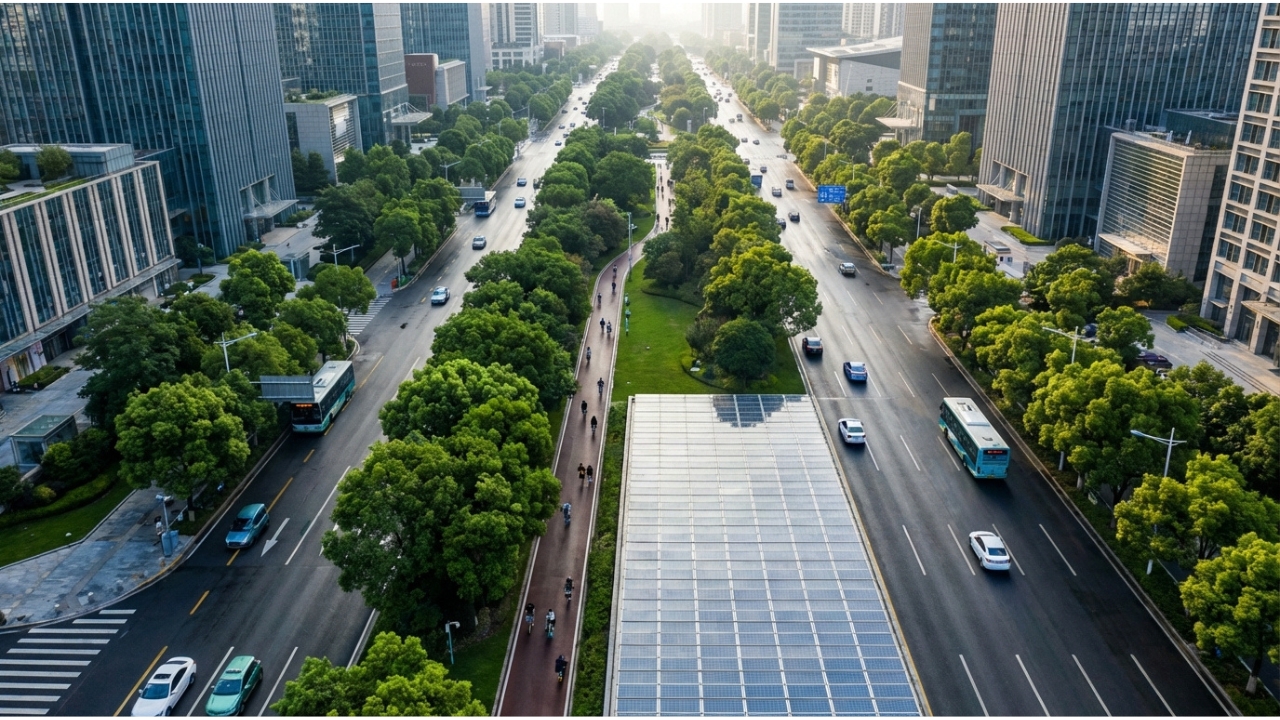
In Jinan, China, Chinese cities implemented a section of 1,080 meters with solar panels on the ground to generate energy and prepare charging in motion, provoking new green avenues and attracting attention from the electric mobility sector.
China has been implementing a change that alters the visual appearance of cities as well as energy and mobility planning. Instead of poles and overhead wires dominating the urban sky, recent projects are burying high-voltage lines and reorganizing the electrical grid.
This frees up the space above the roads for a new urban design, with green corridors, trees, bike paths, and structures ready to accommodate solutions linked to renewable energy and electric cars.
The information was released by Bloomberg, a news agency and financial information service.
-
Brazilian Innovator Marcelo Loureiro Sets Guinness World Record with 12,000 km Robotic Surgery from Brazil to Kuwait

-
Workers Discover 19th-Century Iron Ship and Indigenous Artifacts During COP30 Construction in the Brazilian Amazon
-
Chinese robots trained for two weeks to row a dragon boat at the Sichuan Festival in China, took full control when humans stopped rowing, and even made rice dumplings in one of the most unusual tests ever conducted with humanoids.
-
Public school students in Sergipe create an early autism screening kit for vulnerable communities without a doctor, in the year Brazil won 8 awards at the world’s largest science fair.


At the same time, tests already indicate an even more eye-catching next step: roads and highways that can recharge electric cars while they are in motion, with technology installed beneath the asphalt.
What Happened in Chinese Cities and Why This Became a Topic on the Avenues

The central proposal is simple to understand and hard to ignore. Burying high-voltage cables changes the landscape, reduces the presence of aerial structures, and opens up space for wider, greener avenues.
The detail that attracted the most attention is that these avenues cease to be merely traffic corridors. They are now being planned as axes of energy, connectivity, and electric mobility, with wooded areas, wider sidewalks, bike paths, and infrastructure ready for new technologies.
This reconfiguration is linked to a sustainability agenda projected for 2026, when urban projects are expected to be evaluated also on climate impact, air quality, and ability to attract investments associated with ESG criteria.
How Green Avenues with Buried Infrastructure and Space for Technology Work
When high-voltage lines are no longer exposed, municipalities gain more room to reorganize urban space. The liberation of the urban sky facilitates the installation of more efficient lighting, sensors, and smart urban furniture, as well as creating conditions to integrate renewable energy into the design of the roads.
In practice, the green avenue becomes a multifunctional corridor. It combines mobility, landscaping, and more protected electrical infrastructure, creating an environment that can receive, in a more organized manner, elements that previously competed for space with poles, cables, and old structures.
The idea aligns with the expansion of green finance and the pressure for projects that deliver both urban improvement and measurable environmental gain.
The Smart Highway in Jinan with 1,080 Meters and What the Solar Road Delivers

An example cited is a pilot section in the city of Jinan, in eastern China. A smart highway has been built there, approximately 1,080 meters long, using solar panels embedded under a layer of transparent concrete.
The goal is to turn the asphalt into an energy generation matrix. This type of road can provide electricity for the road’s own lighting and for hundreds of homes, according to the project description.
In addition to generation, integrated sensors enter the pavement to monitor traffic, weather, and road conditions. The result is a road that attempts to operate as a highway, linear solar plant, and data platform for connected and even autonomous vehicles.
Wireless Charging in Motion, What Is DwPT and Why It Reduces Range Anxiety
The technology behind charging in motion is known as Dynamic Wireless Power Transfer, DwPT. It uses wireless power transmission systems installed beneath the asphalt.
The principle is straightforward: coils buried in the road create an electromagnetic field that transfers energy to receivers underneath the car, recharging the battery while the vehicle passes over the prepared lane.
Tests and descriptions of the concept indicate that the lane can operate as an electric corridor, allowing vehicles equipped with receivers to travel at normal speed with reduced battery consumption. It is also noted that the efficiency of the transfer, from the asphalt to the vehicle, is already approaching the efficiency of conventional fast charging stations.
There is also integration with the Internet of Things, IoT, with real-time data transmission about traffic and energy consumption, as well as the potential to support autonomous driving functions in connected scenarios.
Why Burying Cables Changes Network Capacity and What May Happen Now

Burying high-voltage lines is not just about aesthetics. The point is to prepare the infrastructure for increased demand linked to millions of electric cars, in addition to facilitating new connections for distributed generation, such as solar roads, photovoltaic rooftops, and parking lots with panels.
Also entering the discussion is bidirectional charging, V2G. In this logic, cars can inject energy back into the grid during peak hours, with tests cited in nine Chinese cities, involving 30 stations and a goal of 5,000 by 2027.
Even with the enthusiasm, advancing to scale faces challenges. The cost per kilometer tends to be higher than that of a conventional road due to requiring special pavement, panels, coils, and integrated electronics. Durability is also a sensitive point, as heavy traffic, temperature variations, and maintenance can affect performance.
And to create a real impact on autonomy, it is necessary to equip longer stretches and expand the compatibility of receivers in vehicles, which requires coordination between manufacturers, government, and operators.
In the end, the message for other cities is that the transition to electric vehicles may require more than just swapping engines. It may mean redesigning streets, energy, and data at the same time, transforming the ground into a source of electricity and connectivity.
The combination of buried cables, green avenues, solar roads, and charging in motion attracts attention because it brings together urban development, energy generation, and electric mobility in the same asphalt strip, with goals and tests already pointing to 2026 and 2027.







-

-

-

-

-

14 people reacted to this.