Portuguese
  Spanish



Discovery in the South China Sea Could Transform the Global Energy Scenario, but Environmental Risks Concern Experts
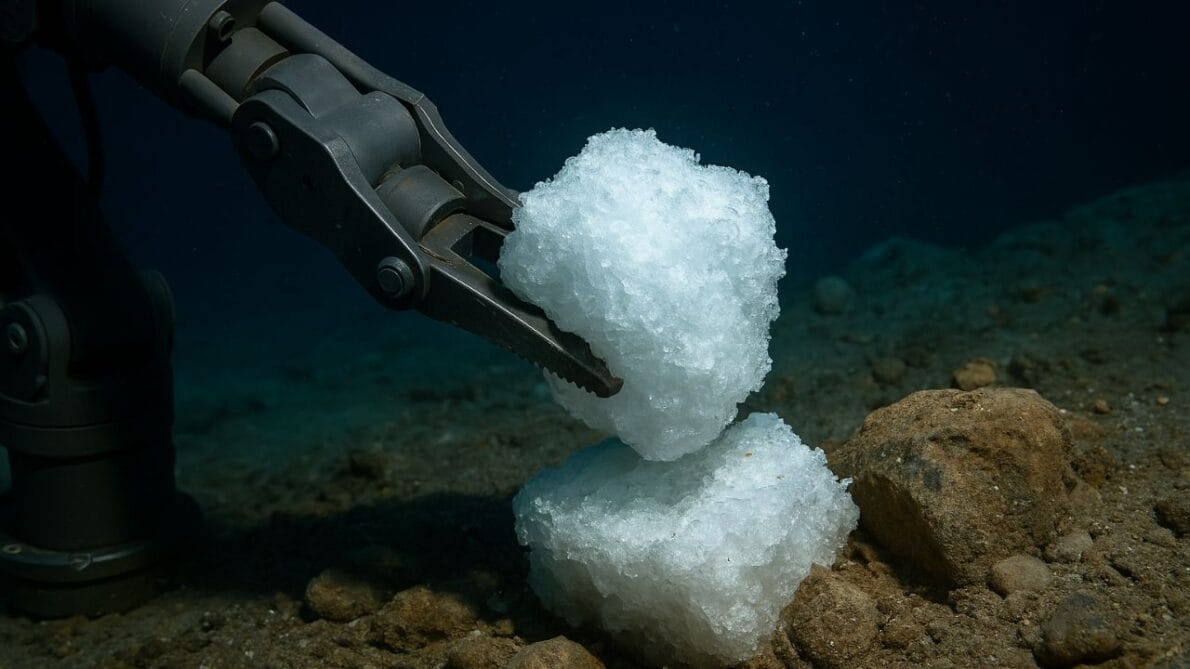
China announced the successful extraction of large quantities of gas hydrate, also known as methane hydrate, from the bottom of the South China Sea, a feat considered strategic and promising for the future of the global energy matrix.
Gas Hydrate: What Is It and Why Does It Matter?
The so-called gas hydrate is a highly energetic mixture of water and methane that forms under extremely high pressures and low temperatures, usually on the ocean floor or in permafrost regions. When heated or depressurized, this ice turns into methane gas, releasing up to 160 cubic meters of gas per cubic meter of the solid substance. This makes it one of the biggest bets to replace fossil fuels in the future.
Researchers believe that global reserves of methane hydrate are immense, ten times greater than those of shale, according to Professor Praveen Linga from the National University of Singapore, in an interview with BBC News. The challenge, however, is to make extraction safe, efficient, and economically viable.
-
After a Year of Success in Switzerland, Solar Railway Attracts Italy’s Interest for Clean Energy Transformation

-
Robots Clean Solar Panels in Desert Power Plants Without Water, Preventing Energy Losses
-
Brazil’s Offshore Wind Energy Potential Worth $1 Trillion Stalled by Long-Delayed Agreement

-
World’s Largest Engie Solar Plant in Brazil Highlights Billion-Dollar Energy Waste Issue: Company Considers Batteries and Bitcoin Mining to Avoid Wasting Production



Chinese Advance and the Global Race for New Energy
The Chinese operation took place in the Shenhu area of the contested South China Sea and resulted in a daily extraction of about 16,000 cubic meters of high-purity gas. This was one of the largest extractions ever recorded, surpassing previous attempts by Japan, the United States, and Canada. The achievement was celebrated by Chinese authorities as a “strategic milestone” for the country’s energy security.
It is worth noting that countries like India, South Korea, and Japan are also investing in technologies to make the exploration of gas hydrate feasible, especially because they rely on imported oil and gas. The United States and Canada focus their research on reserves located under the frozen ground of Alaska and northern Canada.
Energy Potential and Climatic Risk
Although gas hydrate promises to revolutionize the energy sector, it also carries significant environmental risks. Methane, if released into the atmosphere uncontrollably, can drastically accelerate global warming, as it is a gas with climatic impact potential up to 25 times greater than carbon dioxide, according to data from the U.S. Environmental Protection Agency (EPA).
Experts warn that strict control of operations will be essential. “China’s success is an important step, but there is still a long way to go before safe commercial exploration,” Linga highlighted to BBC.
Expectations for the Future of Gas Hydrate
Even with advancements, experts believe that commercial-scale exploration of gas hydrate will only be viable starting in 2025, at best. Until then, the priority will be the development of technologies that allow for the safe and sustainable extraction of the resource.
China, in turn, announced the construction of a submarine laboratory at a depth of 2,000 meters to better study the reserves and their environmental impacts, according to the Engineering Blog. The initiative reinforces the country’s commitment to mastering the technology before its competitors.