






 Portuguese
  Spanish


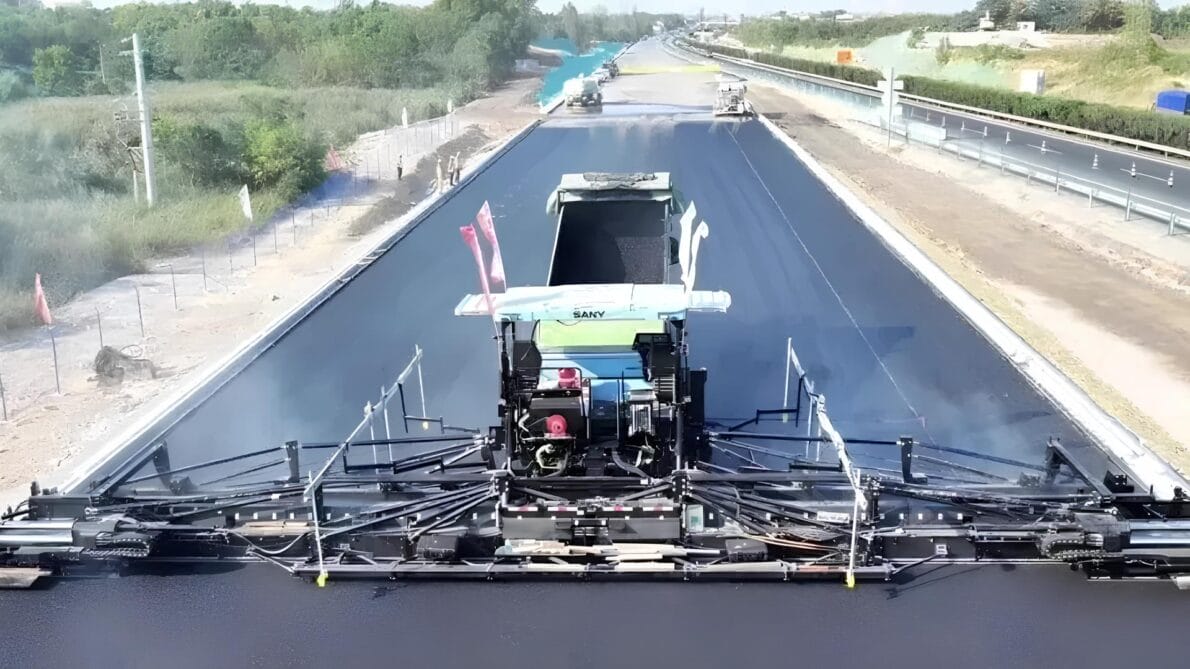


China Builds New 157 Km Road Without Human Intervention: Only 10 Machines Were Used to Complete the Project Totally Automated.
The Road Built Without Human Help: Building a road is a complex task, involving detailed studies and extensive work with machinery to apply, compact, and level the asphalt until the necessary uniformity is achieved. But China has just taken this practice to a new level, announcing the construction of a road entirely made by autonomous machines, without any human intervention. Check out how this revolutionary technology was employed to build the new Chinese road, revealing an innovation that could transform infrastructure in the future.
New Road Built Without Human Help Measures 157.79 Km
China is paving a road of over 150 kilometers where only robots control the autonomous machines, and workers merely supervise. Beginning in Beijing and extending 157.79 km towards Macau, China has achieved the first completely unmanned paved highway, using only autonomous machines, with up to four lanes wide.
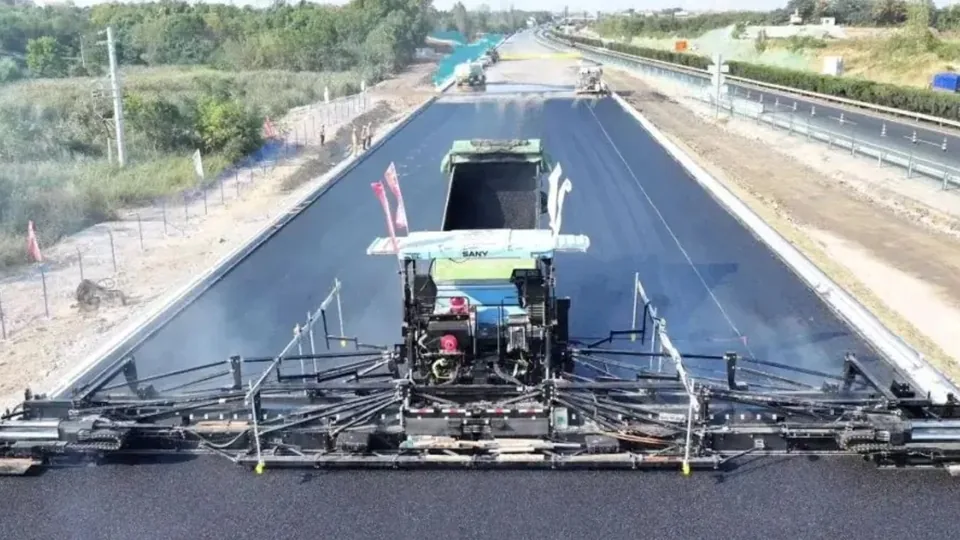
This is an expansion project of the Beijing-HK Expressway, which extends 2,272 kilometers. The completed project of the new road covers the distance between Beijing and Hebei. To achieve this, three state-owned groups worked together.
-
Bamboo Houses Built in 7 Days for the Price of a Smartphone: 26 Survived Intact in Myanmar’s 7.7 Earthquake

-
Prefabricated Home Assembled in Days Offers Cleaner, More Efficient Construction with Factory-Made Panels, Requires Technical Design to Prevent Moisture Issues

-
Single Mother Working Three Jobs Receives 111 m² 3D-Printed Home with Concrete Walls Built in 12 Hours, Featuring 3 Bedrooms, 2 Bathrooms, and a Printer for Replacement Parts
-
Simple Technique to Restore Rusty Metal Window Grilles Gains Attention for Revitalizing Old Structures Without Full Replacement




These companies, which developed the new road built without human help, are China Railway 11th Bureau (which led the project), Hubei Communications Investment (responsible for paving), and Liaoning Guotai Road and Bridge (which worked on compaction). Sany Group was responsible for supplying the machinery that is not operated by humans.
Understand Why the New Road in China Is So Innovative
Local media explain that the presentation of the completed project was made public, coinciding with a conference related to road construction and other infrastructures. The 700 participants were invited to closely observe the new road built without human help, where they could see how the autonomous machines work.
The new road in China is especially spectacular because it is a 19.25-meter-wide road in which ten autonomous machines were used. These vehicles take care of distributing all the material, made up of compacted sand stone amalgam. Subsequently, the bituminous binder is added, which molds the entire surface and prevents the separation of layers.
The Chinese project utilized pavers, responsible for distributing the materials, and autonomous rollers, responsible for applying the necessary pressure to ensure that the entire surface is leveled and has the expected hardness.
In addition, the entire development of the new road in China was monitored with drones for topographical work to confirm that the expected parameters were being followed, as explained by GPC Systems, a company specialized in software development.
The Technology Used in the Construction of the New Road in China
In the formation known as 1+3+3+3, the autonomous machines were supervised by staff, but in various sources, the time savings achieved are emphasized, as the development of specific algorithms for the new road built without human help allowed for precise millimeter work and a faster pace than using human labor.
However, the published information does not state how many workers were excluded or how much time and money were saved. This precision allowed the entire road to be paved in a single pass, without the need to use smaller rollers that serve to correct deviations.
Using the technology, the machinery operates with such precision that it is unnecessary to review the areas that were once constructed. This is what they call zero gap, because there is no substantial separation between the machine and the curb, where the width of the road ends.


