Portuguese
  Spanish


Chinese 10-megawatt prototype is presented as a mobile alternative for electricity generation in remote areas, islands, emergencies, and high-demand operations, but still depends on technical data, safety rules, licensing, and solutions for transportation, shielding, fuel, and radioactive waste.
China tests a 10-megawatt nuclear reactor designed to be installed on a truck, promising to bring stable energy to remote areas, emergencies, islands, ocean systems, space applications, and artificial intelligence data centers.
Mobile nuclear reactor is presented as a long-lasting energy source
The prototype was developed by a team from the Institute of Nuclear Energy Safety Technology, affiliated with the Hefei Institutes of Physical Science. The project is led by Wu Yican, a scientific advisor to the institution and a member of the Chinese Academy of Sciences.
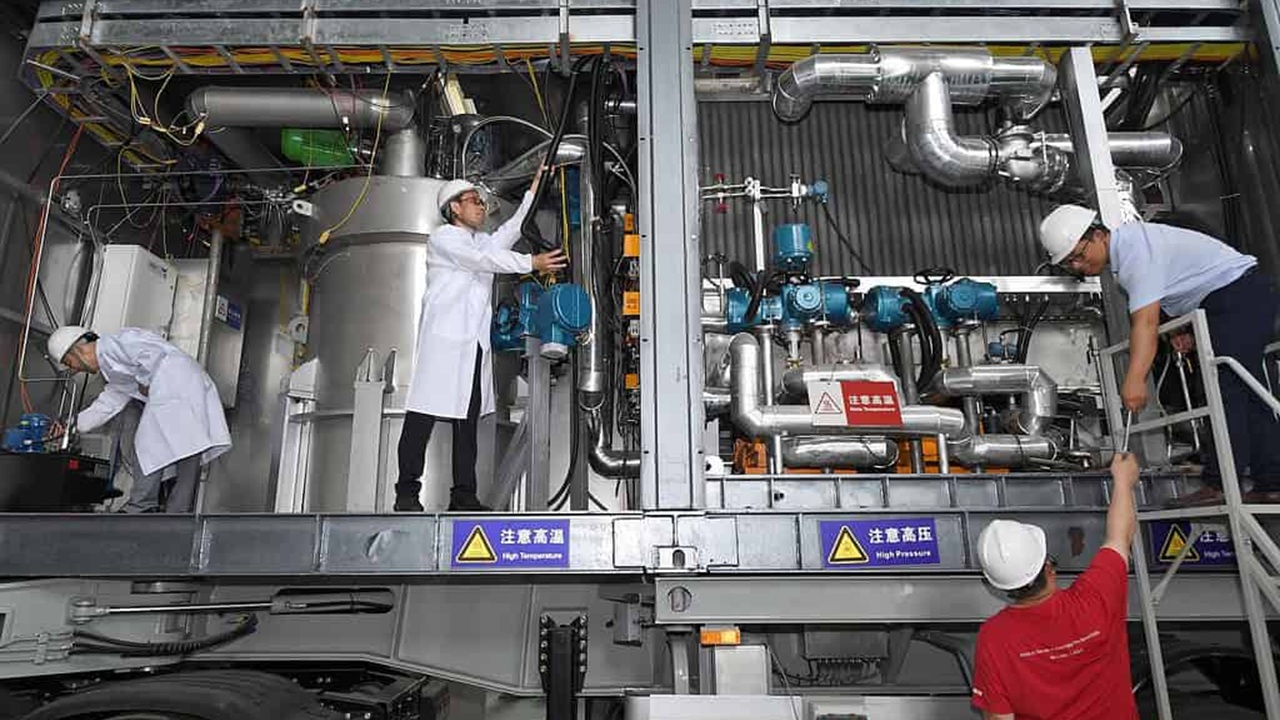
Wu stated to the Science and Technology Daily that his team built the first integrated engineering simulation test prototype of a 10-megawatt vehicle-mounted nuclear power bank. The proposal is to reduce dependence on conventional batteries.
-
Oceanographer Turns Abandoned Fishing Nets from Brazilian Waters into Bags, Creating Jobs and Earning Over $7,000 Monthly

-
Australia deploys poisoned sausages and uses traps, shooting, and fences in a battle against invasive cats that kill over 1.5 billion native animals annually, threatening more than 200 species.

-
NASA Rover Captures “Tired Face” on Mars, Highlighting Human Brain’s Tendency to See Faces in Rock Formations

-
Ancient Stone City in the Desert, Once Home to 30,000, Puzzles Scientists with Nabateans’ Water Mastery 2,000 Years Ago





The term “nuclear power bank” likens the system to a giant portable charger, but the comparison is limited. Unlike a battery, which only stores electricity, the equipment would produce energy through nuclear reactions.

Power is small for plants, but relevant for isolated locations
The announced 10 megawatts represent a fraction of the capacity of a commercial nuclear plant, which can reach hundreds or thousands of megawatts. Still, the power would be enough to supply up to 10,000 homes, depending on demand.
On this scale, a compact nuclear reactor could power industrial equipment, isolated infrastructure, military operations, emergency responses, or smaller data center loads. This possibility depends on cooling, conversion, redundancy, and safety systems capable of operating stably.
The central idea is to offer a nuclear alternative to diesel generators. These devices are common in remote locations but rely on constant fuel deliveries and may face interruptions during storms, conflicts, disasters, or logistical difficulties.
Wu described the system as compact, durable, and “ultra-safe.” He also stated that the unit could operate for decades without refueling, a feature that, if confirmed, would reduce the need for frequent supply chains.
Use in islands, bases, mining, and data centers still requires answers
The most evident uses involve remote islands, isolated communities, mining areas, polar installations, military bases, and disaster zones. In these environments, electricity tends to be more expensive when fuel, equipment, and infrastructure are difficult to transport.
The Chinese team also mentioned applications in ships, space systems, deep-water exploration, and artificial intelligence data centers. Despite the broad list, little public information has been released about the technical functioning of the prototype.
There are still not enough details about reactor type, fuel, enrichment, shielding, cooling method, waste disposal, accident response, and licensing. Without this data, it is not possible to measure the distance between the test and a real deployment.
Truck prototype concentrates safety and regulation challenges
Placing a nuclear reactor in a vehicle does not, by itself, meet operational requirements. A mobile system would have to withstand collisions, fires, sabotage, prolonged transport, extreme weather conditions, maintenance failures, and possible emergencies.
Shielding would also be necessary to protect workers and the population. The fuel cycle would need to be safe, and the destination of irradiated fuel and radioactive waste would have to be defined before any operation outside a controlled environment.
Wu’s team has already worked on the CLEAR-M10d concept, a lead-cooled mini-reactor designed for 35 thermal megawatts or 10 electrical megawatts, plus 17 megawatts of heat in cogeneration. There is no public confirmation that it is the same project.
The initiative appears in a context of Chinese nuclear expansion. The International Atomic Energy Agency recorded 58 commercial nuclear units in China at the end of 2024, responsible for 4.47% of the country’s electricity that year.
Public reports with data from the Chinese industry indicated 59 commercial units in 2025 and nuclear generation of 467.7 billion kilowatt-hours, equivalent to 4.82% of national generation. The share is still limited, but the expansion is accelerating.
Smaller systems meet different demands than large plants connected to national grids. In the case of the truck, the proposal is to bring the energy source to the consumption site, instead of relying on existing transmission lines.
The news about the nuclear test was published by the Chinese site SCMP on April 27.