Portuguese
  Spanish


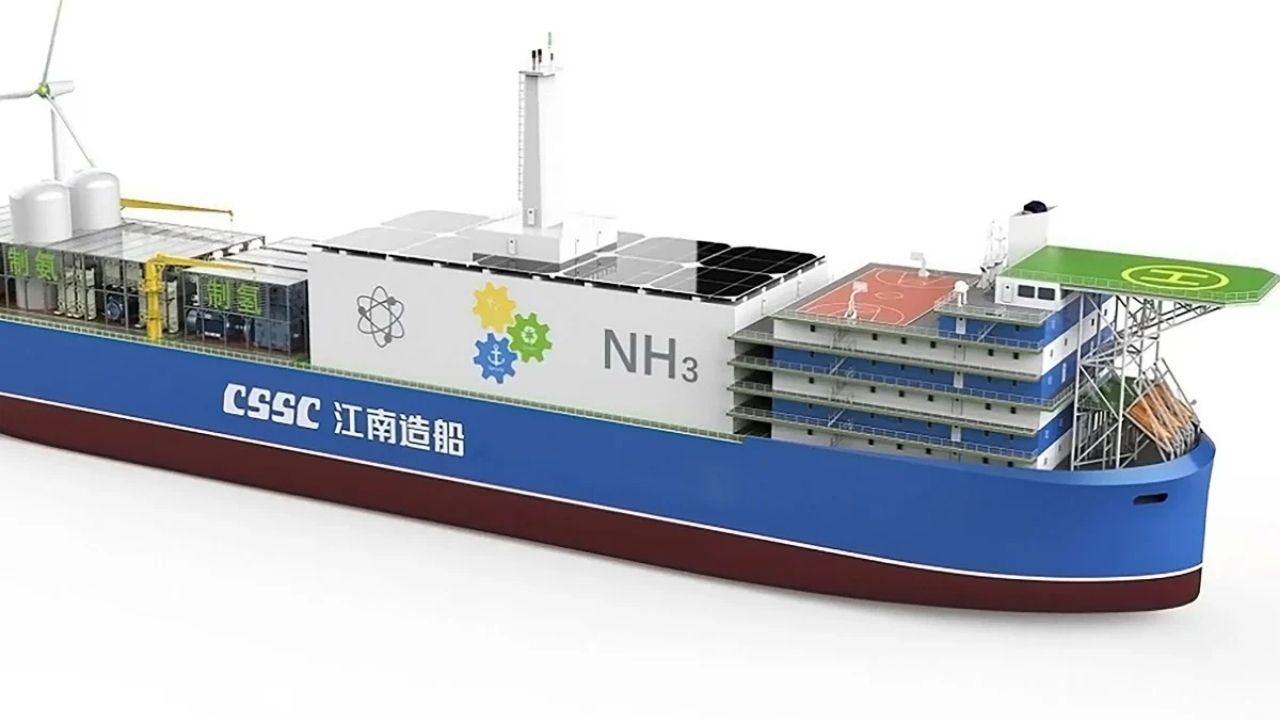
Presented by the Chinese shipyard Jiangnan at Posidonia, Greece, on June 2, 2026, the floating island would have molten salt reactors, solar panels, wind turbine, and hydrogen production to serve as a container terminal and ship recharging station in global maritime transport with zero emissions.
China presented a project that could redesign the future of commercial navigation. A shipyard from the country revealed the plan for a nuclear-powered floating island, designed to function as a container transfer terminal and as a recharging station for ships at sea, according to a report by the South China Morning Post (SCMP).
The presentation was made by the Jiangnan shipyard, a subsidiary of the state-owned China State Shipbuilding Corporation, during Posidonia, one of the largest international fairs in the navigation sector, held in Greece on June 2, 2026. The announced promise is ambitious: to create a new oceanic ecosystem of zero-emission container logistics, aimed at accelerating the transition of maritime transport to clean fuels.
What the complex is and who is behind it
The proposal combines several functions in a single structure at sea. The floating island would act as a container transshipment center and, at the same time, as a refueling and energy recharging point for ships passing through the route. The combination of port, refueling, and energy production in one place is what the shipyard calls a “green maritime transport hub.”
-
Scientists Discover 125-Million-Year-Old “Pregnant Fossil” with Preserved Embryos and Microscopic Larvae Inside Mollusk in England

-
17-Year-Old Justin Bernstein Develops Bacteria to Produce Glass on Arctic Ice to Reflect Sunlight, Wins $50,000 U.S. Scholarship

-
The 19-Meter Rocket-Helicopter: A Private Industry Prototype That Challenged Space Race Logic

-
Brazilian Students Convert Seized Illegal TV Boxes into Linux-Powered Mini Computers for Schools and Social Projects Across São Paulo




The idea came from the Jiangnan Shipyard, part of the state group China State Shipbuilding Corporation, and was detailed in a presentation shared by the company itself on social media and at the Greek fair showcase. For the sector, it is the first time that a heavyweight shipyard describes, in such detail, a floating island designed to serve as permanent infrastructure at sea.
The “zero-emission heart” of the project
At the center of the complex is a specific platform, described by the shipyard as the “zero-carbon heart of the hub.” It brings together a molten salt reactor, solar panels, a wind turbine, a hydrogen production module, and green fuel synthesis, and an electric supply module, forming an integrated energy center.
This composition is what would make the floating island capable of operating without relying on fossil fuels. Nuclear energy would function as a stable base, while sun, wind, and hydrogen would serve as complementary sources and as input to refuel the ships that stop at the structure. The proposal is that everything circulating through the hub, from the container to the hull, operates with zero emissions.
How molten salt reactors work
The choice of the molten salt reactor is not by chance. In this technology, the liquid salt performs two functions at the same time: it serves as fuel and as a coolant, and it has the capacity to store large amounts of thermal energy. Another important advantage for use at sea: this type of reactor can cool without needing water, which reduces dependencies and risks in the oceanic environment.
This reactor model has been studied for decades and has gained traction in recent years as an alternative considered safer and more flexible compared to traditional nuclear reactors. In the case of the floating island, it is the central piece of the promise to operate heavy infrastructure in the middle of the ocean without direct carbon emissions.
From the island to the ship: the nuclear path at sea
The hub is not born isolated from a larger strategy. Engineers at Jiangnan have been developing nuclear-powered vessels, and last year the shipyard released details of a cargo ship designed to be powered by a thorium-based molten salt reactor, with a capacity for 25,000 containers.
This cargo ship and the floating island fit into the same plan: to simultaneously create the ships and the infrastructure that will supply them. Instead of adapting existing ports for a new energy matrix, China signals that it intends to build the ecosystem from scratch, in the middle of the ocean, with the fleet and the recharge point speaking the same technological language.
Why this matters for global maritime transport
The navigation sector accounts for a significant portion of global greenhouse gas emissions, and decarbonizing it is one of the most complex challenges of the energy transition. According to the shipyard, the project aims to offer a pioneering solution for the maritime transport industry’s carbon neutrality goal, integrating navigation, port, energy generation, and transshipment into a single platform.
If it comes to fruition, the floating island would change the current logic, which combines coastal ports and a strong dependence on fossil fuels. The hub would allow long routes to have fully clean support points, shortening journeys and reducing emissions in a sector where small changes often represent millions of tons of carbon avoided per year.
What still needs answers
Despite the impact of the announcement, it’s important to remember what is still undefined. For now, it is a plan presented at a fair and detailed in a slide presentation, with no public construction schedule, no disclosed costs, and no definition of where the complex would begin operation. Issues of nuclear safety at sea, international regulation, and political acceptance by the countries involved are challenges that cannot be ignored.
Even so, the gesture signals where China wants to go. The idea of turning a floating island into a central piece of the next generation of maritime transport places the country at the center of the debate about what will come after fossil fuels and forces competitors, regulators, and customers to consider a route that until recently seemed like fiction.
Now we want to know what you think. Would you trust a nuclear structure at sea to make navigation cheaper and decarbonized, or do you think the risks outweigh the benefits? Do you believe that China will indeed be able to bring the project to life, or is it likely to remain a model?
Comment your opinion below, tell us if you support or reject the idea, and share this article with those interested in the future of energy and global transport.