






 Portuguese
  Spanish


The ships Evros and Acheloos, two supertankers delivered in Dalian by Hengli Shipbuilding, strengthen Chinese shipbuilding and eco-friendly maritime transport with 306 thousand deadweight tons, 332.8 meters, environmental technologies, lower consumption, and completion three months ahead of the contracted deadline for Dynacom.
The ships Evros and Acheloos, two supertankers of 306 thousand deadweight tons, were christened and delivered on the same day by Hengli Shipbuilding in Dalian, in China’s Liaoning province. The operation reinforces the weight of Chinese shipbuilding in global maritime transport.
According to a report by Zhang Xiaomin, the two tankers were built for Dynacom Tankers Management Ltd. According to Hengli Shipbuilding, the simultaneous delivery set a new world record in shipbuilding, while the ships arrived three months ahead of the contracted deadline, with technologies aimed at energy efficiency and eco-friendly maritime transport.
Two supertankers were delivered on the same day
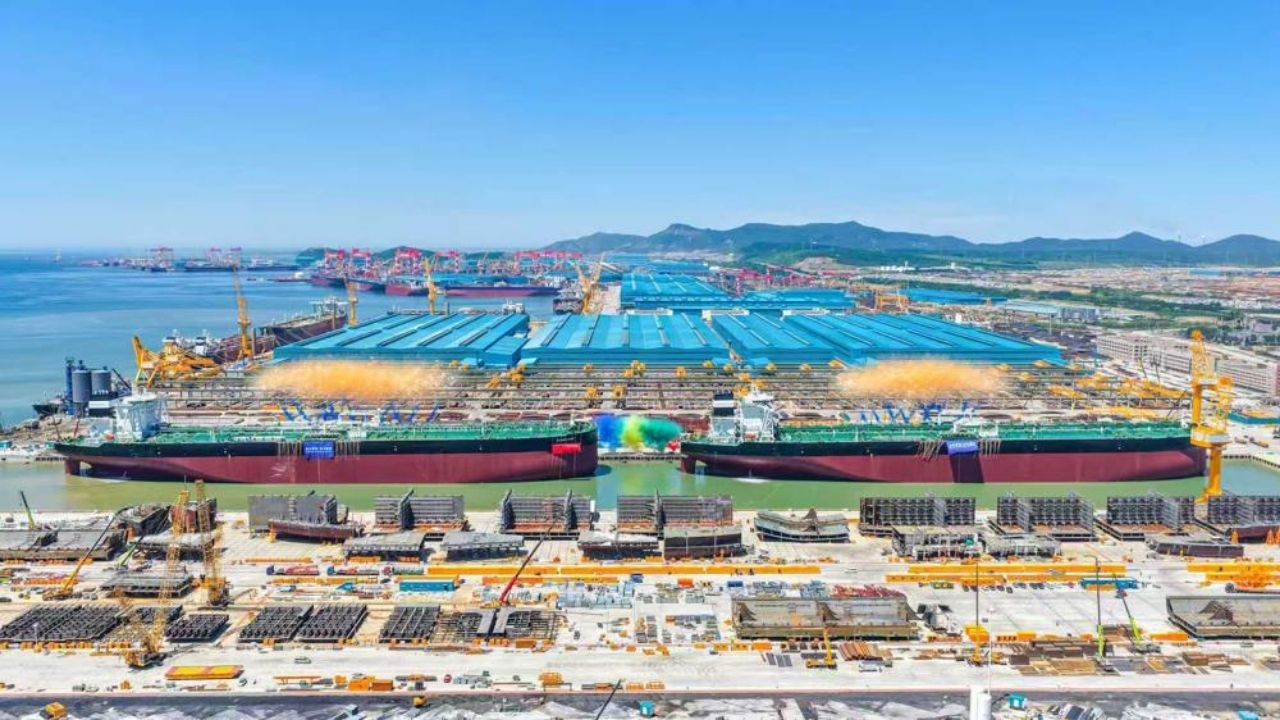
The simultaneous delivery of the ships drew attention because it involved two large supertankers, completed and christened in a single operation in Dalian. For shipbuilding, this type of feat requires industrial coordination, production capacity, and technical control at different stages of the project.
-
Brazilian Engineer Develops Affordable Custom 3D-Printed Prosthetics for Children and Teens, Operated by Elbow or Wrist Movement Without Batteries

-
China Left 51 Rocket Bodies in Low Earth Orbit Between 2021 and 2025, Doubling Previous Period, Report Warns of Space Debris Threatening Satellites for Decades
-
Brazilian Researcher Uses Low-Cost Sensors to Measure Cyclists’ Pollution Exposure in São Paulo

-
18 Iron Age gold coins discovered by a teacher using a metal detector in a Suffolk field sell for £33,200 at auction, exceeding estimates.



The Evros and Acheloos models belong to the VLCC class, an acronym used for very large crude carriers. Each unit was designed to transport large volumes of liquid cargo on international routes, reinforcing the importance of these giants for global maritime trade.
Dimensions show the unusual scale of the operation
Each of the ships measures 332.8 meters in length, 60 meters in beam, and 30 meters in draft. The reported service speed is 14.5 knots, in line with the operational proposal for large-capacity oceanic tankers.
The scale is impressive because it combines size, transport capacity, and operational efficiency. In a ship of this size, any gain in consumption, load, or performance can have a significant impact over years of navigation.
Larger Load and Lower Consumption at the Center of the Project
According to the builder, this new generation of vessels was developed to offer higher speed, lower fuel consumption, and more cargo capacity in the tanks. The combination reinforces the pursuit of efficiency in a sector pressured by costs and environmental demands.
The ships were also described as eco-friendly and energy-efficient tankers. The proposal does not eliminate the impact of maritime oil transport but indicates an attempt to reduce emissions and improve performance within current international regulations.
Environmental Technologies Strengthen the Green Shipbuilding Narrative
Hengli Shipbuilding reported that it adopted advanced desulfurization and denitrification technologies on the supertankers. These systems are used to reduce pollutants associated with vessel operation and meet stricter environmental requirements.
Additionally, the ships received energy-saving equipment and solutions aimed at eco-friendly maritime transport. Chinese shipbuilding is trying to show that industrial scale and environmental suitability can advance together, especially in large vessels.
Early Delivery Increases the Weight of the Chinese Shipyard
Another relevant point was the deadline. The vessels were completed and delivered three months ahead of the contracted deadline, according to the company. This detail reinforces the image of productive efficiency of the Dalian shipyard.
The early delivery also increases the impact of the delivery. In a global market where delays can affect contracts, routes, and logistical planning, delivering two giant ships ahead of schedule signals execution capability and industrial organization.
Dalian Strengthens Position in the Global Shipbuilding Industry
The operation took place on Changxing Island in Dalian, a region already associated with heavy industry and Chinese shipbuilding. The delivery of the two VLCCs increases the visibility of the hub in the international market.
China is strengthening its presence in the shipbuilding of large vessels, and this case shows how its shipyards compete for complex contracts. The global maritime transport competition involves price, deadline, technology, and the ability to deliver increasingly larger ships.
World record was attributed to joint delivery
Wang Lei, deputy general manager of Hengli Shipbuilding, stated that the naming and delivery of two VLCCs on the same day set a new world record in shipbuilding. The statement positions the event as a symbolic milestone for the company.
The record, in this context, is not only in the size of the ships but in the simultaneous delivery of two units of this category. This makes the case relevant to observe the speed with which Chinese shipyards have been executing highly complex projects.
Supertankers expand debate on efficiency at sea
The delivery of the supertankers Evros and Acheloos occurs at a time when maritime transport seeks to reduce consumption, pollution, and operational costs. Tankers remain essential for global energy chains but face increasing pressure for less environmentally aggressive technologies.
Therefore, the ships delivered in Dalian also serve as an engineering showcase. They demonstrate how the industry tries to adapt giant vessels to new environmental demands without abandoning the large-scale logic that drives international trade.
Do you think China is gaining a definitive advantage in building giant ships, or can other countries still compete in technology, deadline, and environmental efficiency? Leave your opinion in the comments.


