Portuguese
  Spanish


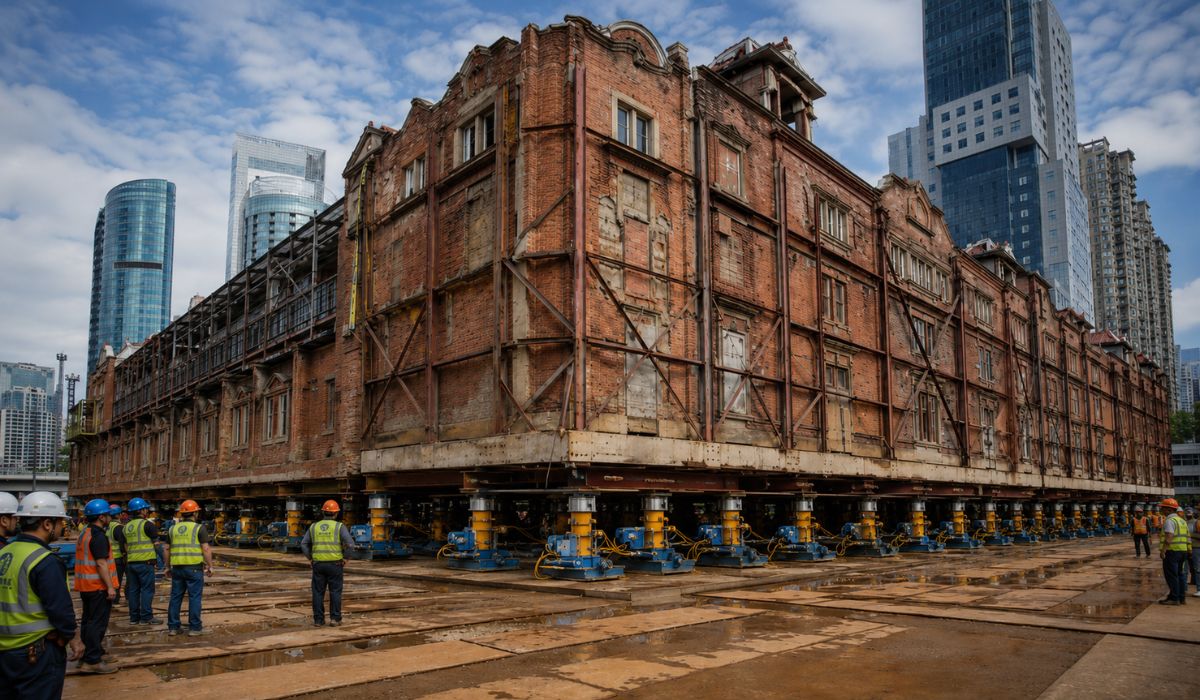

An urban project in Shanghai involved historical preservation, robotics, and precision engineering in a planned operation to adapt a central area without permanently removing part of its original architecture.
Shanghai used 432 small walking robots to relocate the historic Huayanli complex, a set of shikumen-style buildings weighing about 7,500 metric tons, in the Zhangyuan area, in the Jing’an district.
The operation began on May 19, 2025 and, according to CGTN, was completed on June 7, 2025, when the complex returned to its original location after advancing, on average, about 10 meters per day.
The project involved the preservation of three brick and wood structures, built between the 1920s and 1930s, while Shanghai prepares a new underground area for cultural, commercial, and transportation use under Zhangyuan.
-
World Cup Ball Chip Uses Technology to Detect Invisible Touches, Confirms Offside, Secures Portugal’s Victory Over Croatia

-
36-Meter Hydrogen-Powered Superyacht Arrives in Brazil to Debut German Engines and Showcase Future of Clean Navigation

-
Indian Students from Jaipur Win Top Prize at World’s Largest Science Fair with EcoFog, an Affordable Mesh to Harvest Fog Water Without Energy

-
Italy Sinks Massive 11-Story Concrete Structures in the Ligurian Sea to Create a 6.2 km Barrier, Clearing the Way for 400-Meter Ships in Genoa



The information was released by Shanghai’s official international services portal and the state broadcaster CGTN.
Robots move historic complex in Shanghai
The region is recognized for its historical importance in the city.
Zhangyuan is over 140 years old and is described by Shanghai’s official portal as one of the largest and best-preserved sets of shikumen architecture in the Chinese metropolis.
This type of construction combines Chinese and Western elements and marked part of the local urban landscape in the 20th century.
The Huayanli has approximately 4,030 square meters of built area, equivalent to about 43,400 square feet.
Instead of dismantling the structure or demolishing the complex to clear the land, engineers supported the base of the buildings and used hundreds of robotic devices to execute the controlled relocation.
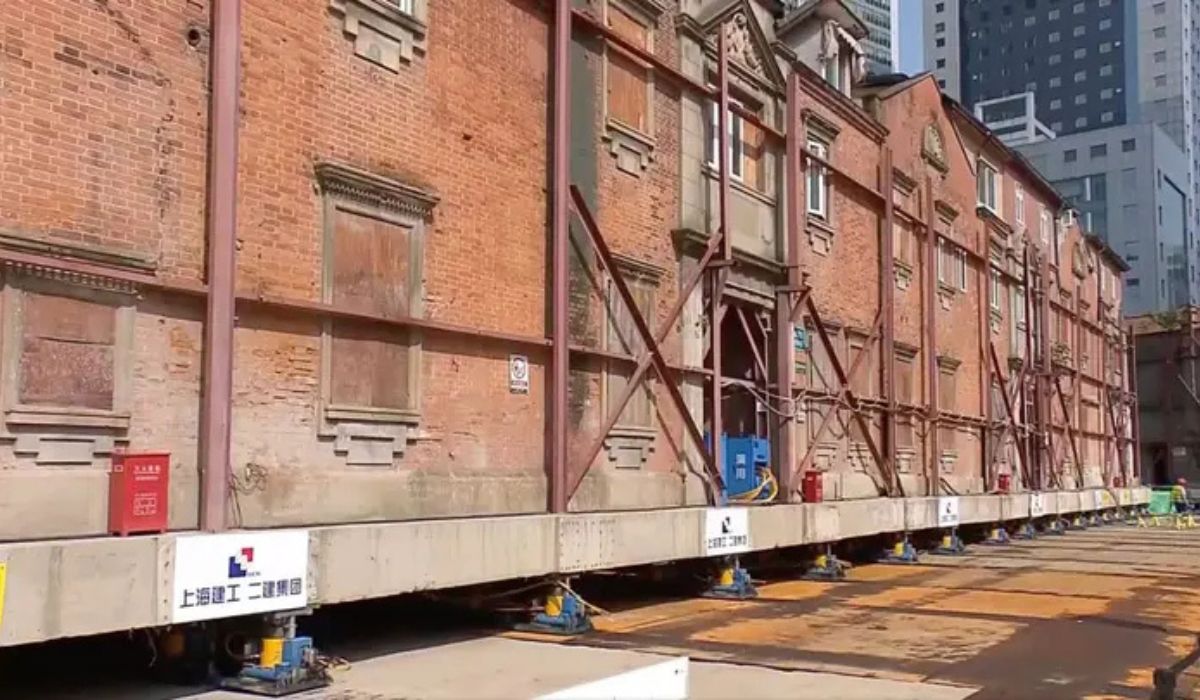
How the robots moved the Huayanli
The robots used in the operation functioned as support and displacement modules.
Installed under the foundation of the complex, they were synchronized to gradually lift and push the structure, with control over speed, direction, and stability during the process.
The average displacement was about 10 meters per day.
According to information released by Shanghai’s official portal, this pace was part of the necessary technical planning to reduce risks to walls, beams, foundations, and other structural elements of the old buildings.
The movement took place in a densely populated urban area.
Huayanli is located within a network of narrow alleys and historical buildings close to each other, which limited the use of conventional large-scale equipment and required solutions adapted to the available space.
In addition to the walking robots, the engineering team employed low-height equipment for foundation work.
According to Shanghai’s official portal, these drilling robots could be operated remotely and move through narrow corridors and doors, allowing work within historical structures without large openings in the ground.
The project also used Building Information Modeling, known by the acronym BIM, and point cloud scanning.
These tools created detailed digital models of the complex and helped engineers identify collision risks, structural attention points, and safer routes for movement.


Underground Work in Zhangyuan
The temporary transfer of the complex was planned to enable a three-story underground project beneath Zhangyuan.
The new space will have more than 53,000 square meters and is expected to include cultural and commercial areas, over 100 parking spaces, and connections with lines 2, 12, and 13 of the Shanghai metro.
With the intervention, the city aims to maintain the historical buildings above ground and reorganize the underground to accommodate new urban services.
This approach was presented by local authorities as part of the renewal of Zhangyuan, an area that combines historical value, commercial use, and connection with the public transport network.
In projects of this type, preservation depends on technical control during all stages of the work.
In the case of Zhangyuan, the historical complex includes streets, passages, facades, and buildings with different ages and structural conditions, making the planning of movement a central stage of the intervention.
One of the buildings that required attention was the large hall of Zhangyuan, built in 1928.
According to Shanghai’s official portal, the space housed a patriotic education night school in the 1940s, a fact that reinforces the teams’ care in preserving the existing historical elements in the area.
Technology used in historical preservation
The movement of Huayanli was one of the stages of a broader urban intervention.
To remove soil in narrow spaces, the team developed curved transport routes and used a system with winches on rails and conveyor belts, organized similarly to an assembly line.
Zhang Yi, general manager of the urban renewal company linked to Shanghai Construction No. 2 (Group), stated that the team designed curved routes for soil removal and adopted a system with winches and conveyor belts to reduce impacts and maintain the efficiency of the project.
The statement was recorded by Shanghai’s official portal.
Excavation robots with foldable mechanical arms capable of operating in spaces less than 1.2 meters wide were also used.
According to the same source, these machines use deep learning algorithms to distinguish clay from solid obstacles during excavation work.
The combination of robotics, 3D scanning, and digital planning was applied both in the movement of the complex and in the preparatory stages of the underground project.
The use of these tools allowed for tracking the structure’s movement, calculating interferences in the surroundings, and adjusting procedures in areas with limited circulation.
In the case of Huayanli, technical precision was necessary to preserve nearly century-old buildings during a large-scale project.
Therefore, the operation was not limited to the movement of the complex: it included reinforcements, monitoring, route planning, and foundation control before, during, and after the movement.
What changes in the historical area of Zhangyuan
With the completion of the return on June 7, 2025, Huayanli returned to the original point and paved the way for the continuation of underground works.
According to CGTN, the return operation was carried out with more than 400 robotic devices and completed the journey started in May.
When finished, the project is expected to integrate the preserved historical complex with an underground structure featuring commerce, culture, parking, and a connection to the subway.
Shanghai Jing’an Real Estate Group reported that the renovation of Zhangyuan is expected to connect the complex to tall buildings, commercial areas, and surrounding neighborhoods.
The intervention in Shanghai illustrates an engineering solution adopted in a central area with preserved architectural heritage.
In the case of Huayanli, the chosen alternative was to temporarily relocate the complex to allow construction below street level and then reposition the structures at the original site.
The operation also shows a specific application of robotics outside the traditional industrial environment.
In Zhangyuan, robots were used as part of an engineering system composed of sensors, digital models, drilling equipment, excavation machines, and soil transport structures.
The work reorganizes the region’s underground without permanently removing the historical constructions from the surface.