Portuguese
  Spanish


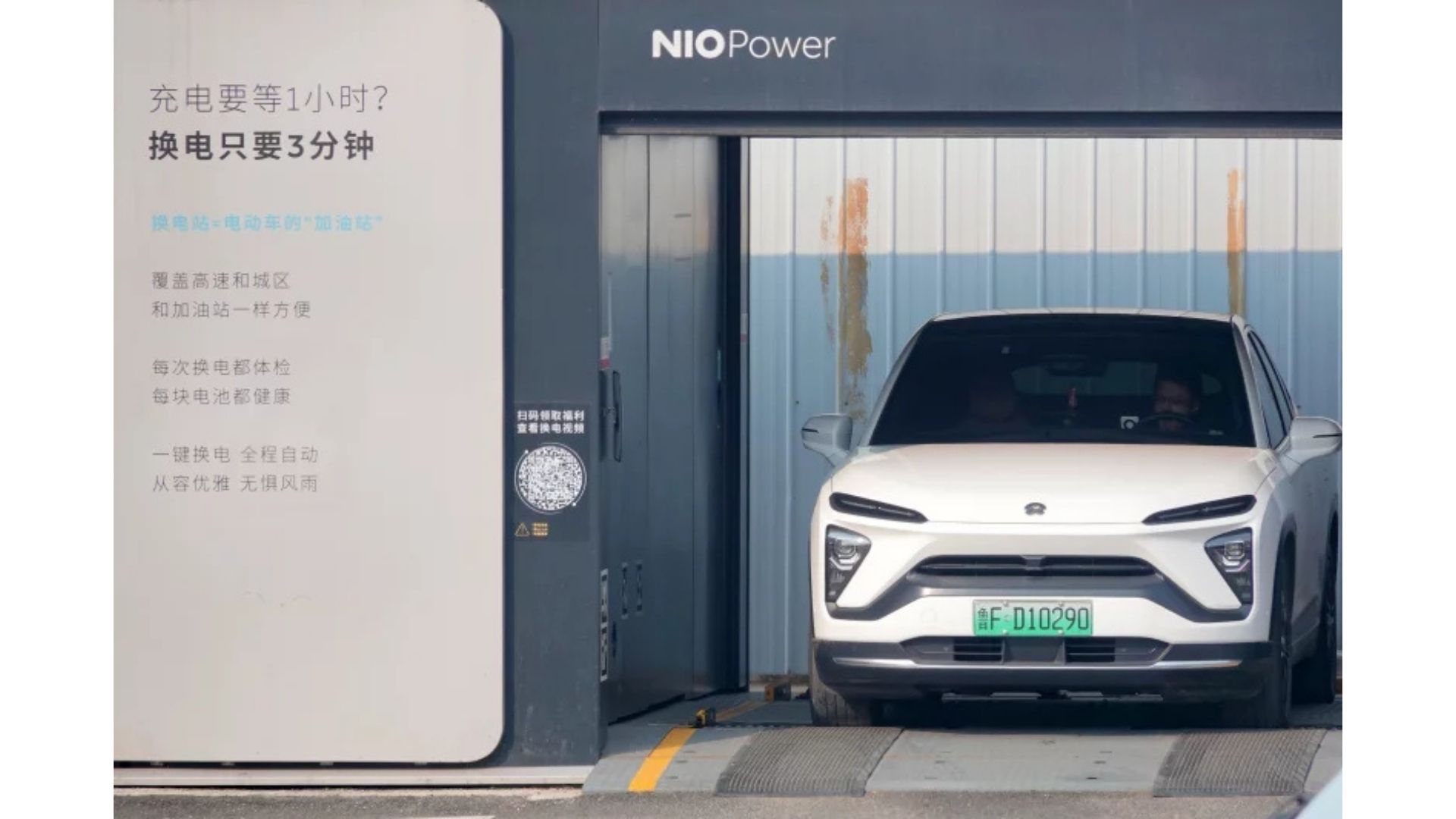

The Chinese quick swap technology allows drivers to replace discharged batteries with new ones in record time, optimizing trips and costs.
The Chinese company NIO is transforming electric mobility infrastructure with a solution that promises to eliminate range anxiety and the long wait times at charging stations.
Instead of plugging the vehicle into a socket for hours, the technology focuses on battery swapping in just three minutes, using fully automated stations. This innovative approach allows the driver to replace a discharged battery with a fully charged one in a time comparable to refueling with fossil fuels.
The mechanics of battery swap stations
The system operates based on a high-precision robotic infrastructure that carries out the entire process without the driver needing to leave the car.
-
Antarctic Sea Creature Yields Promising Compound Against Melanoma, Captivating U.S. Researchers

-
Underwater Guardian: The Autonomous Robot Monitoring Submarine Cables, Self-Returning, Wirelessly Charging, and Transmitting Data Without Onboard Crew

-
Robots Clean Solar Panels in Desert Power Plants Without Water, Preventing Energy Losses
-
AI Radar Built with Old Camera and $20 Gains Attention After Alleged $317,000 Sale to Chinese Government, But Lack of Documentation and Official Confirmation Raises Questions




Upon entering the battery swap station in just three minutes, the vehicle is positioned over a platform that unscrews the old power module and installs a new one in a matter of seconds. This “Battery as a Service” (BaaS) technology also allows users to make temporary upgrades to higher-capacity batteries as needed for long trips.
The business model separates the cost of the vehicle from the cost of the battery, which can significantly reduce the initial purchase price of the electric car.
With the battery swap in just three minutes, the natural wear of energy cells is no longer a direct concern for the owner, as maintenance and slow charging (which preserves battery life) are centrally managed by the company at the stations themselves.
Global expansion and standardization challenges
Although China leads the implementation with thousands of operational stations, the battery swapping in just three minutes system is beginning to gain traction in European and Asian markets. The major challenge for global scaling lies in standardizing battery formats among different manufacturers, something that NIO is attempting to solve through strategic partnerships. Currently, the company has already completed millions of successful swaps, proving the technical viability of rapid replacement logistics.
The efficiency of the system also benefits the urban electrical grid, as the stations can charge stored batteries during low consumption hours, acting as energy reservoirs.
The process of battery swapping in just three minutes mitigates the need for ultra-fast chargers on every corner, which can overload local wiring. This symbiosis between transportation and energy infrastructure is seen as a fundamental pillar for smart cities.
The end of waiting and the user experience
For the end consumer, the greatest advantage is the convenience and predictability of travel time, factors that still deter many buyers from traditional electric models. The battery swapping in just three minutes station operates autonomously, integrated with the car’s navigation system that reserves a spot and pre-selects the available battery. This complete digitization of the refueling journey places Chinese technology ahead of cable fast charging solutions in terms of agility.
As technology matures, the expectation is that operation time will be further reduced, approaching the two-minute mark. The battery swapping in just three minutes is not just a stopgap solution, but a paradigm shift that treats energy as a modular and instantaneous service.
The success of this innovation could dictate the pace of the energy transition in the coming years, consolidating China as the world’s leading automotive innovation hub.
With information from NPR