Portuguese
  Spanish


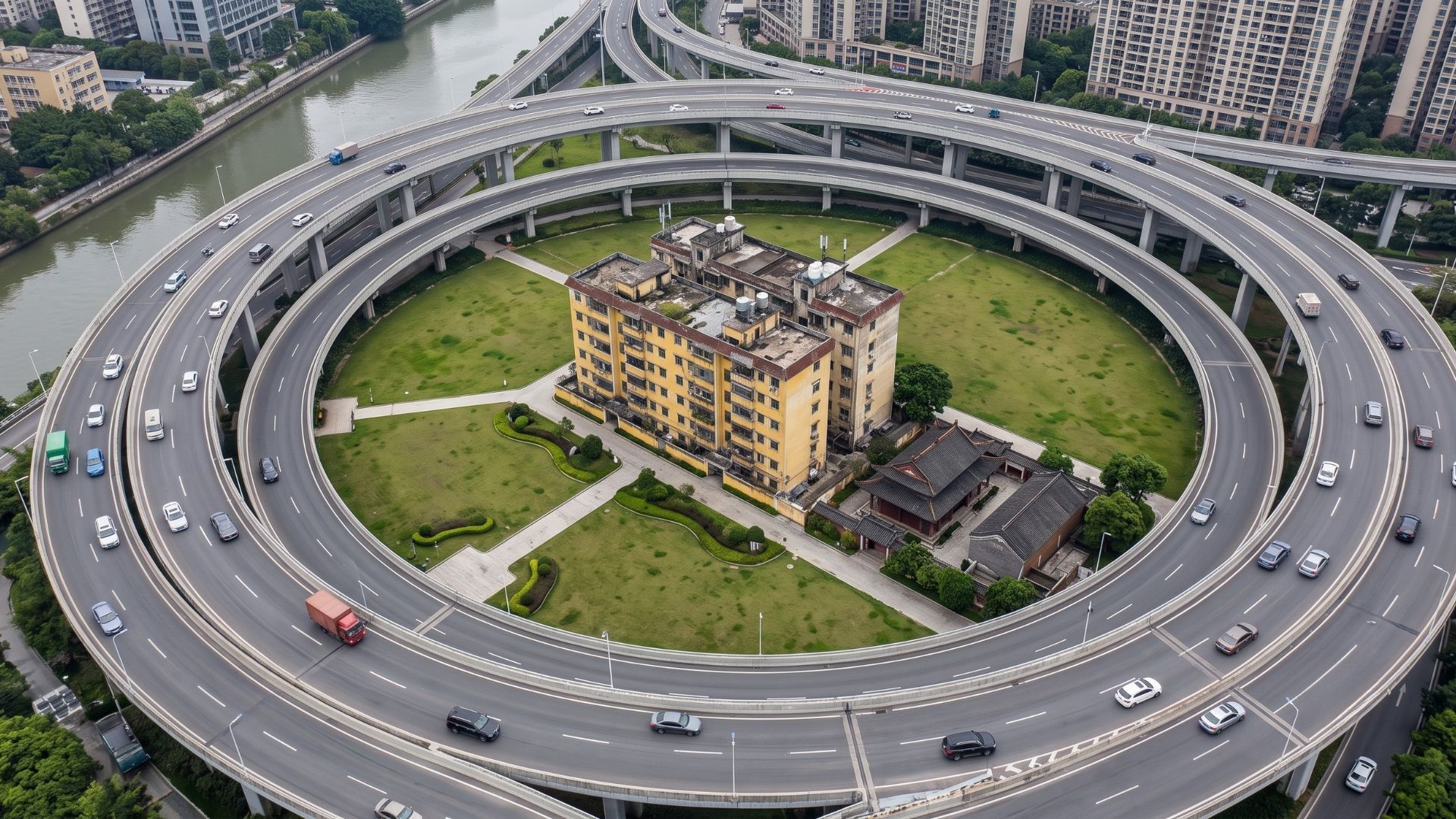

Building in Guangzhou was surrounded by a circular overpass after a compensation impasse and became a symbol of nail houses in China.
A residential building in Guangzhou, in the province of Guangdong, ended up surrounded by a circular overpass after some residents refused the compensation agreements offered for demolition. The case gained international attention in 2015 and became one of the most curious urban images of contemporary China.
For those who saw the photos for the first time, the scene seemed like an engineering error or a futuristic project. In practice, what happened was a typical impasse of the so-called nail houses, properties that remain standing in the middle of major works because the owners do not accept the proposed values to leave.
Residents refused compensation in Guangzhou and a circular overpass ended up being built around the residential building
According to ABC News, the residential block in Guangzhou was scheduled to be demolished since 2008 to make way for a new road. Even so, several residents refused to leave the apartments, claiming that the compensation amounts offered were insufficient.
-
After 79 Months and $145 Million Investment, Nepal Set to Open First 2.7 km Road Tunnel to Ease Traffic in Kathmandu Valley

-
In China, 23 Families Spent Over 4 Years Carving a 1.2 km Road Through a Cliff to Overcome Isolation and Transform a Remote Village

-
Giant 3,600-ton Crane Breaks Two World Records by Installing World’s Largest Single-Piece Forged and Welded Hydrogenation Reactor, Weighing 3,037 Tons, in Chinese Petrochemical Plant in Just Six Days

-
$80 Million Bridge in Brazil Cuts Travel Time from 30 Minutes to 1 Minute, but Audit Reveals Major Flaws


Faced with the impasse, the work was not interrupted. Instead of waiting for a total agreement, those responsible continued with the construction and adapted the infrastructure layout, creating a circular elevated loop around the building.
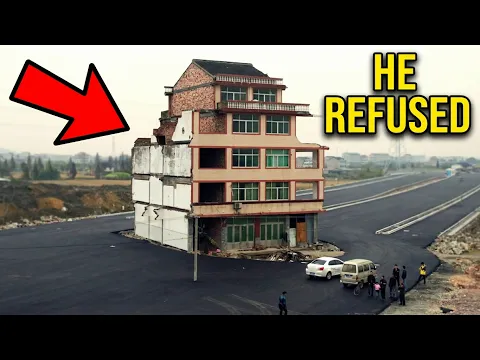

It was this decision that turned a local real estate conflict into a global image. The photo of the building surrounded by the road structure began to circulate in newspapers and websites worldwide as an extreme portrait of China’s accelerated urbanization.
Guangzhou case entered the list of the most well-known nail houses in China during the urbanization boom
Reuters summarizes the phenomenon directly: nail houses are properties that remain standing when residents refuse to leave. The building in Guangzhou fell into this category because units of the building remained occupied even after the decision to demolish the construction for the road work.
In the report by ABC News, the case appears as an example of a broader pattern in China, where residents often contest compensation values in redevelopment projects. When there is no agreement, some buildings end up isolated in the middle of roads, excavations, or new developments.
The term nail house itself was explained by ABC as a reference to something that remains stuck and difficult to remove. This helps to understand why these buildings have come to symbolize resistance amidst the advance of developers and large public works.
Images of the building surrounded by a highway in Guangzhou became a symbol of China’s accelerated urbanization in 2015
The global repercussion of the case came from the visual strength of the scene. In the record made on June 18, 2015, the building appears literally embedded within an elevated ring road, creating a rare image even for China’s urban transformation standards.
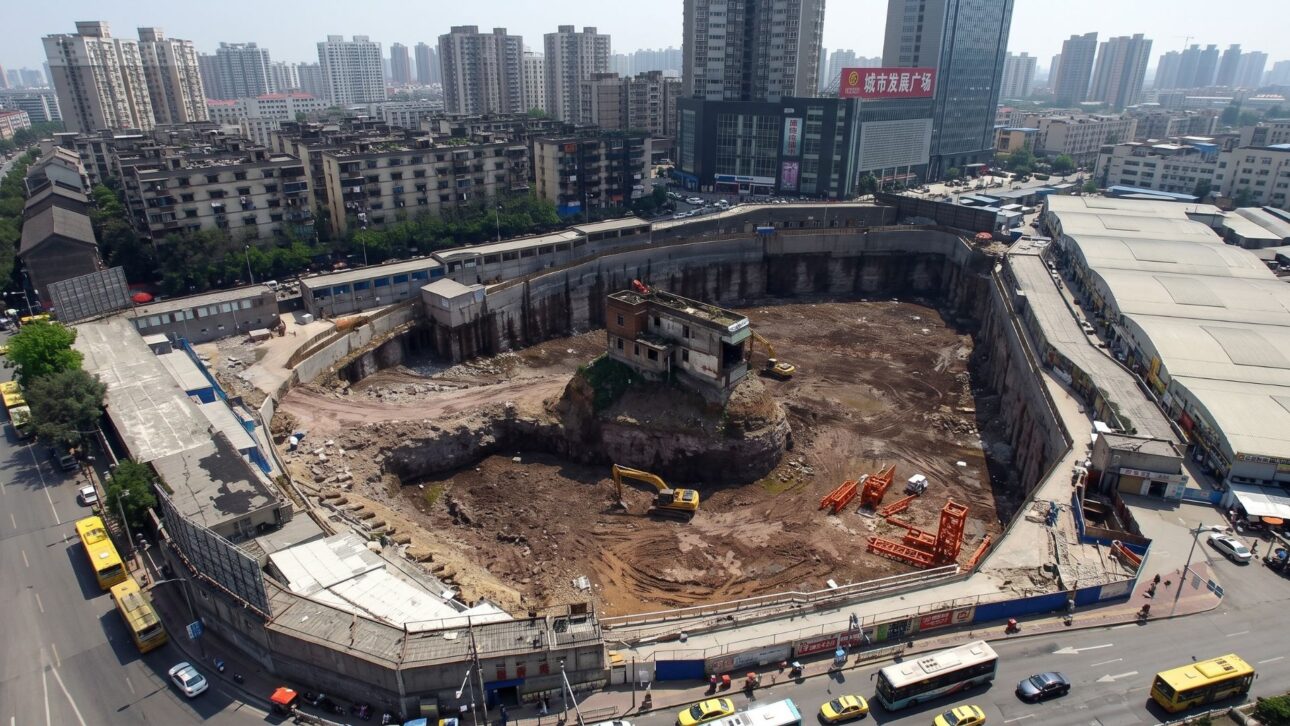
The strength of the photograph was precisely in the contrast between scales. On one side, a large-scale infrastructure project; on the other, an old residential block that remained in the same spot due to the disagreement between residents and authorities over compensation.
This contrast helped to transform the Guangzhou building into an emblematic case. More than an architectural curiosity, it came to represent the clash between accelerated urban expansion, property negotiation, and individual resistance.
Nail houses in China have already appeared in the middle of roads, construction sites, and large real estate projects
The Guangzhou case was not isolated. The Reuters gallery gathers examples of nail houses in cities like Luoyang, Nanning, Wenling, Hefei, Nanjing, Kunming, Xiangyang, and Shanghai, always linked to residents who rejected demolition proposals or demanded higher compensations.
One of the most well-known episodes shown by the agency occurred in Wenling, in 2012, when a house remained in the middle of a newly paved avenue because a couple refused to sign the removal agreement. In other cases, properties were surrounded by ditches, commercial center constructions, or already partially demolished lands.
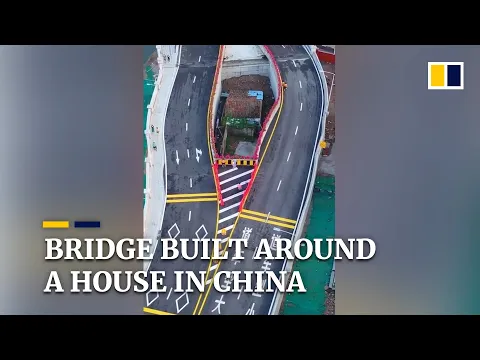
These situations help explain why the building in Guangzhou attracted so much attention. It was not just a building surrounded by an overpass, but part of a larger pattern of urban conflicts that have been repeated in various Chinese regions during decades of rapid growth.
Building surrounded by overpass in Guangzhou became a rare portrait of the clash between urban megaprojects and housing rights
Seen without context, the image of the building within the overpass almost looks like a surreal urban installation. With context, it reveals something simpler and harsher: the difficulty of reconciling billion-dollar infrastructure projects with individual negotiations involving housing, property, and financial compensation.
In Guangzhou, a common residential block ended up transformed into one of the most striking symbols of China’s nail houses. The construction remained in the path of the project, and the project continued around it, creating one of the most emblematic scenes of Chinese urbanization in the 21st century.