Portuguese
  Spanish


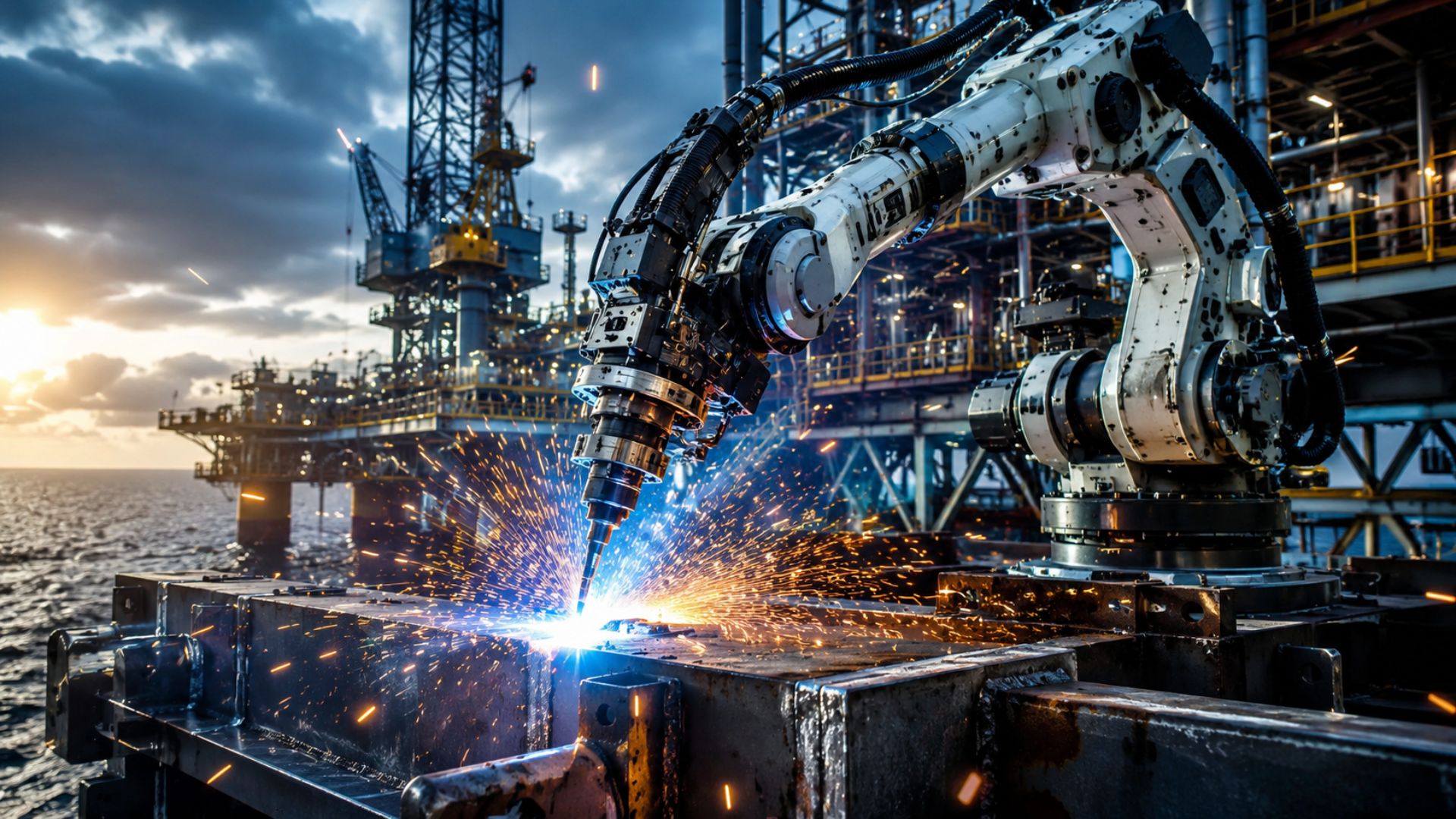

Deployed by Offshore Oil Engineering Co. at a base in Tianjin, the Chinese robot is presented as the country’s first AI maritime welding system and underwent about 10 months of testing. The numbers, however, are provided by the company, which cites up to 98% accuracy on the first attempt.
A Chinese robot with artificial intelligence welds offshore oil platforms on its own, supports a load of 30 tons, cuts steel up to 70 millimeters, and has a projected lifespan of 20 years. According to Offshore Oil Engineering Co., released in June, which developed the system, and with data provided by the Global Times, the machine was designed for highly complex, customized, and heavy welding scenarios, aimed at offshore oil and gas platforms.
It is worth noting, however, that the numbers come from the manufacturer itself and refer to equipment put into operation recently. China deployed this system at an intelligent manufacturing base in Tianjin, presented as the country’s first AI maritime welding system. It is described as capable of handling specialized components for offshore use, including module nodes, fastening rings, and reinforcement rings for deep-water jackets, typical parts of heavy shipbuilding.
Why welding offshore platforms is so difficult
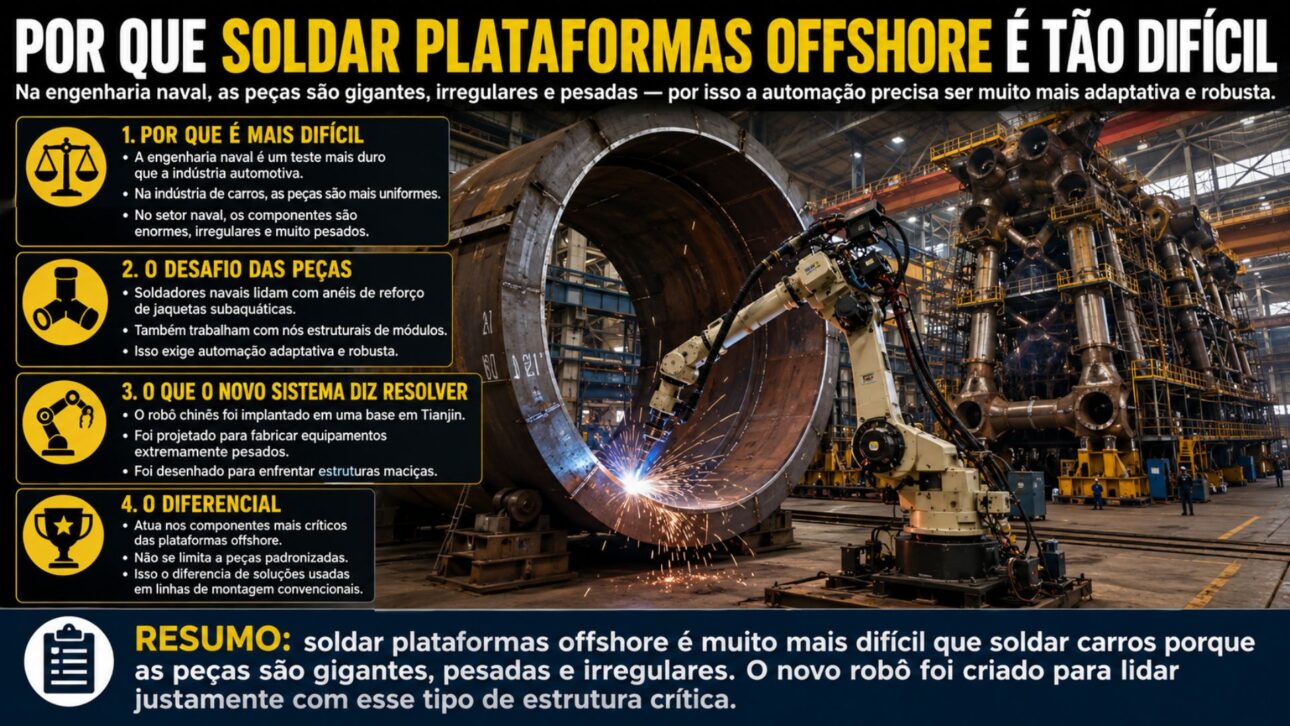
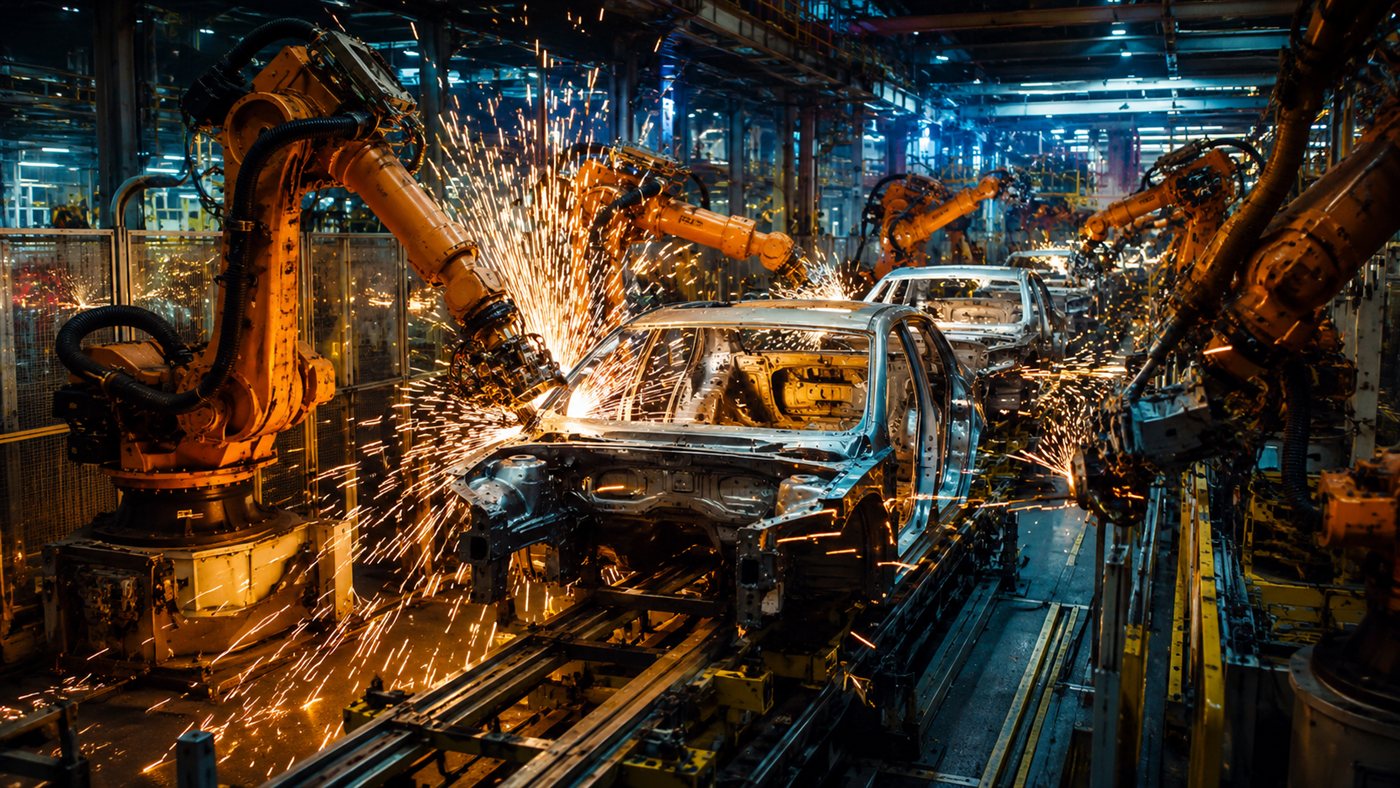
Naval engineering is a tougher test than the automotive industry. For a long time, the car industry was considered the pinnacle of robotic welding precision due to the uniformity of the parts, but naval engineering poses a much greater challenge. Naval welders deal with enormous, irregularly shaped, and heavy components, such as reinforcement rings for underwater jackets and module nodes, which require a much higher level of adaptive and robust automation.
-
Pennsylvania Mine Creates Ice in Summer Heat and Melts in Winter, Turning a Mountain Crevice into a Reverse Natural Refrigerator

-
China Accelerates Global Expansion of Robotics: From Smart Vacuums to Industrial and Humanoid Machines, Millions Exported to Over 150 Markets
-
Polar Air Mass to Hit Brazil: Temperatures to Plummet in Nine States, Near Freezing in the South with Frost Risk Until Monday
-
Chinese “dark factories” produce electric cars 24/7 with minimal human intervention, as Zeekr assembles 800 units daily, raising concerns in Brazil.



This is precisely the problem that the new system claims to solve. Deployed at a base in Tianjin and designed for the manufacturing of extremely heavy equipment, the Chinese robot was created to tackle these massive structures. It operates on the most critical components of offshore platforms, rather than being limited to standardized parts, which sets it apart from solutions already used in conventional assembly lines.
30 tons, 70 mm steel, and what the company promises
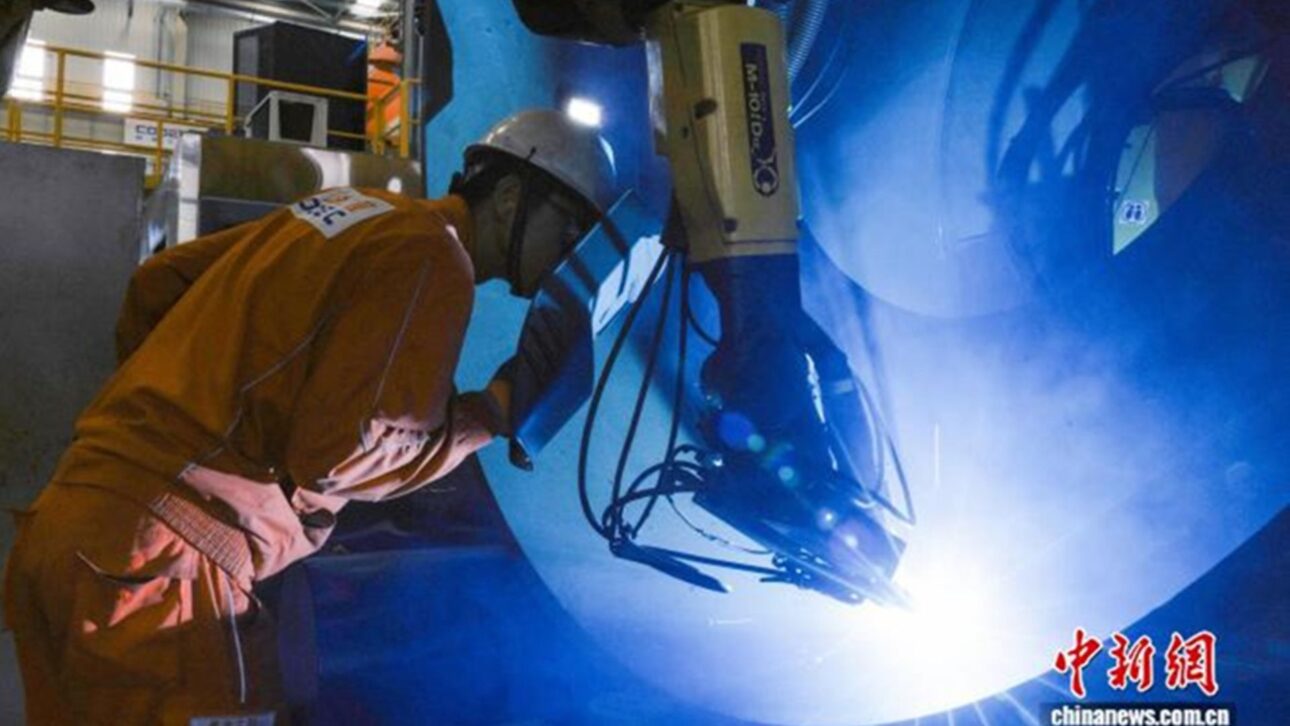
The performance figures are robust, but they come from the manufacturer. According to the developer, the Chinese robot has a projected lifespan of 20 years and a maximum load capacity of 30 tons, in addition to being able to cut and fuse steel up to 70 millimeters thick and operate with overall efficiency exceeding 40%. These are impressive numbers, but they have yet to undergo independent validation over the promised usage time.
The boldest promise is the quality of the weld. According to the company, the precision of the AI ensures a first-attempt approval rate of over 98%, which, in the manufacturer’s assessment, eliminates the need for expensive and time-consuming structural rework. As this is a recently deployed system, this rate should be read as a claim by the developer, rather than an audited result.
How the Chinese robot welds alone with AI and laser vision
The heart of the system is real-time environment reading. Equipped with artificial intelligence, visual recognition of weld joints, and three-dimensional laser vision alignment, the mechanical arm scans the surroundings and assembles a personalized multi-layer trajectory planning strategy for each piece of steel. Thus, the Chinese robot adapts the work to different shapes, without relying on a fixed mold.
In practice, everything starts with a single command. From there, the robot independently manages the entire welding process, from start to finish, using real-time data to seal the first pass and correct its own trajectory during the operation. The manufacturer describes functions such as one-click activation, intelligent weld path correction, intelligent root welding, and intelligent four-wire filling on both sides of the joint.
Tests, rectification robot, and the AI Plus initiative
Before mass production, there was a marathon of tests. The system underwent almost 10 months of on-site testing and adjustments to withstand the harsh conditions of a shipyard, with about 1,000 rigorous welding experiments to enhance the AI. And the Chinese robot does not work alone, as an independently developed rectification robot was placed alongside it to prepare and finish the steel.
The assistant also displays its own numbers. This rectification robot uses intelligent visual positioning and real-time force compensation and, according to the company, has already processed over 500 steel profiles, with a gain of about 15% in efficiency, enabling complex welds where human operators and common machines struggle.
Driven by the Chinese “AI Plus” initiative, the heavy industry has been migrating from dangerous and labor-intensive shipyards to automated systems, which, according to the report, changes the role of manual labor teams to supervisors of a robotic workforce.
The Chinese AI welding robot, developed by Offshore Oil Engineering Co. and deployed in Tianjin, independently welds complex components of offshore oil platforms, supports 30 tons, cuts steel up to 70 millimeters, and has a projected lifespan of 20 years.
The manufacturer also cites efficiency above 40% and a success rate over 98% on the first attempt, in addition to almost 10 months of testing and about a thousand experiments, with a rectification robot working alongside. Even so, these numbers come from the company itself and refer to a system recently put into operation, so the performance over the promised 20 years still needs to be proven in practice.
And you, do you think AI robots will completely replace human welders in heavy industry, or will we still see people and machines working side by side for a long time? Share your opinion and exchange ideas with other readers on the topic, respecting different views.